Here’s the question that stops parents mid-chop, knife in hand: big chunks to gnaw on, or teeny tiny pieces small enough to swallow whole? It feels like it should be one or the other. It’s both, in that order.
At around 6 months, babies grab with their whole fist, so food needs to be big: soft strips they can hold, with a bit sticking out to chew. Months later, once the pincer grasp arrives, the same foods get served small. Most charts list foods by month and leave the cutting to a footnote. This one makes the shape the main event, every food below carries its safe form at each stage, taken from CDC and NHS weaning guidance, so the chart still makes sense if you screenshot it and never read another word. For the nutrient that matters most, see iron-rich first foods for babies.
Medical disclaimer: This article is general information for parents and is not medical advice. Guidance on feeding, health and development can depend on your baby’s individual needs. If you have concerns about your child, please speak to your pediatrician or another qualified health professional.
Table of Contents
First, the readiness signs (the chart doesn’t start without them)
The months in the chart are typical stages, not deadlines, and no birthday overrides a baby who isn’t ready. The NHS boils readiness down to three signs appearing together: your baby can stay sitting and hold their head steady; they can coordinate eyes, hands and mouth to look at food, pick it up and get it to their mouth; and they swallow food rather than spitting it straight back out. The CDC’s longer list adds opening the mouth when food is offered, bringing objects to the mouth, and trying to grasp small objects.
Just as useful is what isn’t a sign, per the NHS: chewing fists, waking more at night, and wanting extra milk feeds. None of those mean “start now.” For the full walk-through, see our guide to the signs your baby is ready for solids. And one hard floor from the CDC and the AAP: solids at about 6 months, and introducing foods before 4 months is not recommended.
How to read the shapes
Read this as a weaning chart from 6 months onward: find the band that matches your baby’s stage, not the calendar.
- Around 6 months: soft strips and smooth textures. Finger foods are pieces big enough to hold in a fist with a bit sticking out: “about the size of your own finger,” in the NHS’s words. Purées and mashes run alongside. Everything soft enough to squash, nothing round, nothing hard. (The NHS suggests moving on to lumpy textures from around 6 to 7 months, as soon as your baby can manage them.)
- Around 9 months: pincer pieces. Small, soft pieces your baby can pick up between finger and thumb. The AAP’s ceiling for pieces is no larger than ½ inch.
- Around 12 months: family foods, cut small. Meals look like yours, minus salt and sugar, still cut with care. This is the stage where USDA WIC’s “pea-size pieces are safest” guidance applies (it’s written for 12 to 24 months, not for 6-month-olds, whatever older charts say).
One more rule that applies at every stage: cook hard fruit and vegetables until they’re soft enough to easily mash with a fork (CDC), and take out bones, skin, seeds and hard pits before serving.
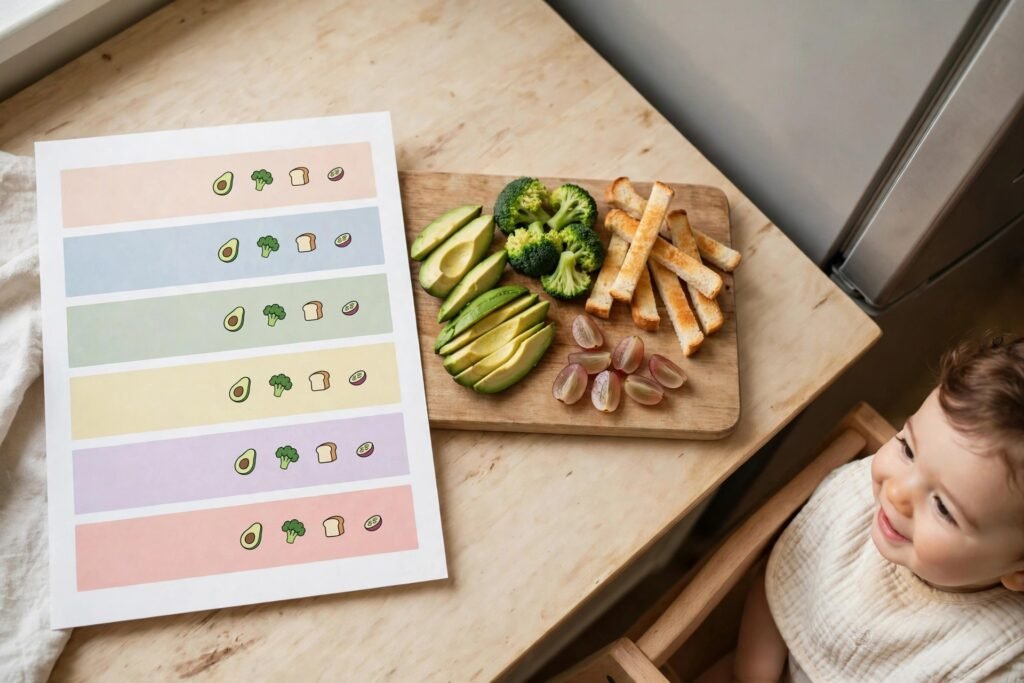
Save this: the first foods chart
Start only when the readiness signs are there, sitting steadily, head held steady, swallowing instead of spitting food back out. Ages are typical stages, not deadlines.
Screenshot it and keep it on the fridge.
| Food | Around 6 months | Around 9 months | Around 12 months |
|---|---|---|---|
| Avocado | Soft finger-length spears, or mashed | Soft spears or chunks | Soft pieces |
| Banana | Spears, or mashed | Soft pieces | Pieces |
| Broccoli | Soft-cooked floret with a long stem to hold | Smaller soft florets | Soft chopped pieces |
| Carrot | Cooked until fork-soft, in batons — never raw | Soft-cooked pieces | Cooked pieces; raw only grated or very thin |
| Apple & pear | Cooked until soft — slices or mash | Cooked soft, or grated | Thin slices or grated — no raw chunks |
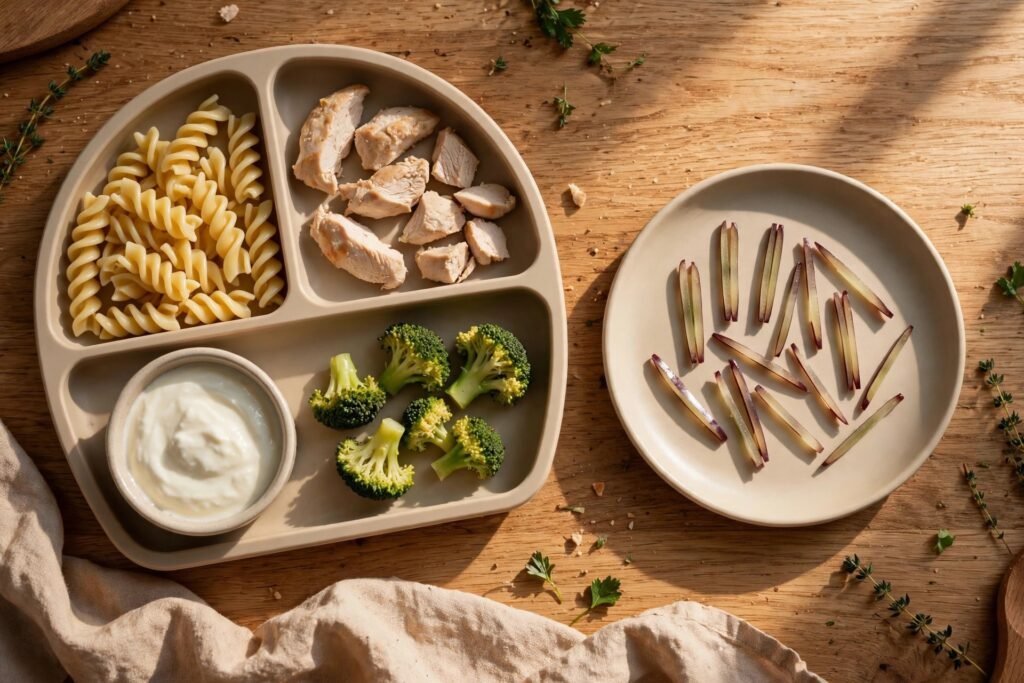
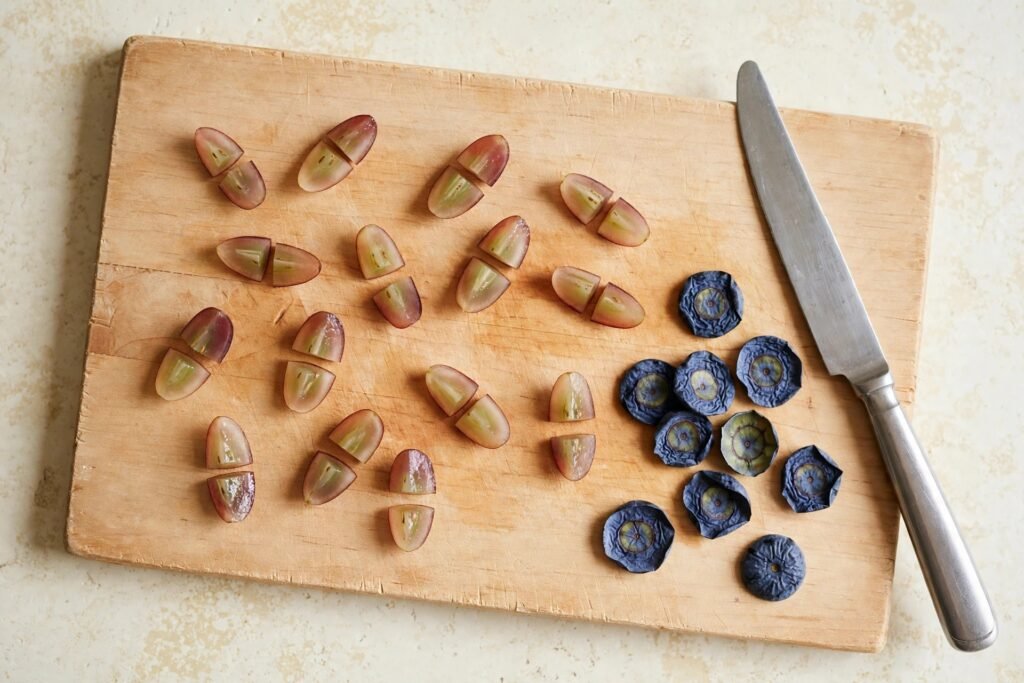
| Grapes & cherry tomatoes | Cooked until soft, then flattened, or blended into food. Not raw at this stage. Never whole | Quartered lengthwise (pieces no larger than ½ inch) | Quartered lengthwise. Never whole |
| Blueberries | Squashed flat or quartered | Quartered | Quartered — not whole |
| Strawberries | Ripe and soft, quartered or thin-sliced | Quartered | Halved or quartered |
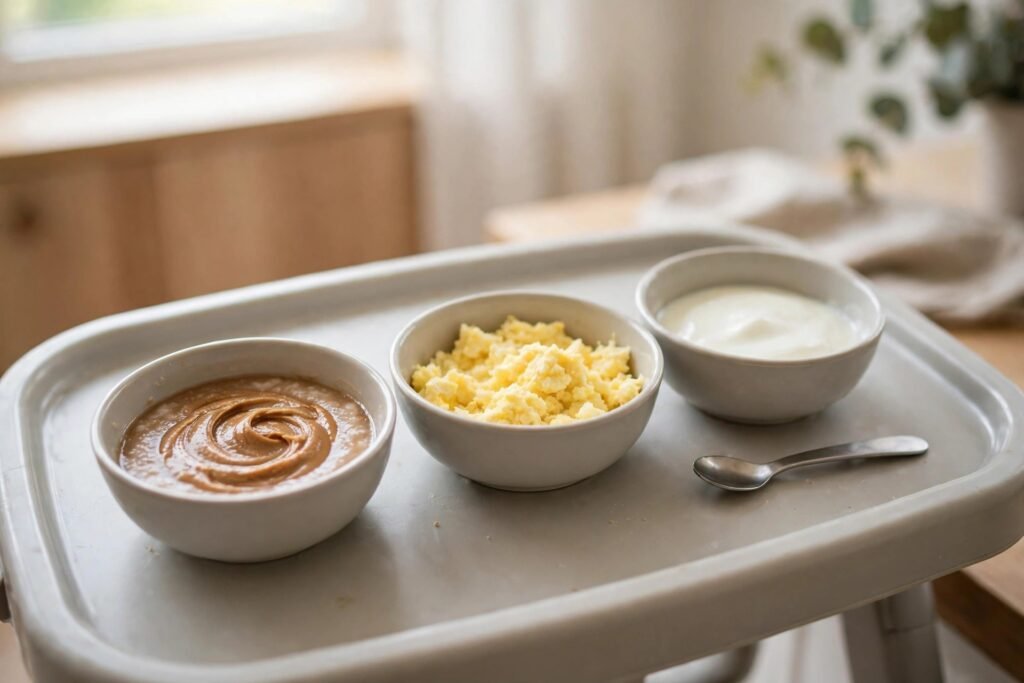
| Egg, well-cooked | Strips of firm-cooked egg, or soft scramble (start with about ⅓ of an egg) | Scrambled or diced pieces | Diced or scrambled pieces |
| Chicken, turkey & beef | Soft strips, or finely chopped/ground — bones, skin and fat removed, pieces no larger than ½ inch | Small soft pieces, no larger than ½ inch | Small pieces |
| Fish (low-mercury, such as salmon) | Boneless, cooked soft — flakes or strips | Flakes or small pieces — check for bones | Pieces — still check every flake for bones |
| Cheese (pasteurized) | Grated, or short narrow strips | Grated or thin strips | Thin strips or shavings — never cubes |
| Toast & bread | Lightly toasted finger strips (light toasting stops white bread going doughy) | Strips or torn soft pieces | Bite-size pieces |
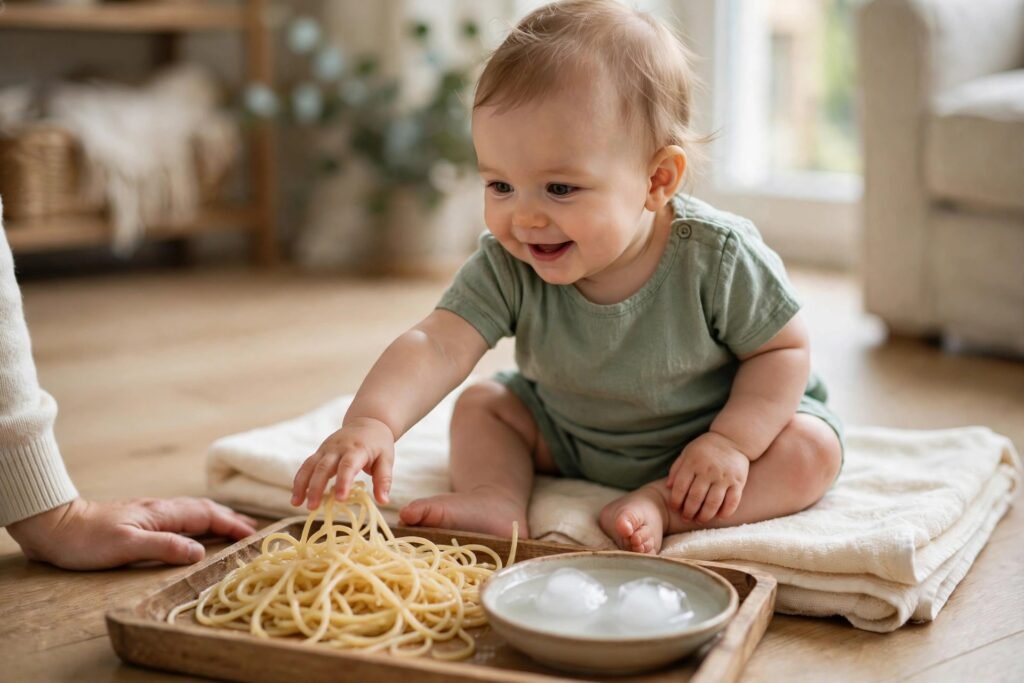
| Pasta | Well-cooked and soft, chopped | Soft pieces | Family pasta, cut small |
| Lentils & beans | Lentils split/mashed; beans mashed — never whole beans | Mashed or squashed | Squashed or split — still not whole and firm |
| Peanut & nut butters | Thinned with water, milk or purée; spread thin on toast or stirred in — never a spoonful | Spread thin, or stirred into foods | Spread thin — still never by the spoonful or in chunks |
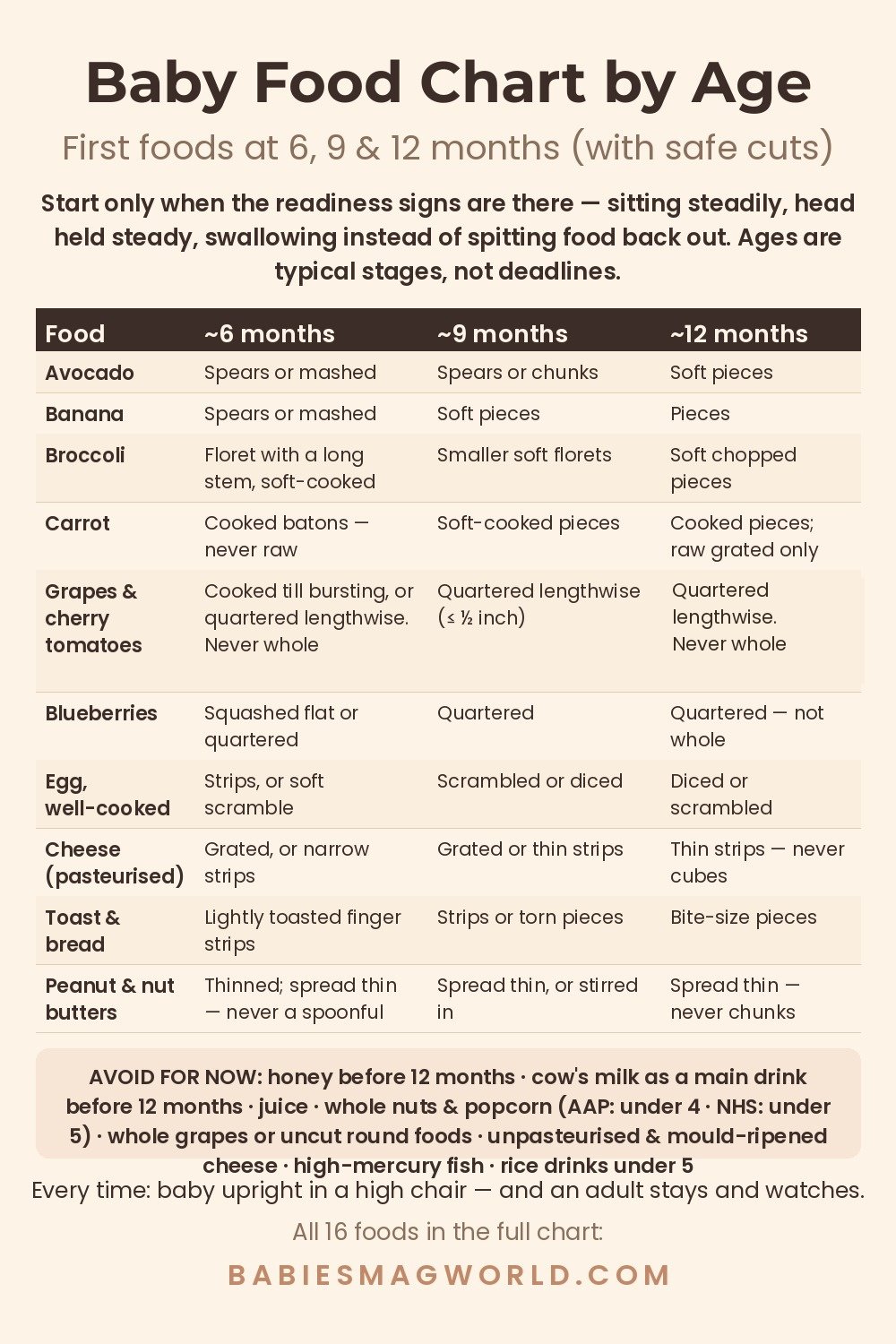
Avoid for now, at every stage in this chart: honey in any form before 12 months, not in food, water, formula, or on a pacifier (infant botulism risk) • cow’s milk as a main drink before 12 months (yogurt, cheese and milk in cooking are fine from around 6 months) • juice before 12 months • whole nuts and popcorn (the AAP flags both under age 4; the NHS says under 5) • whole grapes or any round food served uncut • spoonfuls or chunks of nut butter • unpasteurized milk, yogurt or cheese, and soft mold-ripened cheeses like brie • high-mercury fish (shark, swordfish, marlin, king mackerel, orange roughy, bigeye tuna, Gulf tilefish) • added sugar • salty processed meats like hot dogs and sausages (best kept off the menu in the first year; when they do appear later, cut them lengthwise into short thin strips, never coins) • rice drinks for under-5s.
Every time: sit your baby upright in a high chair, stay and watch them eat, and keep meals calm, no eating lying down, crawling around, or in the car or stroller. Gagging is noisy and usually normal; choking can be silent. Know gagging vs choking: how to tell them apart before you need to.
Sources for the chart: CDC Infant and Toddler Nutrition (foods to encourage, introducing solid foods, choking hazards), AAP HealthyChildren.org (starting solids, choking prevention), NHS Your Baby’s First Solid Foods and NHS Best Start in Life (preparing food safely).
The rules that don’t change at any age on the chart
There’s no required order. The AAP says it directly: for most children, you do not need to give foods in a certain order. And if you’ve heard that vegetables must come before fruit or your baby will reject vegetables forever, the AAP looked for evidence of that and found none. Order is your choice; form is the safety part. These rules sit underneath every row of the chart.
One new food at a time, at first. The CDC suggests letting your baby try one single-ingredient food at a time and waiting 3 to 5 days before the next new food, so any reaction is easy to trace. (You’ll also see “wait a day or two” in some guidance, the 3-to-5-day version is the cautious one, and it’s the one this chart follows, especially for allergens in the first weeks.)
Don’t delay the allergens. Egg, peanut, tree-nut butters, dairy, wheat, soy, fish, shellfish and sesame are introduced with other foods from around 6 months, one at a time, in small amounts first, then kept in the diet regularly. The AAP is specific on peanut: babies with severe eczema or an egg allergy may benefit from peanut products as early as 4 to 6 months, but that early route goes through your pediatrician first, because testing may be recommended before the first taste. For babies without severe eczema or a known egg allergy, thinned peanut butter can go in at home around 6 months, without waiting for an allergy appointment. Never whole nuts, which stay off the table until at least age 4 (AAP) or under 5 (NHS).
Milk still runs the show. Breast milk or formula stays the main drink through the first year. With solids, the CDC suggests offering about 4 to 8 ounces of water a day. And repetition is the job: the NHS says it can take 10 tries or more before a baby accepts a new food or texture, so a pulled face is not a verdict.
Once fruits are familiar, blends are an easy way to widen flavors without added sugar. These easy smoothie recipes for babies at 6 months keep the forms safe for the youngest stage of the chart.
Three questions parents ask
So is it big pieces or tiny pieces? I’m getting both answers.
Both, in sequence, that’s the whole idea. Big, soft, grippable strips work at 6 months because that’s how a 6-month-old holds things. Small pieces come with the pincer grasp, and they still need to be soft and never round. The dangerous middle is hard and round, at any age on this chart. Big first, small later.
Can my baby have grapes if I cut them?
Yes, the cut is what makes them servable. Quarter them lengthwise (per NHS guidance) into pieces no larger than ½ inch, soften them by cooking at the youngest stage, and don’t serve them whole: a whole grape can block a young child’s airway, which is why every authority lists grapes as a hazard in that form.
Do I need to tick off 100 foods before the first birthday?
No. The popular ‘100 foods before one’ list works best as an aspiration and a record of what you’ve tried, not a target. Variety matters, and a checklist is a nice record, but no authority sets a number or a deadline. Milk is still the main nutrition source all year; the chart is a map, not a race.
When to check with your pediatrician first
Before using the chart as written, ask first if your baby was born prematurely (the NHS advises checking weaning timing in that case), has severe eczema or a known egg allergy (peanut timing may move earlier, with medical input), has reflux or swallowing difficulties, or isn’t hitting the physical milestones the readiness signs depend on, head control and sitting. A short conversation first beats unpicking a bad start later.