Medical disclaimer: This article is general information for parents and is not medical advice. Guidance on feeding, health and development can depend on your baby’s individual needs. If you have concerns about your child, please speak to your pediatrician or another qualified health professional.
Every parent hits the same week. The diapers are suddenly disgusting in a new way, someone at playgroup announces their younger child is “done,” and you start googling potty training readiness signs at midnight, half hoping for a checklist and half hoping for permission to wait. Good news: both exist. The signs are real and observable, and so are the signs that waiting is the smarter move. This guide covers both halves, because most guides only give you the first.
One thing to hold onto before the lists: readiness isn’t a birthday. The American Academy of Pediatrics (AAP) says children generally show signs of bladder and bowel control somewhere between 18 and 24 months; Mayo Clinic only suggests talking to a doctor if a child older than 3 isn’t trained during the day, so there is no rush. Readiness is also not a measure of your child’s intelligence, will or character, or of your parenting. It’s a set of skills quietly assembling themselves, and your job is mostly to notice.
Table of Contents
Wait for signs, or start learning early? Two honest approaches
Most of the guidance you’ll find, from the AAP, Mayo Clinic and the NHS, runs on a signs-led model: watch for readiness, start when the pattern is there, don’t force it, and pause if it clearly isn’t working.
One respected voice disagrees, and you deserve to hear it fairly. ERIC, the UK children’s bowel and bladder charity that NHS pages themselves signpost parents to, argues there is no need to wait for “signs of readiness” at all. ERIC’s position is that the readiness idea is not based on good research evidence, that it confuses parents, and that waiting often delays training in ways ERIC links to a higher risk of bladder and bowel problems in childhood. Instead, ERIC suggests gradual potty learning from the time a baby can sit up, usually around 6 to 9 months, building familiarity long before diapers come off.
This article is readiness-led, because that’s where most of the guidance sits. The signs in the next section are drawn from the AAP, Mayo and NHS lists. But notice what both camps agree on, because it’s the part that actually matters day to day: gradual beats sudden, positive beats pressured, and nobody serious suggests forcing or punishing a child into it. Whichever approach your family leans toward, those rules hold.
The three kinds of signs to watch for
Readiness isn’t one skill. The AAP describes it as a chain. Your child has to notice the body’s signal, connect it to the potty, remember where the potty is, get there in time, stay on it, and tell you what they need. That’s why the signs cluster into three groups, and why a pattern across all three means more than any single sign.
Body signs
- Stays dry for longer and longer stretches, or wakes up dry from a nap. (How long is “long enough”? The authorities genuinely disagree: the NHS lists a gap of at least 1 hour between wettings, ERIC’s professional assessment uses at least 1½ hours, and the AAP says dry at least 2 hours at a time. Watch the trend, not a stopwatch.)
- Notices a wet or dirty diaper and dislikes it, wants it off, wants changing, tells you about it.
- Shows you they’re about to go: grunting, freezing mid-play, squatting, or disappearing somewhere quiet to do it in private.
- Bowel movements are getting more predictable, and stools are soft and regular.
Skills
- Can walk to the bathroom and get onto the potty (the AAP’s chain includes remembering where it is and planning the trip).
- Can pull pants down and up, at least with a bit of help, and help with undressing.
- Can follow simple instructions and, per Mayo, is starting to manage two-step ones.
- Can sit on the potty briefly and safely, feet supported. ERIC’s assessment uses a simple version of this: sitting comfortably for at least a minute.
Communication and interest
- Tells you during or after a pee or poop, and gets praise for using their words, because that reporting is progress.
- Asks to use the toilet or potty, or watches family members and wants a turn.
- Asks for “big-kid” underwear, the AAP lists this as a sign in its own right.
- Shows the wider toddler package Mayo describes: imitating others, putting things where they belong, saying “no” (independence is a feature here, not a bug), and wanting to cooperate.
A useful backdrop for reading these signs: bowel control usually comes before bladder control, most children start training somewhere between 2 and 3 years, and most are trained by 4. By age 3, the NHS notes, 9 out of 10 children are dry most days. If your neighbor’s child was earlier, that’s a data point of one, not a deadline.
Save this: the potty training readiness checklist
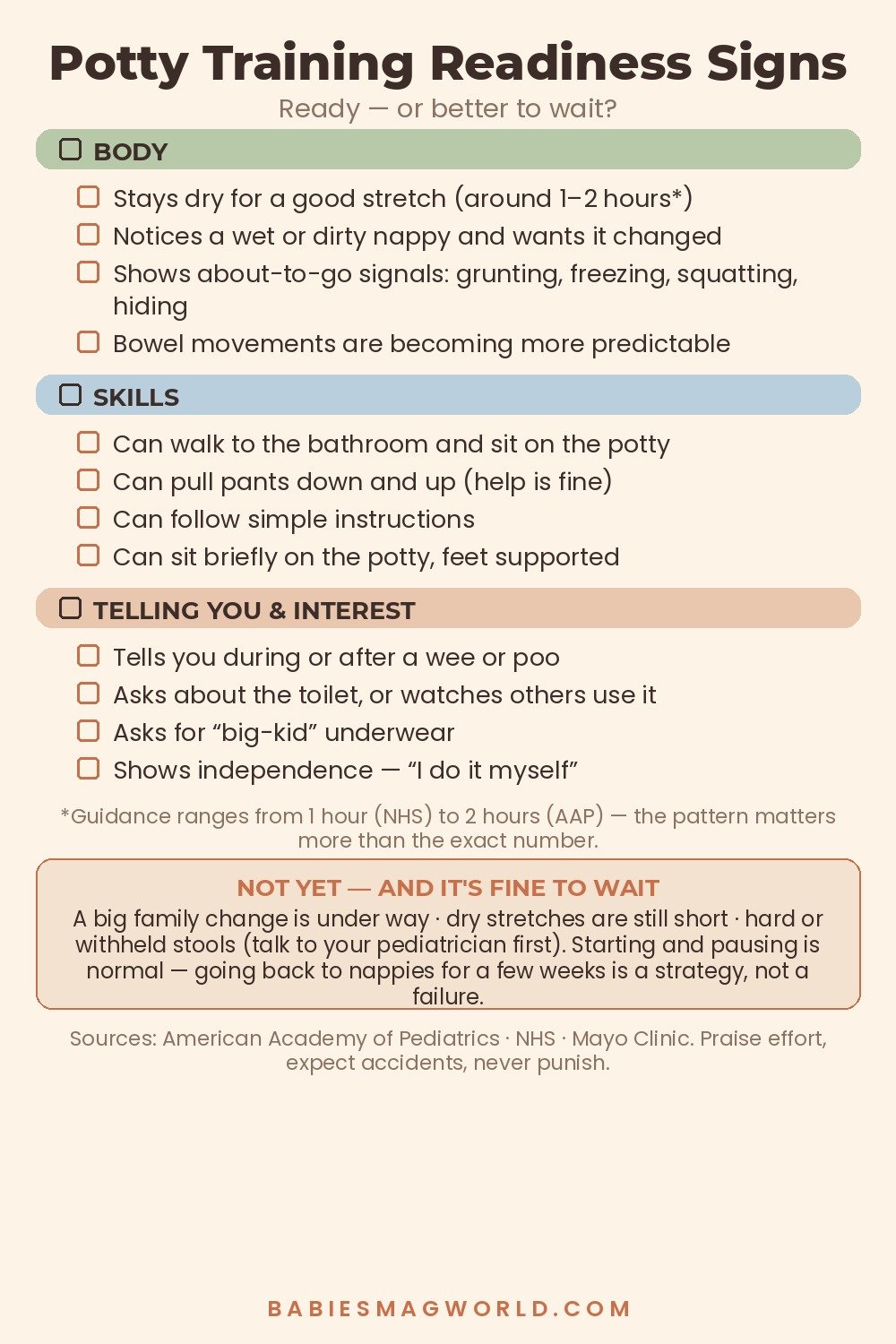
Here is the checklist version of the signs above, the same three groups, in the order you’d actually scan for them.
Signs matter more than birthdays. Most children show these signs somewhere between 18 months and 3 years. Look for a pattern across all three groups, not one magic sign.
| Body signs | Skills | Telling you & interest |
|---|---|---|
| Stays dry for a good stretch (around 1–2 hours*) or wakes dry from a nap | Can walk to the bathroom and sit on the potty | Tells you during or after a pee or poop |
| Notices a wet or dirty diaper and wants it changed | Can pull pants down and up (help is fine) | Asks about the toilet, or watches others use it |
| Shows about-to-go signals: grunting, freezing, squatting, hiding | Can follow simple instructions | Asks for “big-kid” underwear |
| Bowel movements becoming more predictable | Can sit briefly on the potty, feet supported | Shows independence, “I do it myself” |
Guidance ranges from 1 hour (NHS) to 2 hours (AAP), the pattern matters more than the exact number.
Not yet, and it’s fine to wait: a big family change is under way (a move, a new baby); dry stretches are still short; sitting briefly or following a simple instruction isn’t there yet; or stools are hard or being withheld. Talk to your pediatrician first. Starting and pausing is normal: going back to diapers for a few weeks is a strategy, not a failure.
Sources: American Academy of Pediatrics · NHS · Mayo Clinic. Praise effort, expect accidents, never punish. Night dryness comes later, usually between 3 and 5 years.
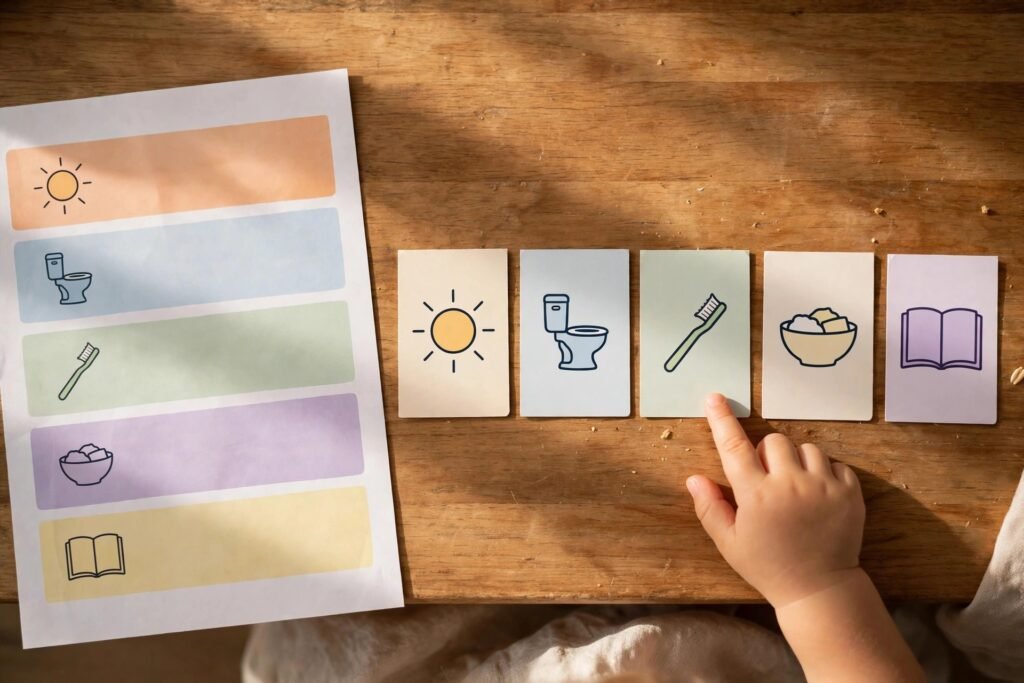
Sticker chart idea: draw a simple Monday-to-Sunday grid with three rows: tried, pee, poop. Tries earn a sticker too, because sitting and trying is the behavior you’re building.
The signs it’s wiser to wait, or to press pause
This is the half of the topic most guides skip, and it’s half the decision. If several signs are still missing, or the ones that were there have stalled, that isn’t a problem to push through, it’s information.
Wait if life is upside down. The AAP’s list of reasons to put training on hold is plain life stuff: your family has just moved or is about to; you’re expecting a baby or have recently had one; there’s been a major illness, a death, or another family crisis. Training asks for a calm, consistent few months (more on that below), and a chaotic month is a bad stage for it.
Wait if the body signs aren’t there. If dry stretches are still short, the earliest signs haven’t shown, and your toddler has no awareness of peeing at all, the NHS is blunt: you cannot force a child who is not ready to use a potty. Trying anyway mostly trains frustration.
Pause if you started and it stalls. NHS Healthier Together says it directly: if, after starting, it becomes clear your child wasn’t quite ready, go back to diapers or pull-ups and try again in a few weeks. That’s not quitting. It’s the official advice.
Pause for power struggles. The AAP notes some children hold back bowel movements to test limits or keep parents involved, and that children control when and where they go, begging, pleading, rewarding and punishing all work against the child managing it themselves. If every sit has become a negotiation, stepping back for a while usually unsticks things faster than pushing through.
And a timing note: night dryness is a separate, later stage, usually somewhere between 3 and 5 years, and up to 1 in 5 five-year-olds still sometimes wet the bed. It isn’t trained the way daytime is; the sign it’s coming is a dry or nearly-dry diaper a few mornings in a row, and it only follows once daytime dryness is established.
Your first week: starting gently
When the signs are there as a pattern and life is calm, the opening moves are small and repeatable, more rhythm than event. It’s worth knowing where potty sits in your toddler’s day: our toddler daily routine chart shows the natural anchor points.
- Set up for success. A potty-chair your child can sit on with feet reaching the floor, per the AAP. For the family toilet, add a trainer seat and a sturdy, non-slip step so feet are braced (stay close while they climb up and down), dangling legs make sitting (and pooping) harder.
- Sit at the body’s cue times. Short, low-key sits after meals and first thing in the morning work with digestion rather than against it; ERIC’s program guidance suggests 20 to 30 minutes after meals for bowel timing. Keep sits brief and boring if nothing happens.
- Swap to underwear when you start. Both the AAP and the NHS describe the switch away from diapers/pull-ups as part of starting, though they frame training pants differently (the AAP sees disposables as sending a “not quite taking over” message; the NHS treats training pants as a legitimate step). Cloth training pants are a middle option both can live with.
- Boys sit first. Start boys peeing sitting down; standing comes later. The NHS adds a practical bonus: sitting helps the bladder empty properly and means a poop can happen at the same sit.
- Praise specifically, skip the treats. “I’m proud you used the toilet” beats generic cheering. The AAP advises avoiding treats and punishments altogether. Mastery is its own reward, and the NHS, which is fine with a sticker chart, is explicit that candy should not be the reward. Punishment has no role at all, as Mayo makes clear.
- Hygiene from day one. Girls wipe front to back, and everyone washes hands afterward. A sturdy, non-slip step up to the sink makes it their routine, not your inspection; stay within arm’s reach while they’re on it. (The same step-and-routine setup helps at bath time, see our guide to washing toddler hair without tears.)
- Expect accidents. They are inevitable, not evidence of failure. Stay calm, don’t make a fuss, change, move on.
- Mind the words in the moment. Toddlers take phrases literally and shame sticks. Our guide to what to say instead at the potty has swaps for the common flashpoints.
Fears deserve a line of their own: the AAP notes that imagination at this age can produce real fears, of flushing, of being sucked in, even a belief that pee and poop are part of the body. Letting your child do the flushing hands them control, and worried is normal, not naughty.
Groundwork, by the way, can start long before the start: Mayo suggests potty books and simply watching family members from around the first birthday, so the whole idea is familiar furniture by the time the signs arrive. Still in the diaper stage a while longer? A good setup helps, see the best changing pads in our roundup for the “graduating from” phase.
When to talk to your pediatrician
Most readiness questions resolve with time. Some shouldn’t wait:
- Stools are the big one. Once a child is on solids, ERIC‘s clinical baseline is soft poop that’s passed easily, usually somewhere between 3 times a day and 4 times a week. Hard stools, pain, blood, going less often than that, straining every time, or persistent withholding are reasons to sort out constipation or bladder issues with a clinician, ideally as part of training, not after it stalls. Peeing more than once an hour belongs on the same list.
- Your child can’t sit comfortably or safely on a potty, supported, even briefly.
- Fears or struggles are escalating rather than settling, or withholding is becoming a pattern.
- Your child has additional needs. ERIC and the NHS both carry specific guidance for children with disabilities and additional needs, a conversation with your pediatrician or health visitor will point you to it properly rather than us improvising adaptations here.
- You simply want a steer. Toilet training is a standard topic at the 18-month, 2-year, 2½-year and 3-year well-child visits, so asking is using the appointment exactly as intended. And remember the readiness factor nobody puts on a chart: you. This needs an adult who can be consistent, daily, for a few months. Choosing a start date when that’s realistic isn’t delay. It’s planning.
Sources
- American Academy of Pediatrics (HealthyChildren.org): “Potty Training Readiness: Thinking, Language & Developmental Milestones”; “The Right Age to Toilet Train”; “Potty Training: 12 Tips to Keep the Process Positive”
- Mayo Clinic Press: “Toilet training: Recognizing readiness”; Mayo Clinic, “Potty training: How to get the job done”
- NHS: “Potty training tips”; NHS West Yorkshire Healthier Together: “Toilet training”
- ERIC, The Children’s Bowel & Bladder Charity: parent advice on potty training, and the professional Toilet Readiness Assessment