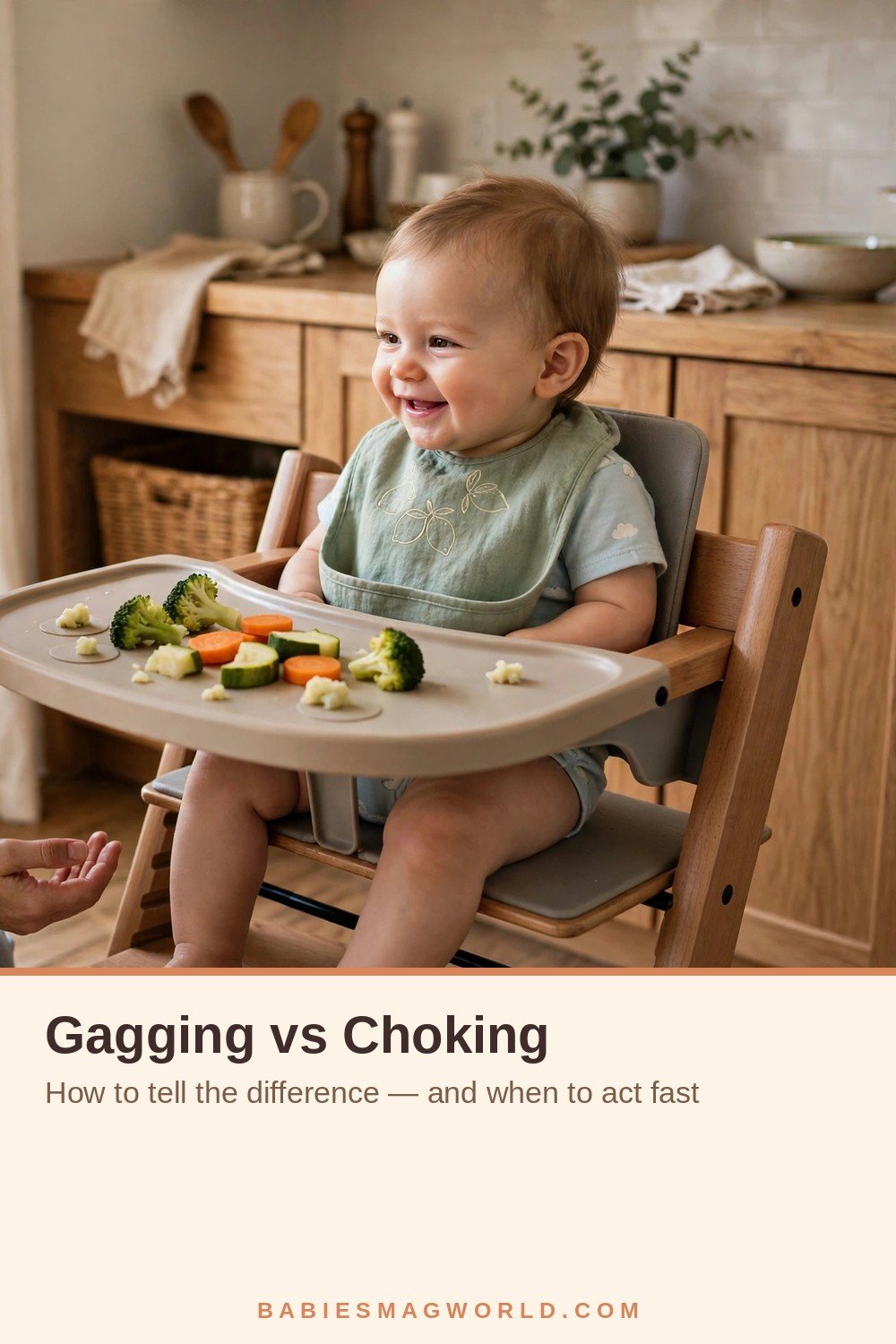
It usually happens on day two or three of solids. Your baby takes a spoonful, their face flushes red, their eyes water, and out comes a retching sound that seems far too dramatic for a mouthful of mashed banana. Your heart is in your throat. Theirs, almost certainly, is fine.
That noise is gagging, and it’s one of the most misunderstood parts of starting solids. Choking, the real emergency, often looks completely different, and much quieter. Knowing which one you’re looking at changes what you do next, and getting it wrong in either direction helps nobody: panicking over a normal gag can put you off feeding, and mistaking choking for gagging costs time you don’t have.
Medical disclaimer: This article is general information for parents and is not medical advice. Guidance on feeding, health and development can depend on your baby’s individual needs. If you have concerns about your child, please speak to your pediatrician or another qualified health professional. If your baby can’t breathe, can’t cry or make sounds, is gasping, turning blue, or going limp, call 911 immediately.
Table of Contents
The 10-second difference
Screenshot this chart and keep it on your phone until first foods feel routine. It is the whole difference in one glance:
| Gagging | Choking | |
|---|---|---|
| Sound | Loud: coughing, retching, spluttering | Quiet or silent; weak cough at most |
| Face | Often red, eyes watering | May turn pale or blue |
| Breathing | Still breathing between gags | Struggling to breathe, or can’t |
| Crying / noise | Can cry and make sounds | Can’t cry, talk or make noise |
| Movement | Food comes forward, may be pushed or spat out | May grab at throat, look panicked, arms waving |
| Your job | Stay calm, stay close, let them work it out | Call 911 and act: this is an emergency |
The AAP’s HealthyChildren.org page on choking prevention lists the danger signs exactly this way: a child who can’t breathe, is gasping or wheezing, can’t talk, cry or make noise, turns a bluish color, appears panicked, or becomes limp or unconscious needs help right away.
Why babies gag so much
Gagging is a safety feature, not a malfunction. The gag reflex triggers when something touches the back of the tongue area, and it shoves food forward before it gets anywhere near the airway. In young babies that trigger zone sits further forward in the mouth than it does in adults, which is why a new texture, even a lumpy purée, can set it off. As babies practice eating, the reflex gradually becomes less sensitive and they handle lumpier food with less drama. That reflex is also why the first clue is sound: gagging is loud because air is still moving.
The CDC’s guide to introducing solid foods says it plainly: as your child adjusts to new textures, they might cough, gag, or spit up. That’s expected in the early weeks, especially if you’ve moved from smooth purée to mashed or soft finger foods a little faster than your baby’s skills have.
It does tend to ease. The first couple of weeks of solids are usually the gaggiest in most families’ experience. If it isn’t easing at all after several weeks of practice, that’s worth raising at a check-up, more on that below.
What to do when your baby gags
If it’s gagging, the job is mostly to do less than you’d think:
- Stay where you are and stay calm. Your baby reads your face. A relaxed parent helps a gagging baby finish the job and swallow or spit.
- Keep them upright in the high chair. Don’t tip them forward, lie them down, or lift them out mid-gag unless they stop coping.
- Let the cough work. Coughing and retching are the body clearing the problem. Watch, wait, and let it happen.
- Don’t put your fingers in their mouth. This is the big one. A blind finger-sweep can push food further back and turn a gag into an obstruction. If you can clearly see a piece of food and can lift it out easily, that’s different, but never go fishing.
- Offer a pause, then a small sip and a smaller next bite once they’ve settled. If they gag repeatedly on one texture, step back to something smoother for a few days and build up again.
What to do if it is choking
Treat silence as the alarm: it is the dividing line between gagging and choking. If your baby cannot breathe, cry or cough effectively, is turning blue, or goes limp:
- Call 911 immediately (or have someone else call while you stay with your baby).
- Follow the infant choking response. For a baby under 1 year who can’t cough, cry or breathe, the American Red Cross infant choking steps are:
- Lay your baby face-down along your forearm, supporting the head and jaw with your hand and resting your arm on your thigh. Keep the head lower than the chest.
- Give up to 5 firm back blows between the shoulder blades with the heel of your other hand.
- If the object hasn’t come out, turn your baby face-up along your other arm, head still lower than the chest, and give up to 5 quick chest thrusts in the center of the chest, just below the nipple line, about 1½ inches deep.
- Keep alternating 5 back blows and 5 chest thrusts until the object comes out or your baby can cough, cry or breathe.
- If your baby becomes unresponsive, start infant CPR and make sure 911 has been called.
Book the course during pregnancy or in the first months, ideally. It’s a few hours, and it’s the single most useful safety step around starting solids.
Prevention: where the real safety work happens
Most choking risk is decided before the food reaches the tray. The CDC’s choking hazards guidance covers the habits that matter:
- Upright, seated, supervised. Your baby should sit up in a high chair or other safe place while eating, never lying down, crawling, or walking around with food. The CDC specifically advises against eating in the car or stroller, where you can’t see or reach them quickly.
- Calm, unhurried meals. No rushing, no tickling a laughing baby through a mouthful.
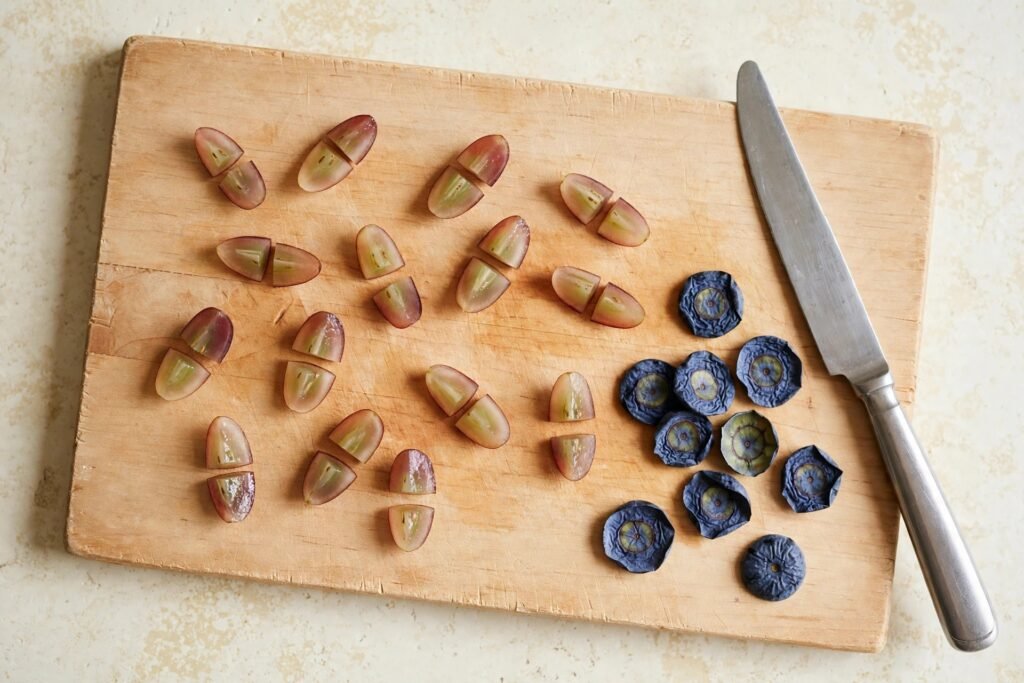
- Right food, right shape. Cook food until it’s soft enough to mash with a fork. Cut small round foods, grapes, cherries, berries, tomatoes, into small pieces (lengthwise quarters for grapes). Cut tube-shaped foods like hot dogs and string cheese into short, thin strips, never coin-shaped rounds. The AAP suggests cutting food for infants and young children into pieces no larger than half an inch.
- Know the repeat offenders. Whole grapes, hot dogs, whole nuts and seeds, popcorn, marshmallows, hard candy, chunks or spoonfuls of nut butter, raw hard vegetables and fruit like carrot and apple pieces, and large chunks of cheese or meat top both the CDC and AAP lists. Several of these simply shouldn’t be served to under-4s in their whole form at all.
Texture progression helps too. Babies who’ve shown the signs your baby is ready for solids, sitting steadily, swallowing instead of pushing food out, gag less than babies started too early. And smooth options have their place in the early weeks: well-blended foods like smoothies for babies at 6 months are still food your baby has to manage, but without the lumps that trigger the most dramatic gags while skills are new. Our overview of starting baby food after 6 months walks through the full first-foods sequence. See our guide to how to cut grapes and round foods safely for babies.
When gagging deserves a conversation with the pediatrician
Gagging is normal. Patterns around it sometimes aren’t. Mention it at your next visit, or sooner, if your baby:
- gags or coughs on thin liquids like milk, not just new textures
- coughs during most feeds, or feeds regularly end in coughing fits
- is gaining weight poorly, or mealtimes have become a battle more often than not
- gags just as much after several weeks of daily practice, with no easing at all
- has noisy breathing, or repeated chest infections
None of those automatically means something is wrong. All of them are legitimate reasons to ask a professional who can watch your baby feed, rather than guessing from an article.
Quick answers
Is gagging actually a good sign? In a strange way, yes. It means the protective reflex is doing its job while your baby learns. Loud, red-faced, coughing gagging on a new texture is learning, not danger.
Can a baby choke on purée? Yes, though it’s less likely. Choking means the airway is blocked, and it can happen with food or small objects. Purées are lower-risk because there are no pieces, but “lower” isn’t “none”, which is why supervision matters at every meal and snack, not only finger-food ones.
My baby gagged and then vomited. Is that normal? It happens, especially in the early days: a strong gag can bring the whole feed back up. Clean up, comfort them, and end the meal there if they’re upset. If vomiting with feeds becomes a regular pattern, raise it with your pediatrician.