Six o’clock. Dinner is half-cooked, somebody is sitting in the dog’s water bowl, and a voice suspiciously like yours is saying “Don’t, stop, no, because I said so” for the fortieth time today. If your discipline vocabulary has shrunk to variations on no, you’re not doing it wrong, you’re doing it unprepared. That’s the idea behind positive discipline phrases: short lines, settled in advance, that say what to do, not just what to stop.
Below are 25, organized by situation, each with a one-line reason drawn from AAP and CDC guidance, the script-level companion to our broader guide to positive parenting and building strong bonds. One honest note: no phrase stops a tantrum on the spot. These teach, on a slower clock than shouting.
Medical disclaimer: This article is general information for parents and is not medical advice. Guidance on feeding, health and development can depend on your baby’s individual needs. If you have concerns about your child, please speak to your pediatrician or another qualified health professional.
Table of Contents
First, why “don’t” is hard work for a toddler
Two developmental facts explain most of the daily friction, both from the guidance this page is built on.
They can’t self-govern yet. The AAP’s toddler guidance is blunt: young children have little natural self-control, haven’t yet learned to regulate big emotions, and run on needs, wants and impulses rather than logic. And their words lag far behind their feelings, a toddler often can’t say “I’m frustrated and I wanted a turn,” so it comes out as a hit, a bite, a thrown block or a wail.
That’s why “discipline” in the AAP’s policy statement means teaching, not winning. Children under 3, sometimes older, simply don’t understand the concept of punishment, so calm limits beat consequences at this age. The most useful technique in the guidance is this: tell the child what to do, not only what to stop. The CDC’s rule guidance: state the rule, then immediately state the behavior you want instead. The phrases below are that technique, pre-written.
Two habits make these phrases land: rules kept few and specific, toddlers hold two or three at a time, and “be good” isn’t one of them, and limits kept consistent across days and caregivers, because predictability makes a limit feel safe, not random. Many flashpoints are tiredness or hunger on schedule. Head them off, the AAP suggests, with well-timed naps and meals.
25 positive discipline phrases, by the moment you’re in
Big feelings: hitting, biting and the home meltdown
The storm moments: safety first, vocabulary second, in that order.
1. Instead of: “Stop hitting!”
Try: “I’ll hold your hands so everyone stays safe. You’re mad, mad is okay. Hitting isn’t.”
Why: Stop the hit first; naming the feeling then builds the vocabulary hitting is standing in for.
2. Instead of: “Don’t bite!”
Try: “Biting hurts. Teeth are for food. Bite this instead.” (Hold out something chewy.)
Why: Biting rides along with frustration a toddler can’t say aloud; a legal target for the mouth redirects it.
3. Instead of: “Calm down!”
Try: “You’re really upset. I’m here. We’ll sit together until your body feels calm.”
Why: Staying close and naming the emotion is the CDC’s time-in pattern, its tool for meltdowns, not rule-breaking.
4. Instead of: “Stop crying, you’re fine.”
Try: “You’re sad. It’s okay to cry. I’ll stay with you.”
Why: Feelings aren’t misbehavior, the AAP’s line: feeling mad or sad is okay; hurting and breaking aren’t.
5. Instead of: “Say sorry right now!”
Try: (once things are calm) “Your friend is hurt. Let’s check she’s okay and get her a cold cloth.”
Why: Remorse can’t be performed on command at two; modeling repair teaches more than a forced word.
Throwing, climbing, running: the safety moments
Where “no” genuinely lives: short, physical, bodies and places, not character.
6. Instead of: “Stop throwing your toys!”
Try: “Thrown toys take a rest. Balls are for throwing, here’s the soft ball, for outside.”
Why: It states the wanted behavior, adds a calm consequence, and gives the urge somewhere legal to go.
7. Instead of: “Don’t climb on that!”
Try: “Feet stay on the floor in here. Climbing is for the park, we’ll go after lunch.”
Why: Positive phrasing says where their body should be; the alternative gives the urge a time and place.
8. Instead of: “Come back here, NOW!”
Try: “Hold my hand, or ride in the cart. You choose.”
Why: Two options, both safe: a limited choice hands over control inside a limit that doesn’t move.
9. Instead of: “Be careful!”
Try: “Wet steps. Slow feet, and hold the rail.”
Why: Vague warnings don’t say what to do; rules this age need to be specific, a named action, not a hope.
10. Instead of: “Don’t touch that!” (the all-day version)
Try: “Hands back, that’s hot. This spoon is yours to hold.”
Why: Save flat “no” and “stop” for real danger, as the AAP advises, so they keep their weight; otherwise redirect.
Mealtime
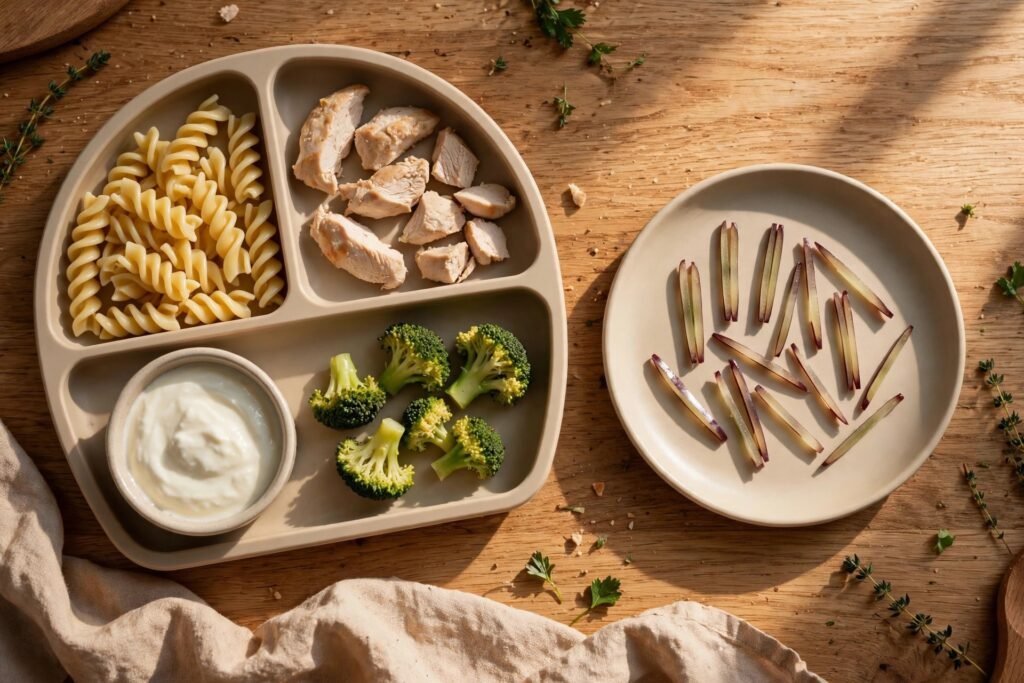
The table has its own flashpoints, and its own phrases, and one rule under all of them: food is never the punishment or the prize.
11. Instead of: “Sit down and eat your dinner.”
Try: “Bottoms on chairs at the table. Blue cup or green cup?”
Why: One doable instruction instead of three, plus a choice that’s theirs.
12. Instead of: “Eat it, or there’s no dessert.”
Try: “This is what’s for dinner. You choose what goes on your plate from what’s here.”
Why: Consequences should never remove something a child truly needs, the AAP’s example is a meal. Food isn’t leverage.
13. Instead of: “Stop throwing food!”
Try: “Food stays on the table. Throwing tells me your tummy might be full. All done? Show me ‘all done.'”
Why: Throwing is often the only “I’m finished” a toddler has; the words or sign replace it. If it keeps happening, move the plate out of reach for a minute and then offer it back, so the meal isn’t taken away as a punishment.
14. Instead of: “Don’t play with your food.”
Try: “Forks are for eating. When lunch is finished, the play kitchen is all yours.”
Why: Name the job of the thing, then point the playing urge at its proper place, redirection beats a ban.
Whining
Usually a language problem wearing a noise costume.
15. Instead of: “Stop whining!”
Try: “I want to understand you. Try your talking voice: ‘More, please.’ I’ll wait.”
Why: Give them the exact words to copy, then answer the better version; the CDC counts whining as redirect-and-respond, not time-out.
16. Instead of: “I’ve told you a hundred times, no!”
Try: “You really want it, and my answer stays the same. Let’s find what we can do meanwhile.”
Why: Consistency is the mechanism: a boundary that bends under protest teaches protesting; one that stays teaches it’s real.
Transitions
Most daily battles are schedule changes in disguise, and the same phrases work at potty time, too.
17. Instead of: “We’re leaving the park. NOW.”
Try: “Two more slides, then we wave bye-bye to the park. Which slide is the last one?”
Why: Preparing a child for what’s coming, with a small choice inside it, is the AAP’s “be prepared for trouble” strategy.
18. Instead of: “Hurry up!”
Try: “Shoes next. Do you want to hop to the door, or stomp like a bear?”
Why: “Hurry” is abstract; a named next step with a game attached is doable at two.
19. Instead of: “Turn that off RIGHT NOW.”
Try: “One more song, then the tablet goes to sleep. You can press the button when it ends.”
Why: A warned ending beats sudden removal; predictable endings are why routines feel safe.
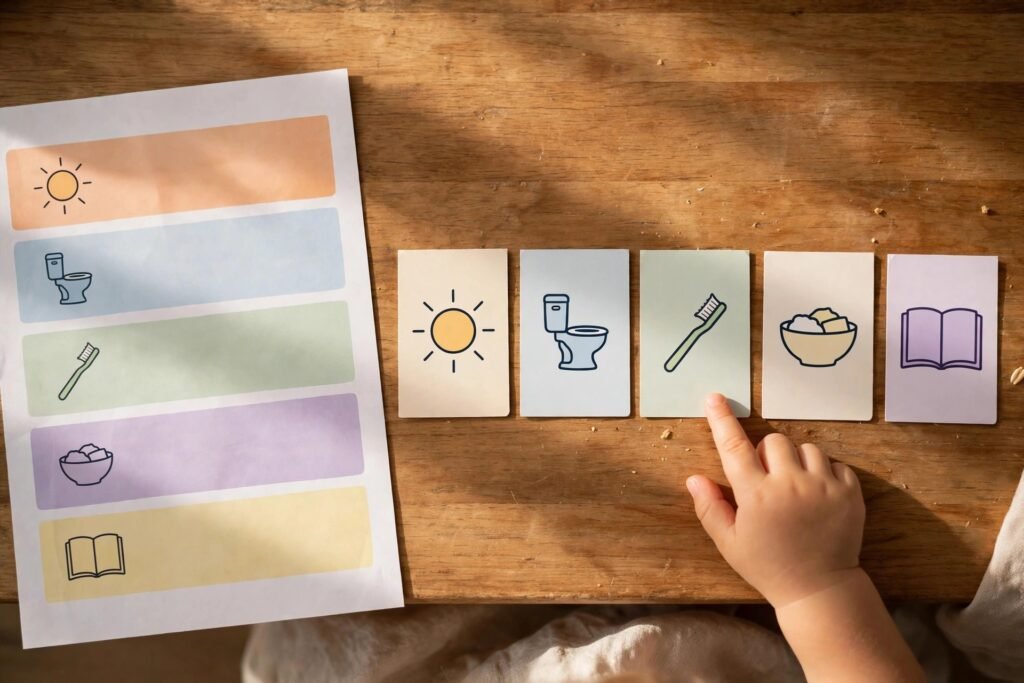
The full shape of the day those transitions sit inside is in our toddler daily routine chart.
“I do it myself”: independence
The slowest, messiest phase; these mostly buy patience.
20. Instead of: “Let me do it, you’re so slow.”
Try: “You’re working hard on those buttons. Shout if you want a hand with the tricky one.”
Why: Praise effort and good tries specifically, naming good behavior is how the AAP says new behavior gets built.
21. Instead of: “Stop making a mess!”
Try: “Water goes in the cup. Uh-oh, a spill, here’s your cloth for wiping.”
Why: Name the job, treat the spill as part of learning it, fix, not blame.
Bedtime refusal
Tired child, tired parent, same nightly argument, predictability is the strategy. If nights are broken rather than resisted, our guide to sleep regression or teething helps work out what’s waking them.
22. Instead of: “Go to bed RIGHT NOW.”
Try: “Bath, book, bed, same as always. Tonight you choose: the bear book or the truck book?”
Why: The sequence does the heavy lifting; the choice gives control without reopening bedtime itself.
23. Instead of: “If you get up one more time…”
Try: “Your job is staying in bed. If you need me, call, and I’ll come and check on you.”
Why: Expectations stated clearly, in advance, then kept, make limits believable; unenforced threats erode that.
Public meltdowns
Meltdowns with an audience, who doesn’t get a vote. These are for you and your child only.
24. Instead of: “Stop it, everyone’s looking at us!”
Try: (down at eye level, low voice) “You’re having a really hard time. I’m right here. We’ll sit together until it passes.”
Why: A public meltdown is distress, not defiance: stay close, name the feeling, coach afterward, the CDC’s steer.
25. Instead of: “Right, we’re NEVER coming back here!”
Try: “This is too much for the store today. We’re going to the car to calm down; we’ll try another day.”
Why: A calm consequence you actually follow through beats a dramatic one nobody believes, follow-through makes other limits credible.
Where do time-out and time-in fit?
Phrases handle most of the day, but sometimes a consequence is the honest tool, here is what the authorities behind this article actually say, and they don’t all say the same thing.
The AAP and CDC both describe time-out as a legitimate tool for specific moments: dangerous behavior, hurting someone, or a known rule broken after a warning. Their version is brief and unglamorous: warn first; name the behavior in a few calm words; use a quiet spot that isn’t the bedroom or a playroom; keep it to about one minute per year of age (the worked examples start at age two, with two minutes); then go back to normal and praise the next good thing. The AAP’s toddler aggression guidance adds the restraint: use time-outs sparingly, as a last resort, a tool that can be overused.
For a child who is simply overwhelmed, the full meltdown, the CDC points the other way, to time-in: stay close, name the emotion, offer support, coach once the storm passes.
You’ll find stronger claims both directions online, including that time-outs are harmful. Nothing in the AAP or CDC guidance read for this article says that, nor does it present time-out as the main event. The phrases above are the main event.
The other half of the script: catching them being good
These phrases only stick if the rest of the day runs the other way. The AAP calls attention “the most powerful tool for effective discipline”, it reinforces whatever it lands on, so your best sentences land on good behavior, immediately and by name. Their own example is disarmingly small: “Wow, you did a good job putting that toy away!” The CDC calls the same move labeled praise, and advises using it a lot whenever a new rule is being learned. The least dramatic item here, and the one the rest depend on.
When it’s more than phrases
These phrases are for ordinary toddler weather. Talk to your pediatrician if aggressive behavior is unusually frequent or lasts more than a few weeks, if your child injures themselves or others, if outbursts are getting them sent home from playgroups or childcare, or if you aren’t coping. That list is the AAP’s own guidance on when to ask for backup.
Pick two or three favorites and stick them on the fridge. They will do most of the work, because toddlers learn from the hundredth calm repetition, not the first.
Sources
- American Academy of Pediatrics (HealthyChildren.org), “What’s the Best Way to Discipline My Child?”
- American Academy of Pediatrics (HealthyChildren.org), “Time-Outs 101” and “Aggressive Behavior” (10 tips to prevent aggressive behavior in young children)
- CDC, Essentials for Parenting Toddlers and Preschoolers (time-in, time-out and creating rules)
- Sege RD, Siegel BS, “Effective Discipline to Raise Healthy Children”, Pediatrics, 2018 (AAP policy statement).