Medical disclaimer: This article is general information for parents and is not medical advice. Guidance on feeding, health and development can depend on your baby’s individual needs. If you have concerns about your child, please speak to your pediatrician or another qualified health professional.
Search for a baby milestones by month chart and you’ll find five charts that disagree with each other, one swears your 9-month-old should be pulling to stand, another expects rolling in both directions at 6 months. They’re not all describing your baby. Some of them are describing an old checklist. In February 2022 the CDC rebuilt its developmental milestone checklists, and a lot of the charts still pinned, printed and sold today predate that rebuild. This chart uses only the current CDC checklists, nothing added, nothing quietly borrowed from anywhere else.
Two framing facts before the chart itself, because they change how you read every row. First, a CDC milestone is a skill most children, 75% or more, can do by that age. The older lists used a roughly 50% threshold, which meant half of all babies “missed” milestones they were never late for; the higher bar exists so that a genuinely missing item prompts a conversation instead of a shrug. Second, the CDC is explicit that its checklists are communication tools, not developmental standards, and not screening or diagnostic tools. Filling in this chart is not screening your baby. It’s a way of noticing, and knowing what to say at the next appointment.
And one structural surprise: in the first year, the CDC has checkpoints at 2, 4, 6, 9 and 12 months, there is no CDC checklist for 1 month, or for 3, 5, 7, 8, 10 or 11 months. Monthly grids covering those months exist all over the internet, but they’re editorial creations, whoever publishes them. Our chart sticks to the five real checkpoints.
Table of Contents
Save this: the baby milestones by month chart (0–12 months)
Skills most children (75% or more) can do by this age, CDC developmental checklists, revised February 2022.
By 2 months
| Domain | What most babies do by 2 months |
|---|---|
| Social/Emotional | Calms down when spoken to or picked up · Looks at your face · Seems happy to see you when you walk up to her · Smiles when you talk to or smile at her |
| Language/Communication | Makes sounds other than crying · Reacts to loud sounds |
| Cognitive | Watches you as you move · Looks at a toy for several seconds |
| Movement/Physical | Holds head up when on tummy · Moves both arms and both legs · Opens hands briefly |
The theme of this first stop is connection: faces, voices and the very first social smiles.
By 4 months
| Domain | What most babies do by 4 months |
|---|---|
| Social/Emotional | Smiles on her own to get your attention · Chuckles (not yet a full laugh) when you try to make her laugh · Looks at you, moves, or makes sounds to get or keep your attention |
| Language/Communication | Makes sounds like “oooo”, “aahh” (cooing) · Makes sounds back when you talk to her · Turns head toward the sound of your voice |
| Cognitive | If hungry, opens mouth when she sees breast or bottle · Looks at her hands with interest |
| Movement/Physical | Holds head steady without support when you are holding her · Holds a toy when you put it in her hand · Uses her arm to swing at toys · Brings hands to mouth · Pushes up onto elbows/forearms when on tummy |
Two of this checkpoint’s items explain a lot of parental googling: “looks at her hands with interest” and “brings hands to mouth” are 4-month milestones, which is why the hand-staring and hand-chewing phase arrives right on schedule, we’ve written a whole explainer on why babies chew on their hands. The same goes for the self-soothing mouthing behaviors parents worry about, like baby sucking on their bottom lip, at this age, mouths are how babies investigate and settle.
By 6 months
| Domain | What most babies do by 6 months |
|---|---|
| Social/Emotional | Knows familiar people · Likes to look at self in mirror · Laughs |
| Language/Communication | Takes turns making sounds with you · Blows “raspberries” (sticks tongue out and blows) · Makes squealing noises |
| Cognitive | Puts things in her mouth to explore them · Reaches to grab a toy she wants · Closes lips to show she doesn’t want more food |
| Movement/Physical | Rolls from tummy to back · Pushes up with straight arms when on tummy · Leans on hands to support herself when sitting |
Notice what’s not here, because older charts will tell you otherwise: the 6-month rolling item is tummy-to-back only. “Rolls over in both directions” was a pre-2022 item. And the sitting item is leaning on hands for support, sitting without support is a 9-month item on the current checklist.
By 9 months
| Domain | What most babies do by 9 months |
|---|---|
| Social/Emotional | Is shy, clingy, or fearful around strangers · Shows several facial expressions, like happy, sad, angry, and surprised · Looks when you call her name · Reacts when you leave (looks, reaches for you, or cries) · Smiles or laughs when you play peek-a-boo |
| Language/Communication | Makes a lot of different sounds like “mamamama” and “bababababa” · Lifts arms up to be picked up |
| Cognitive | Looks for objects when dropped out of sight (like her spoon or toy) · Bangs two things together |
| Movement/Physical | Gets to a sitting position by herself · Moves things from one hand to her other hand · Uses fingers to “rake” food toward herself · Sits without support |
The stranger shyness and the big reaction when you leave the room are milestones now, not a phase to apologize for, they’re in the Social/Emotional column. (If nights have fallen apart around this age too, our guide to sleep regression or teething can help you sort out which you’re dealing with.) And the famous absence: crawling appears nowhere in this table, or anywhere else in the first-year checklists. More on that below.
By 12 months
| Domain | What most babies do by 12 months |
|---|---|
| Social/Emotional | Plays games with you, like pat-a-cake |
| Language/Communication | Waves “bye-bye” · Calls a parent “mama” or “dada” or another special name · Understands “no” (pauses briefly or stops when you say it) |
| Cognitive | Puts something in a container, like a block in a cup · Looks for things she sees you hide, like a toy under a blanket |
| Movement/Physical | Pulls up to stand · Walks, holding on to furniture · Drinks from a cup without a lid, as you hold it · Picks up things between thumb and pointer finger, like small bits of food |
Read the movement row carefully, because it’s the most misquoted line in milestone content: the CDC’s 12-month movement items stop short of independent walking: pulling up to stand and walking while holding on to furniture are as far as they go. Independent steps are not a 12-month CDC item, they belong to a later checkpoint. Any chart promising “walks alone by 12 months” as an expectation is not using the current checklist.
A checklist for noticing and chatting, not a test and not a diagnosis. Missing one? Don’t wait and see: talk to your child’s doctor and ask about developmental screening. If your child loses skills at any age, act right away. Born early? Ask your doctor which age to track.
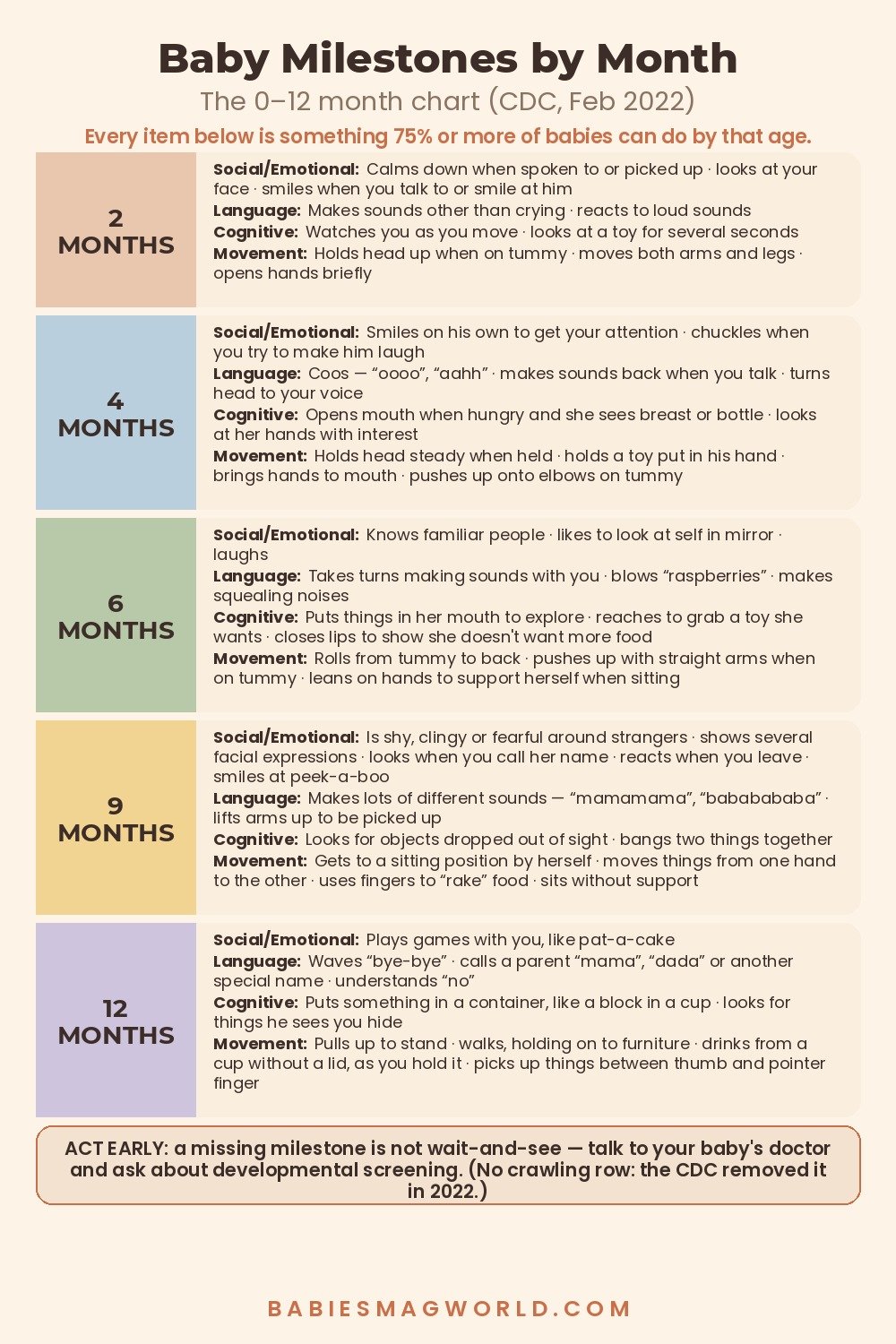
Why some charts disagree: the 2022 rebuild
If your saved chart says different things, it was probably built before February 2022. That revision, informed by a peer-reviewed evidence review published in Pediatrics, changed the checklists in ways that ripple through every milestone chart on the internet:
- The threshold moved. Items are now placed at the age by which about 75% or more of children show them, instead of around 50%. Many familiar items therefore moved to later checkpoints, not because babies changed, but because the question changed from “when do half of babies do this?” to “when can almost all babies do this?”
- Crawling was dropped entirely. It appears on no first-year CDC checklist. That’s the single biggest visual difference between an old chart and this one.
- Specific favorites moved or vanished. “Rolls over in both directions” at 6 months, “reaches for toy with one hand” at 4 months, “pulls to stand” at 9 months and “responds to own name” at 6 months (name response now sits at 9 months, as “looks when you call her name”) are all pre-2022 items. If a tracker or printable lists them as current CDC milestones, it’s working from the old instrument.
Neither chart is lying about babies. They’re answering different questions, a decade of habit apart, but only one of them is the checklist your pediatrician’s office is working from now.
Milestones are checkpoints, not deadlines
Hold both halves of this at once, because the CDC designed it that way. A milestone on this chart is something 75% or more of babies can do by that age, which means a baby can be developing typically and still not show a listed item on the birthday itself. KidsHealth makes the same point from the clinical side: there’s a wide range of what’s considered normal, some children gain skills earlier or later than others, and babies born prematurely may reach milestones later, the CDC checklist itself asks whether your child was born early, so ask your doctor which age to track against rather than doing that math alone.
And the other half: the 75% threshold was chosen specifically to reduce “wait and see.” Because the bar is set where most babies clear it, a missing item is meant to start a conversation, not a panic and not a shrug. Not a deadline, and not a wait-and-see either. The checklists also don’t contain every milestone a child might show, an item missing from the list isn’t a judgment that the skill doesn’t matter.
If something’s missing: act early, don’t wait and see
The CDC’s own word for this is “Act Early,” and the pathway on every checklist is the same:
- Talk with your child’s doctor. Bring the checklist, name the specific item, and share your concern in plain words.
- Ask about developmental screening. The checklist is a conversation starter; screening is the formal tool, and it’s the doctor’s next step.
- If concern persists after screening, ask for two things: a referral to a specialist and a connection to services and supports, early intervention contacts by state are at cdc.gov/FindEI.
- Losing skills is its own rule. The checklists ask directly whether your baby has lost any skills they once had. If that happens at any age, 3 months, 10 months, any age, act right away. Don’t wait for the next checkpoint.
What this article will never do is tell you your child “is delayed”, no chart can say that, and this one is a noticing tool, not a verdict. What it can do is make sure that if you ever sit in a pediatrician’s office saying “she’s not doing X yet,” you arrived early, with specifics, instead of months late with a worry. That’s the entire point of the rebuild, and it’s why this chart keeps the CDC’s wording, changing only the pronouns so every row says “she.”
Sources
- CDC, “Key Points about CDC’s Developmental Milestone Checklists” (checklists revised February 2022; milestones placed at the ≥75% threshold)
- CDC, Developmental Milestone Checklists: 2 months, 4 months, 6 months, 9 months, 12 months (all items in the chart above are reproduced from these checklists)
- CDC, “Learn the Signs. Act Early.” program
- KidsHealth (Nemours), “Your Child’s Development: 1 Year (12 Months)”
- Zubler JM et al., “Evidence-Informed Milestones for Developmental Surveillance Tools”, Pediatrics, 2022