The feed ended ten minutes ago. Your baby is full, burped, and (somehow) the fist is already back in the mouth, sleeve soaked, chewing away like the meal never happened. So it can’t be hunger. Can it?
“Why do babies chew on their hands, then?” Usually, it isn’t hunger. Hand-chewing is one behavior with several different jobs, and the job changes as your baby grows. At 2 months it really might be hunger. At 4 months it’s mostly discovery. By 6 months, teeth enter the chat. Here’s how to read it at each age, and the short list of times it’s worth mentioning to someone qualified.
Medical disclaimer: This article is general information for parents and is not medical advice. Guidance on feeding, health and development can depend on your baby’s individual needs. If you have concerns about your child, please speak to your pediatrician or another qualified health professional.
Table of Contents
Why do babies chew on their hands? Four reasons, overlapping
Almost all hand-chewing comes down to some mix of these:
- Hunger: strongest in the newborn weeks, and it fades as the main explanation surprisingly fast.
- Discovery: hands are the first things a baby can reliably get into their own mouth, and the mouth is a serious learning tool.
- Self-soothing: sucking and chewing are calming, and babies deploy them when tired, bored or overstimulated.
- Teething: sore gums plus something to gnaw on equals relief, once teeth are actually on the move.
The ages below are typical ranges, not deadlines. Babies run their own schedules.
0 to 2 months: mostly hunger and comfort
A newborn’s hands spend a lot of time in fists near the face, and mouthing at this age is closely tied to feeding. Hand-to-mouth movement alongside rooting (turning toward anything that brushes the cheek), lip-smacking and fussing is a classic hunger cluster. One sign alone means little; the cluster, plus time since the last feed, is the real signal.
Outside feeds, sucking on a hand is also one of a newborn’s few self-soothing tools. If your baby has just fed well and starts drowsily chewing a fist on the way into a nap, that’s comfort, not a second course.
Around 3 to 4 months: they’ve found their hands
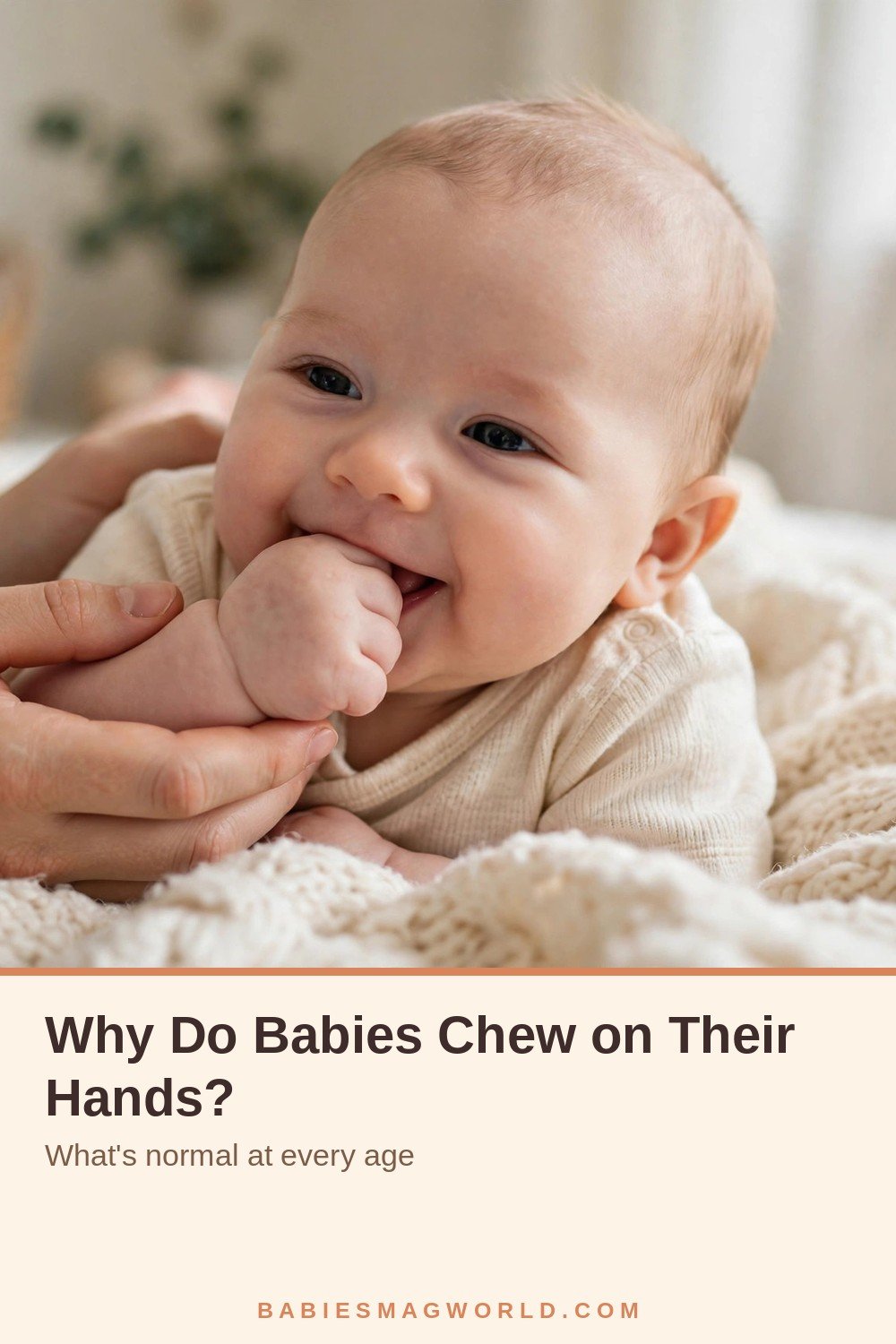
So what is it at this age, if it isn’t hunger? This is the stage that confuses everyone, because it looks exactly like hunger and teething and is usually neither. Somewhere in this window, babies discover their hands are theirs. They stare at them. They wave them around. And they practice landing them in the mouth, at first by luck, then with intent. That practice matters. Bringing the hands to the mouth on purpose is a genuine developmental skill, the same coordination that later gets toys, teethers and eventually food to the right address. A baby who chews their hands happily between feeds, while alert and interested in the world, is generally a baby doing homework.
4 to 6 months: everything goes in the mouth
Hand-chewing now graduates to object-chewing. As Mayo Clinic’s overview of development from 4 to 6 months puts it, hand-eye coordination improves, babies grasp what they can reach, and anything within reach is likely to end up in your baby’s mouth.
This is oral exploration in full swing. Your baby isn’t being awkward; the mouth gives them detailed information about texture, shape and taste that their fingers can’t yet. The CDC’s readiness signs for starting solids include exactly this (bringing objects to the mouth and trying to grasp small things), because it’s the same skill set eating is about to need. At 5 months, exploration is usually the answer.
Some babies at this age also branch out into related habits, like why babies suck on their bottom lip, different target, same story of exploration and soothing.
Around 6 months and beyond: teething joins in
Now teeth become a real suspect. The NHS guide to baby teething symptoms notes that most babies start teething at around 6 months (some earlier, some not until after 12 months), and its symptom list reads like a description of the older hand-chewer: gnawing and chewing on things a lot, dribbling more than usual, a sore red patch of gum where a tooth is coming through, one flushed cheek, and more fretfulness than usual. The bottom front teeth are usually first, typically at around 5 to 7 months. If nights fall apart too, see sleep regression or teething.
How to tell teething-chewing from discovery-chewing? Look for company. Chewing plus drool plus a visible red gum area plus a grumpier-than-usual baby points toward teeth. Chewing alone, in a contented baby with smooth gums, is probably just exploration continuing. At 7 months, teething is finally a fair suspect, but look for company.
What helps at this stage is something safe to gnaw: a clean finger to rub the gum, or a teething ring. Keep wiping the drool, too: constant wetness around the chin is a fast route to a dribble rash.
9 to 12 months: habit, boredom, and a bigger safety job
Mouthing doesn’t vanish at the first birthday. It tapers. Older babies still chew hands and objects when tired, teething (molars start arriving around 12 months, per the NHS timeline), or simply because chewing is a familiar comfort during new situations.
Your job description changes, though. A mobile baby can reach far more than a newborn, and as the AAP’s HealthyChildren.org page on choking prevention explains, babies and toddlers explore the world by putting things in their mouths, and their airways are small. Coins, batteries, pen caps, older siblings’ small toys: the hand-chewing phase is cute, and it’s also the reason the floor-level sweep becomes a daily habit in most houses.
Save this: hand-chewing by age, at a glance
The short version, by age:
| Age | What you’ll see | What it usually means | What helps |
|---|---|---|---|
| 0–2 months | Fists near face, rooting, lip-smacking | Hunger, or self-soothing after a feed | Feed if other hunger cues are there; let them suck to settle |
| 3–4 months | Staring at hands, deliberate hand-to-mouth | Discovery, they’ve found their hands | Nothing to fix; it’s a developmental skill |
| 4–6 months | Hands, toys, everything goes in | Oral exploration and learning | Clean, safe objects to mouth; supervised floor time |
| Around 6 months | Chewing + drooling + red gum + fretfulness | Teething becomes likely | Teething ring, clean finger on the gum, wipe the drool |
| 9–12 months | Chewing when tired, bored or teething | Comfort habit; later teeth arriving | Safe chew options; keep small objects out of reach |
Is it hunger? The 30-second check
Before you warm a bottle for a hand-chewer, run through this: It’s the fastest way to sort out what’s behind it this time.
- When did they last feed? Twenty minutes ago, with a good feed? Hunger drops down the list.
- What’s the rest of the body saying? Rooting, squirming, escalating fussing and hands jammed in together suggest hunger. A relaxed baby chewing while watching the room does not.
- What happens if you offer a finger or teether instead? A baby who happily transfers to it was probably exploring or soothing. A baby who rejects it and escalates may genuinely want the feed.
Reading cues like these (rather than reacting to one signal) is a big part of building a strong bond with your baby: you get better at knowing what your particular baby is asking for, and they get better at being understood.
When to mention it to your pediatrician
Hand-chewing itself is normal. Bring it up, at a routine visit, or sooner, if you notice:
- your baby isn’t bringing hands or objects to the mouth at all by around 6 months, especially alongside other skills you’re waiting on
- sores, white patches, or swelling in the mouth that don’t clear
- a temperature of 38°C (100.4°F) or higher, diarrhea, or a baby who seems properly unwell. The NHS is clear that teething isn’t a proven explanation for those, so don’t write them off as teeth
- chewing that seems constant and distressing rather than contented, at any age
Trust the pattern over any single afternoon. You see your baby every day; a change that persists is worth a professional opinion, and asking early is never wasted.
Quick answers
Should I stop my baby chewing their hands? No, it’s how they learn and soothe. Keep hands reasonably clean, offer safe alternatives when teeth are sore, and supervise the object-chewing stage. The behavior fades on its own.
Does hand-chewing at 3 months mean teeth are coming? Probably not yet. Most babies start teething around 6 months, according to the NHS, though a few start before 4 months. At 3 months, discovery is the far more likely explanation.
Is all that drool normal? During teething, yes, dribbling more than usual is on the NHS symptom list. Wipe it regularly to protect the skin, and mention drooling that’s paired with fever or illness to your doctor instead of assuming it’s teeth.