These sensory play ideas start from a fact of baby life: if it fits in your baby’s hand, it goes in her mouth. That’s not a phase to wait out before the “real” play can start, it is the play.
The CDC lists “puts things in her mouth to explore them” as a cognitive milestone at 6 months, which means the mouthing is the learning, not an obstacle to it. So every filler below is an ordinary food, prepared the way food is prepared, in textures that follow the same rules as a baby’s plate. Nothing in any age band needs a craft-store run, and the two most-pinned fillers in this niche aren’t here at all, there’s a short section near the end explaining why, with the receipts.
Medical disclaimer: This article is general information for parents and is not medical advice. Guidance on feeding, health and development can depend on your baby’s individual needs. If you have concerns about your child, please speak to your pediatrician or another qualified health professional.
Table of Contents
Why mouth-first play is the whole point
The AAP calls play “serious business” for health and development, and its clinical report on play is clear that this isn’t filler in a baby’s day: developmentally appropriate play with parents and other children builds social-emotional, cognitive, language and self-regulation skills, the executive-function machinery underneath almost everything else. Play also supports the safe, stable, nurturing relationships children need to thrive.
Watch a baby with a new object and you’ll see the method. The AAP describes babies exploring objects with their sensory-motor skills like “little scientists,” running experiments on whatever they pick up. Zero to Three’s guide to play says the same thing from the other side: a baby learns by engaging all her senses, and her eyes, ears, nose, hands and mouth are her tools. A rattle gets looked at, shaken, listened to and chewed. Textured blocks, rattles and crinkly fabrics are the classic provision because babies work through every channel they’ve got.
This is also why the taste-safe standard exists on this site. If mouthing is a milestone, then anything handed to a mouthing baby has to be judged as food first and as a toy second. (If the hand-chewing itself is new to you, why babies chew on their hands explains what’s behind it.)
What “taste-safe” means in this house
Our definition of taste-safe, built from the sources above, is the standard every idea here is judged by: taste-safe means every ingredient is a food, prepared the way food is prepared, in pieces and textures that pass the CDC’s food-prep rules, and it still requires an adult right there. It does not mean “a snack,” and it never means “safe unsupervised.”
Two honest notes before the ideas themselves. First, the age bands are ours, 6 to 12 months, 12 to 24 months and 2 to 3 years, anchored to how babies actually develop (sitting up, the mouthing peak, mouthing fading). No authority publishes an official sensory-play age chart, and we’d rather say that than borrow one. Second, several fillers below are allergens, yogurt and cereal grains, for instance. Taste-safe play is not a way to introduce allergenic foods, and a bin of yogurt paint doesn’t count as a first taste. When you’re ready for that step, it’s a feeding step: see introducing allergens step by step.
Ages 6 to 12 months: the mouthing peak
The setup is the same all through this band: a towel or old sheet on the floor, your baby sitting propped or steady, you on the floor with her. Small trays and baking dishes beat big bins, less to tip, less waste when it ends in tears over nothing.
| Idea | What you need | How it goes |
|---|---|---|
| Water splash tray | A shallow baking dish of water, a cup | Well-supervised water play is a Zero to Three staple for older babies. She pats, splashes and watches her hands disappear. You stay within arm’s reach the entire time, water play in this house is never a look-away activity. |
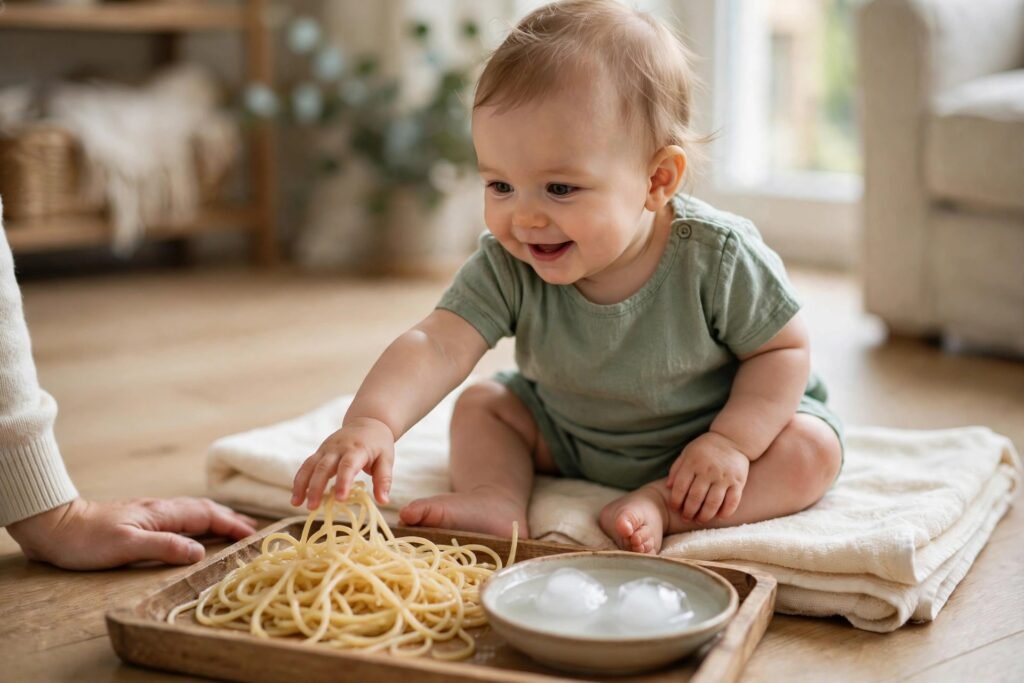
| Big ice melt-and-push | Two or three large ice cubes or a frozen tub of water tipped out as a block | Cold, slippery, shrinking, a lot of information for one object. Large pieces only, so there’s nothing small to break off and mouth. She pushes it around the tray and chases it as it slides. |
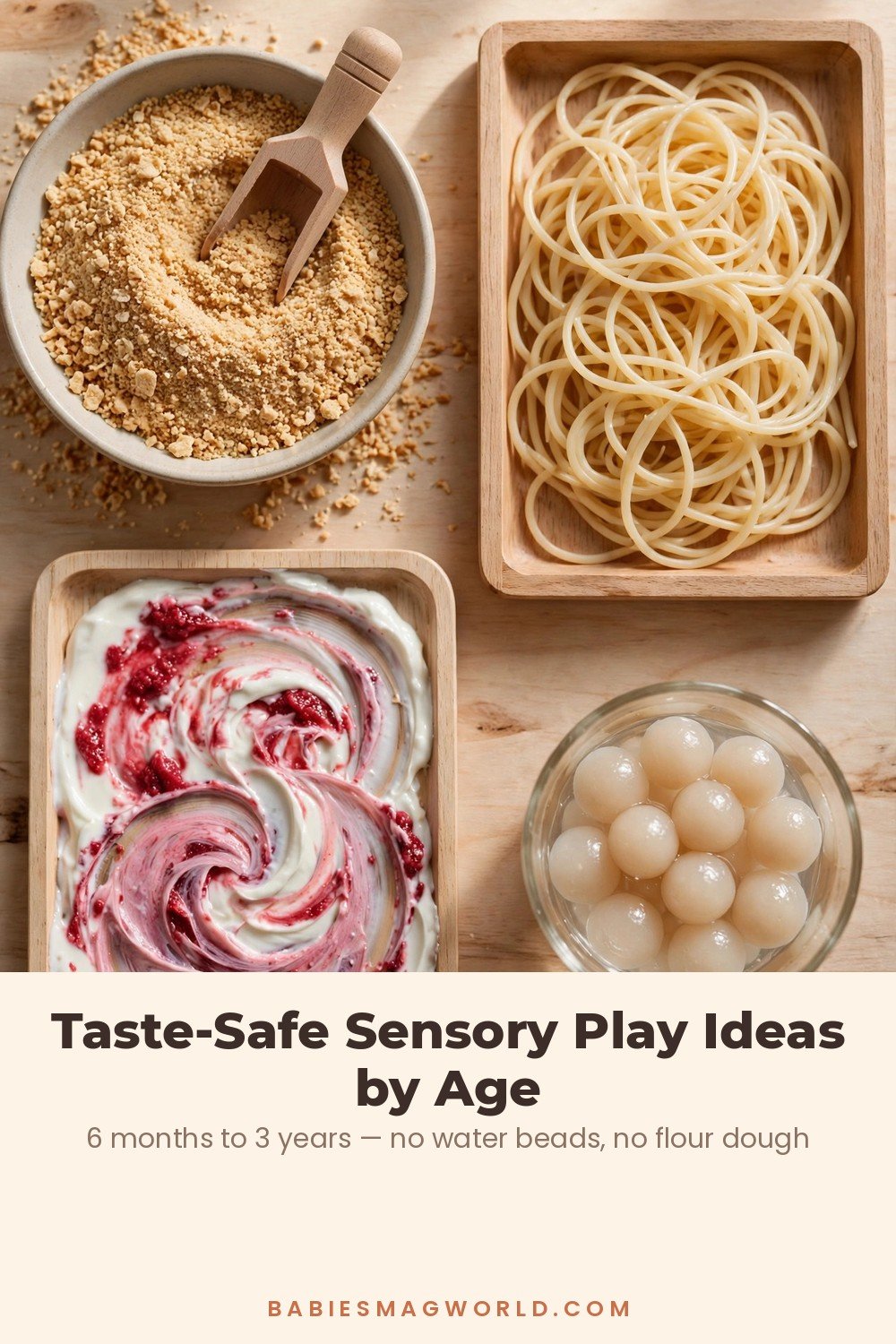
| Cooked spaghetti squish | A handful of spaghetti, cooked soft and cooled | Grabbing, pulling, squishing fistfuls. It clings to fingers, piles up and falls apart, and if some gets eaten, lunch came early. |
| Crushed cereal “sand” | Plain cereal or crackers, crushed to coarse crumbs, in a tray with a cup | The taste-safe answer to sand: pourable, scoopable, and fine to taste. Stay close anyway: a big fistful of dry crumbs can still make a baby cough or gag. Crush it coarse, not powder-fine, so it’s satisfying to rake. |
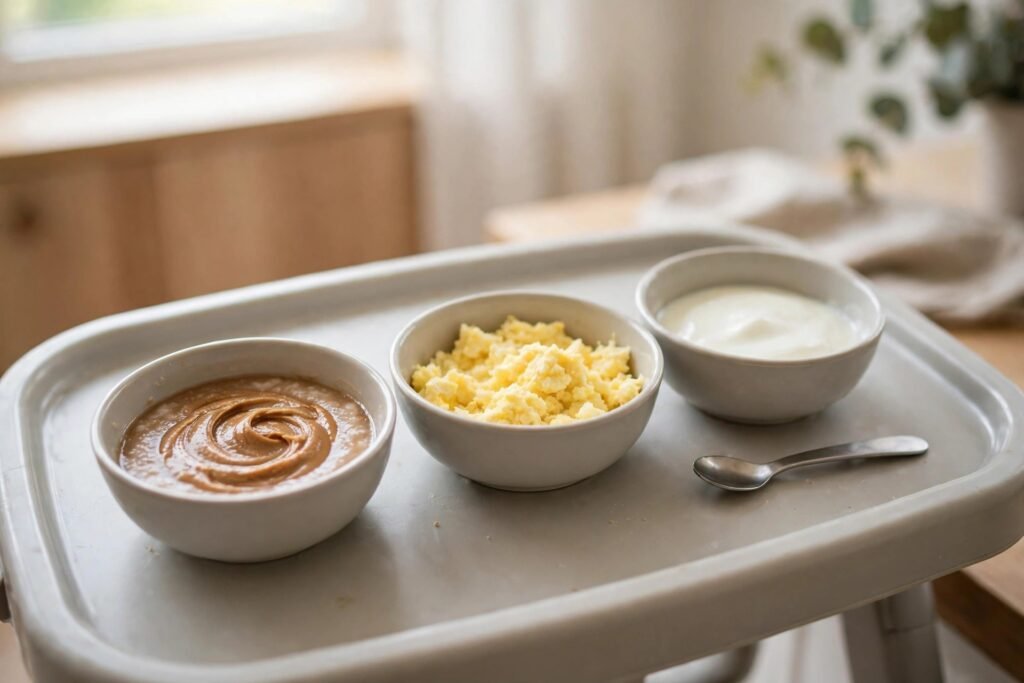
| Yogurt finger painting | A few spoonfuls of plain yogurt on the highchair tray | Smear art with zero cleanup anxiety. Plain yogurt as-is, or swirled with mashed soft fruit for color. Straight in the bath afterward. |
| Cooked oatmeal bowl | A bowl of oatmeal, cooked and cooled | Warm-then-cool, thick, squeezable. Good for babies who prefer their mess contained in one bowl, and it washes off everything. |
Ages 12 to 24 months: scooping, pouring, still tasting
The mouthing hasn’t stopped, but the hands have leveled up: scooping, pouring between containers, and carrying things across the room become the main event. The food rules stay exactly the same.
| Idea | What you need | How it goes |
|---|---|---|
| Cooked tapioca pearl scooping | Large tapioca pearls only, cooked until soft all the way through and cooled, in a bowl with cups | This is the swap for water beads (see the swap list below): soft, squishy, scoopable spheres that are food. Squash a few between your fingers to check there’s no firm center. Like grapes, they’re round and slippery, so we keep this one for about 18 months and up, with your toddler seated and you right beside her. Skip it if she still crams handfuls into her mouth. |
| Oobleck | Cornstarch and water, roughly 2:1, in a tray | It pours like a liquid and resists like a solid. Our house caution: it enters at this band, not the baby band, and with you beside her; the youngest babies stick to water, ice and cooked foods. Why cornstarch when raw flour is out? The FDA and CDC warnings, and the outbreaks behind them, are about raw wheat flour and dough. Cornstarch is a refined starch and isn’t the subject of those warnings, but it isn’t sterilized either, so oobleck is for squishing, not snacking: keep tasting to a minimum and wash hands afterward. |
| Cooked rice tray | Cooked rice, cooled, with cups and a spoon | The cooked answer to the classic dry-rice bin: scoopable, pourable, and it passes the mouth test. Use rice cooked fresh that day, cooled quickly, and throw it away after play. Leftover rice that has been rewarmed or left out at room temperature can carry bacteria that cause food poisoning. |
| Ice rescue | A favorite plastic toy frozen in a tub of water, tipped out; a cup of warm water | She pours, pats and waits the toy free. Melting as a cause-and-effect lesson, and a very good hot-afternoon activity. You manage the warm water; she runs the excavation. |
Ages 2 to 3 years: themes and pretend play
Mouthing fades for most children in this band, which opens up themed play and pretend scenarios, but small parts stay supervised-only, and the fillers below are still foods, because “mostly stopped mouthing” is not the same as “never.”
| Idea | What you need | How it goes |
|---|---|---|
| Construction site | Crushed cracker or cereal “sand” in a tray, toy trucks and a scoop | The format that runs this niche: a theme, an edible filler, household vehicles as tools. Load, tip, flatten, rebuild. Works outdoors on a patio too, our roundup of small-backyard playsets has the outdoor setups it pairs with. |
| Big cooked pasta play | Large pasta shapes (rigatoni, fusilli), cooked and cooled; pots and spoons | Sorting by shape, scooping into toy pots, “cooking” for teddies. The dried-bean job, sorting and pouring, done by a cooked food instead. |
| Pouring station | Two jugs, cups, a funnel, water, a towel you don’t love | Filling, emptying, aiming. Toddlers will do this for a startlingly long time. Outside or in the bath on warm days; small quantities and refills on the floor indoors. |
| Big-paper painting | Mashed soft fruit or yogurt on a big sheet of paper on the floor | Finger painting scaled up: hands, feet, whole arms. Fruit mash gives real color; raspberries and cooked beets go a long way, and the paper makes a genuinely good fridge-door souvenir. |
The swap list: what goes in the bin instead
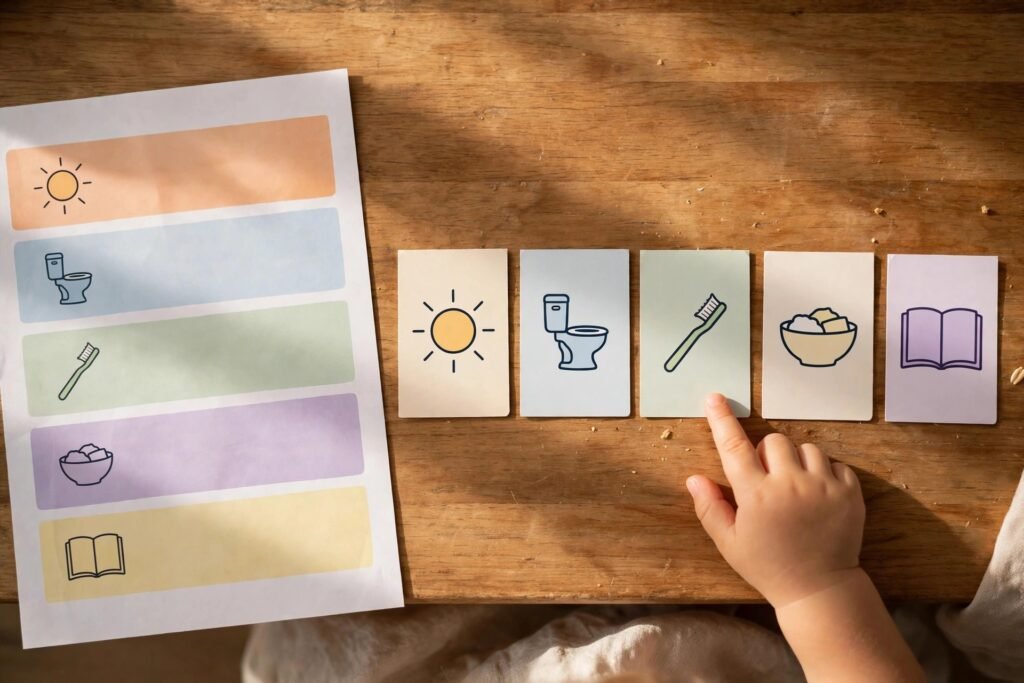
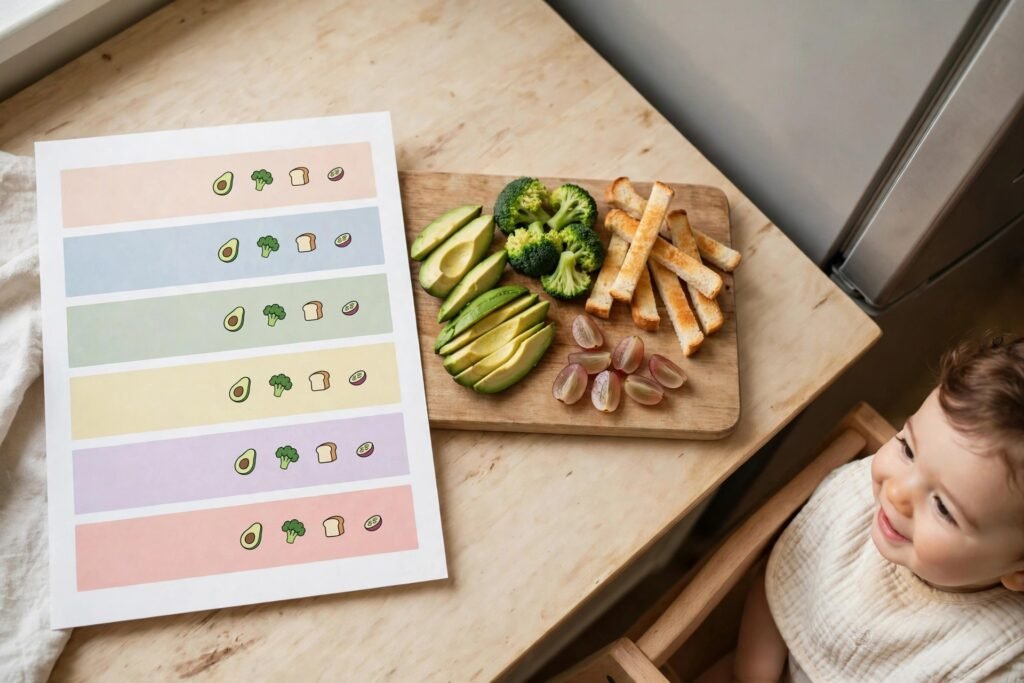
Most “taste-safe” content is one swap away from being safe. These are the four swaps we make, printed on the chart so they survive a screenshot:
- Instead of water beads → large cooked tapioca pearls (about 18 months+, seated, supervised)
- Instead of dry rice → cooked rice
- Instead of flour or cloud dough → crushed cereal “sand”
- Instead of dry beans → big cooked pasta shapes
What we left out, and why
This section is the point of this guide. Two of the most popular fillers in the taste-safe niche are excluded here on the safety authorities’ own wording, and we’d rather show our work than quietly skip them.
Water beads are out, at every age, not just for babies. The US Consumer Product Safety Commission (CPSC) warns that swallowed water beads keep growing inside the body, where they can cause vomiting, dehydration, intestinal blockage and life-threatening injury, sometimes needing surgery to remove. CPSC reports nearly 7,000 water bead ingestion injuries treated in US emergency departments from 2018 through 2022, and a 10-month-old girl died in 2023. A mandatory federal safety standard took effect on March 12, 2026, and its required warning label reads, in part, “Children have DIED when the beads blocked their intestines.” The AAP also notes beads may not show up on X-rays. Bead-filled squishy toys were still being recalled in October 2026. Some guides band water beads as “ages 3+, supervised”, we don’t adopt any age at which they become a recommendation here, which is why the tapioca swap above exists.
Raw flour and raw dough are out, including homemade play dough and “cloud dough.” The FDA states it plainly: flour is a raw food that can carry Salmonella and E. coli, processing doesn’t kill those germs, and cooking is the only way to be sure. Its instruction to parents is direct, do not let children use raw dough for crafts or play clay. The CDC’s raw dough guidance says the same, explicitly including homemade play dough. The exposure route is ordinary play: children put their hands in their mouths after handling it. And the popular fix doesn’t work: the FDA says do not try to heat-treat flour at home, because home treatments may not kill all the bacteria. (Commercial edible doughs are made with industrially heat-treated flour, a factory process, not a kitchen step.) Cloud dough is flour plus oil; the hazard is microbial, not chemical, so “nothing toxic in it” misses the point.
Also left out for under-3s: dry beans, uncooked rice, kinetic sand and pom-poms, hard, non-dissolving and choking-sized, the opposite of what a mouthing child needs. They can have their turn after 3, supervised, once mouthing is genuinely over; they don’t belong under a taste-safe heading. And glow-stick liquid or tonic-water “glow” bins are chemicals dressed as sensory play, not food, not here.
The rules that don’t bend
Three rules sit underneath every idea here:
- Stay and watch. Every idea above assumes an adult right there, for water play above all. Taste-safe describes what happens if something gets mouthed; it is not a supervision substitute.
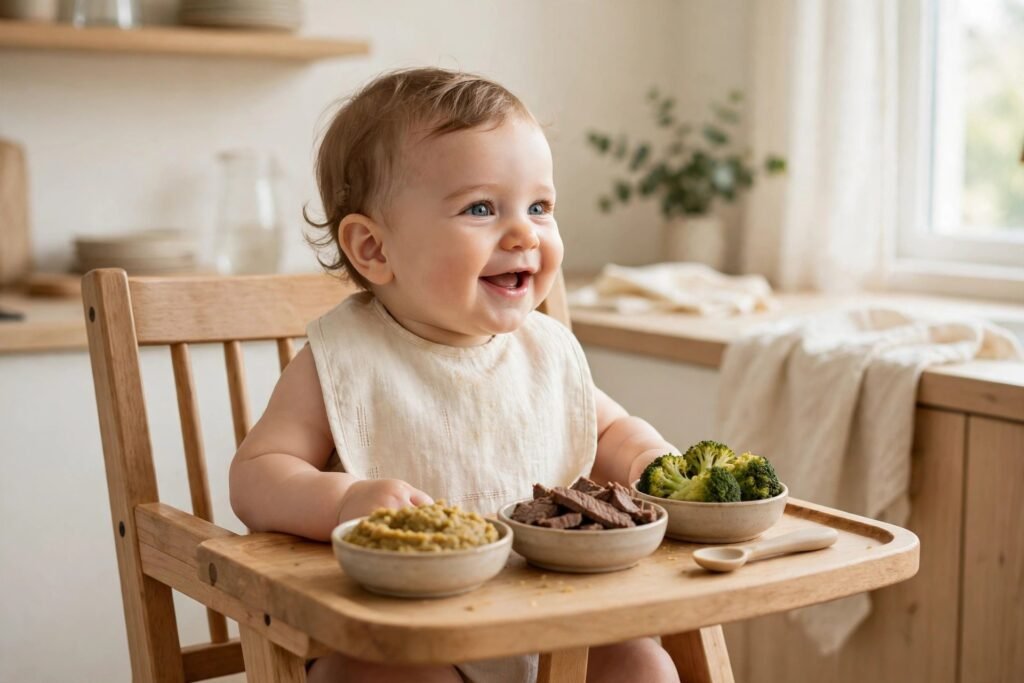
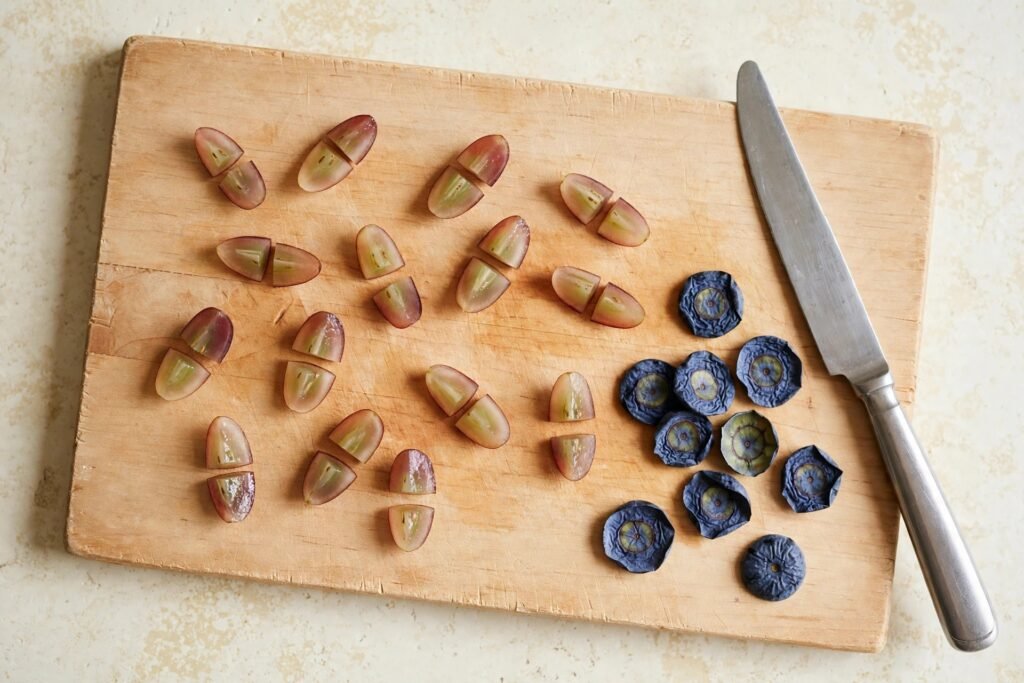
- Prep play food like plate food. The CDC’s rules travel with the food: round foods such as grapes, berries and tomatoes cut into small pieces, hard foods cooked until they mash with a fork, seeds and hard pits removed, small portions, and an adult watching while a child eats, in a bin or at a table.
- End it when it stops being play. Bins have a natural life of ten to thirty minutes. A tired, hungry or frustrated toddler plus a tray of oatmeal is a bath appointment, not a learning outcome.
On wet-weather weeks, these bands pair well with movement play, our guide to indoor swing sets for toddlers covers the big-energy end of the day. But most days, the sensory play ideas that actually happen are the simplest ones: a tray, some cooked spaghetti, and a baby doing serious science.
Sources
- American Academy of Pediatrics (HealthyChildren.org), “The Power of Play: How Fun and Games Help Children Thrive”
- Yogman et al., “The Power of Play: A Pediatric Role in Enhancing Development in Young Children”, Pediatrics (AAP Clinical Report, 2018)
- CDC, “Milestones by 6 Months” (mouthing as a cognitive milestone)
- CDC, “When, What, and How to Introduce Solid Foods” (food preparation and choking-safety rules)
- Zero to Three, “The Power of Play”
- US Food and Drug Administration, “Handling Flour Safely: What You Need to Know” and “Flour Is a Raw Food and Other Safety Facts”
- CDC, “Raw Flour and Dough”
- US Consumer Product Safety Commission, “Safety Standard for Toys: Requirements for Water Beads” (final rule), Water Bead Toys Business Guidance (effective March 12, 2026), and the October 1, 2026 ABC Trading squishy toy recall