It’s 3am. The baby who was sleeping in long stretches last week has been up three times since midnight, and you’re standing in the dark running the same loop: is this a sleep regression or teething? Your mom says teeth. A friend swears it’s a regression. The internet says both.
Here’s what nobody tells you at a reasonable hour: there aren’t two possible answers. There are three. Some rough patches are a sleep pattern changing and nothing more. Some are a tooth, on a timetable research has actually measured. And some aren’t either, they’re the early shape of an illness, and the right move is to stop sorting and call the pediatrician.
Medical disclaimer: This article is general information for parents and is not medical advice. Guidance on feeding, health and development can depend on your baby’s individual needs. If you have concerns about your child, please speak to your pediatrician or another qualified health professional.
Table of Contents
Sleep regression or teething: the 3am three-way check
Save this table to your phone: the whole check in one screen, readable on no sleep:
| Sleep-only pattern | Teething | Call the pediatrician | |
|---|---|---|---|
| At night | Wakes more often, takes longer to settle, naps shrink too | A few rougher nights, worst as a tooth breaks through | Any waking plus the red flags below |
| In the daytime | Feeds, diapers, temperature and mood stay broadly normal | Grizzly in the day too, sore gums don’t clock off at bedtime | Refusing feeds, far fewer wet diapers, unusually sleepy or hard to wake |
| Mouth clues | Nothing new | Gum sore, red or swollen in one spot; heavy drooling; constant gnawing; one flushed cheek | None |
| Temperature | Normal | Normal, or slightly raised but under 100.4 °F (38 °C) | 100.4 °F (38 °C) or higher, see the age bands below |
| How long | Often a week or two, sometimes longer | Symptoms cluster in an 8-day window around each tooth | Don’t wait it out, call today |
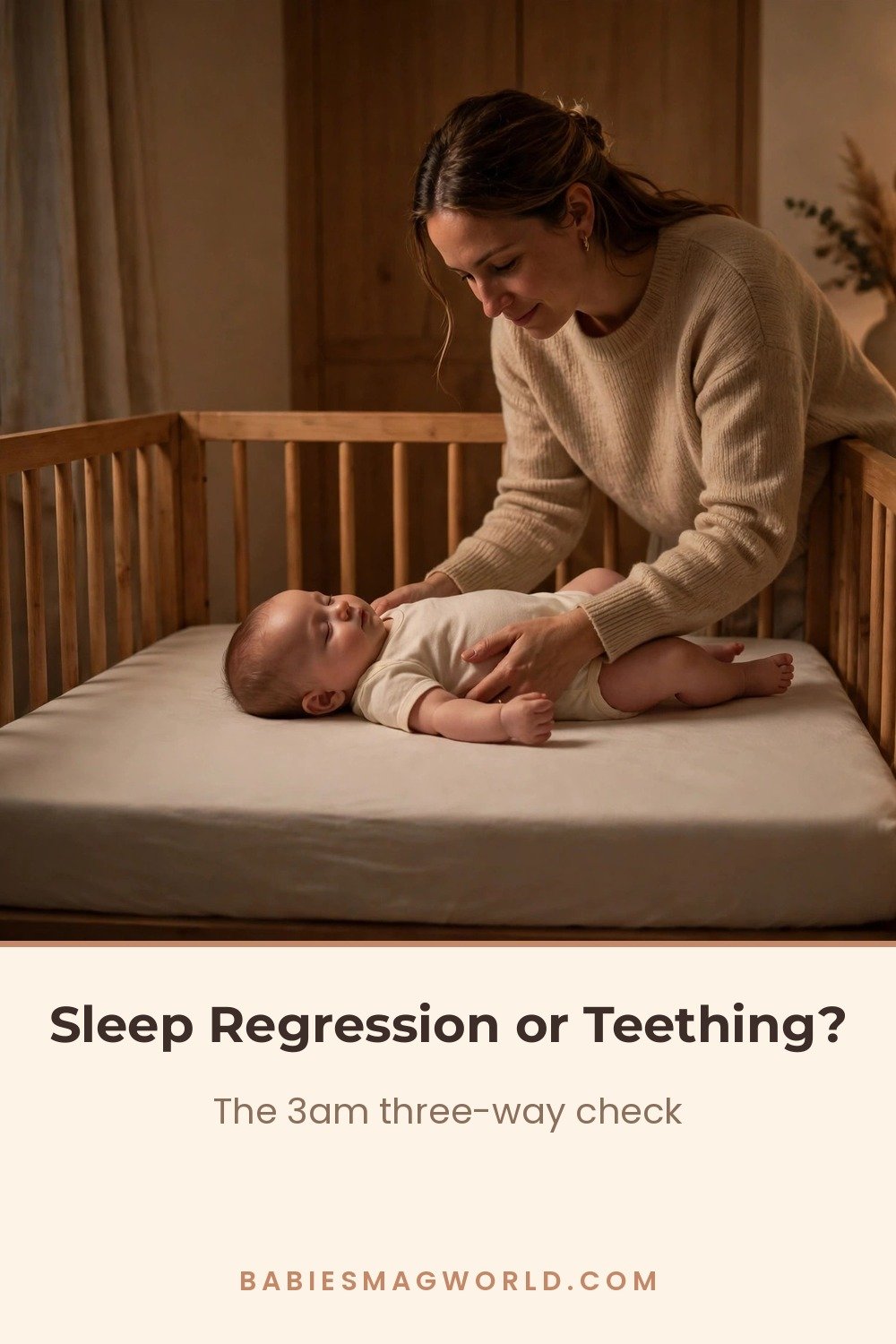
Sort 1: a sleep-only pattern
This is the pattern behind most “regressions”: suddenly waking more often, more fussiness, shorter or harder naps, and longer, tearier bedtimes, Cleveland Clinic’s exact cluster. What matters is what doesn’t change: feeding, diapers, temperature, daytime mood. When the question has a boring answer, it’s usually this one.
The one age where there’s a real mechanism underneath is around 3 to 4 months. Early on, babies spend more of the night in deep sleep. As they grow, sleep starts cycling between light and deep phases, like adult sleep, and in the light phases, babies surface and sometimes wake fully. This isn’t a step backwards that heals. The new pattern is permanent maturation. What improves is your baby learning to drift back off between cycles.
Later rough patches have ingredients: a new skill practiced at 2am (rolling, sitting, standing), separation anxiety, a nap transition. Cleveland Clinic puts the typical disruption at a week or two; other sources give longer ranges, anyone promising an exact end date is guessing.
What helps tonight is unglamorous: same bedtime routine, baby down drowsy but awake, daytime feeds, new skills practiced on the floor in daylight, room calm and dark. Keep every sleep safe while you ride it out: back to sleep, firm flat surface, bare crib in your room, no weighted sacks or positioners, no bed or couch sharing. Exhausted improvisation is where safe sleep slips.
An honest word about “sleep regression.” It’s the phrase parents and sleep consultants use, not a formal AAP or CDC diagnosis. The famous calendar (4 months, then 6, then 8 to 10, then 12, then 18) is mostly folklore. Parents do report rough patches at those ages, but Cleveland Clinic notes research hasn’t shown clockwork regressions at a specific age, and Huckleberry, a sleep app with every reason to sell the calendar, says there’s no reliable scientific evidence for it. Only the 3 to 4 month sleep-cycle change has clear biology behind it. The rest are patterns, not appointments, which is why this site treats baby sleep by month cautiously: the month is a clue, never the answer.
Sort 2: teething, inside its 8-day window
Teething gives you daytime evidence, sore gums don’t only hurt at night. The signs of teething the NHS and the AAP recognize are local and visible: a gum that’s sore, red or swollen over the coming tooth, much more drooling than usual, constant gnawing and chewing, one flushed cheek, a facial rash, ear-rubbing, a bit less interest in solid food, and being more fretful than usual. HealthyChildren.org adds: many babies get teeth with no trouble at all. Teething is the answer only when the daytime evidence lines up.
The strongest fact here is about timing. In a Pediatrics study (Macknin, 2000), parents recorded symptoms and eruptions daily for months. Symptoms were significantly more common only in an 8-day window around each tooth: the 4 days before it emerged, the day of, and the 3 days after. Teething can explain a few rough nights. It can’t explain three weeks of them. If broken sleep drags on after a tooth appears, something else is at work.
Two traps here. First, the 3-month-old who drools and chews everything is usually not teething: around 3 months, mouthing, extra saliva and hands constantly in the mouth are normal development, says HealthyChildren.org, also why babies chew on their hands at that age. Second, ear-rubbing sits on both lists: it’s a recognized teething sign, but with a fever or real distress it can be an ear infection, a Sort 3 problem. And the only sure sign of teething is the tooth itself: a white nub or swollen ridge you can feel. Everything else is circumstantial, including habits like your baby sucking on their bottom lip, which has causes of its own.
What teething does not do (NHS, AAP, and that Pediatrics research): cause a true fever, diarrhea, vomiting, a cough or runny nose, a body rash, hours of inconsolable crying, or a baby refusing milk feeds. If you’re seeing those, skip to Sort 3.
How to help a teething baby sleep tonight
Start with what every authority endorses: rub the sore gum with a clean finger. Pressure helps. Offer something cold and safe to chew: a solid teething ring chilled in the refrigerator (never frozen solid, not liquid-filled), or a clean, chilled damp washcloth. Keep it awake-and-supervised; nothing goes into the crib for the night, and nothing gets tied around your baby’s neck. Comfort is allowed, too: rocking a baby in pain back to sleep for a few nights won’t undo their sleep skills. And don’t start sleep training tonight, Huckleberry advises against it during teething or illness discomfort.
Pain relief rules differ by country, so they’re labeled here, not blended. In the US, the AAP says you can talk to your pediatrician about acetaminophen (Tylenol) for an occasional rough night. The dose is weight-based, get it from your pediatrician or pharmacist; you won’t find one here. Ibuprofen (Advil, Motrin) is for babies over 6 months in US guidance. In the UK, the NHS says paracetamol (the same drug as acetaminophen) or ibuprofen can be given for teething symptoms from 3 months, following the packet or your pharmacist’s advice; children under 16 should never have aspirin.
And the do-not-use list: the FDA warns that benzocaine teething gels can cause methemoglobinemia, a serious and sometimes fatal blood condition, and that prescription lidocaine gel can cause seizures and heart problems. The AAP’s do-not-use list names benzocaine gels outright. Homeopathic teething tablets and gels are on the same list: some have been found to contain belladonna. Amber teething necklaces have no research behind them and carry strangulation and choking risks; the AAP recommends babies wear no jewelry at all. The UK’s NHS position on gels differs in law, not enthusiasm: no good evidence gels work, non-medical options come first, and any gel used should be a child-specific pharmacy one, never a US benzocaine gel.
Sort 3: stop sorting and call the pediatrician
This sort outranks the other two. Cleveland Clinic’s sleep specialist puts it bluntly: don’t just assume a sleep problem is a regression, it can be illness. Blaming teething for a fever is a known trap, too: Seattle Children’s warns it can delay care for ear infections, urinary infections and meningitis. Some of these questions stop being a sorting exercise; this is that line.
Call the same day for any of these. Temperature first, check with a thermometer, not a hand on the forehead, and use 100.4 °F (38 °C) as the fever line, per the AAP’s fever guidance:
- 3 months or younger: 100.4 °F (38 °C) or higher, call immediately, even if your baby otherwise seems fine.
- 3 to 6 months: 101 °F (38.3 °C) or higher, notify the doctor.
- Over 6 months: 103 °F (39.4 °C) or higher, notify the doctor.
- Any age: a fever that keeps rising above 104 °F (40 °C); a fever lasting more than 24 hours in a child under 2, or more than 3 days in a child 2 or older.
Fever isn’t the whole box. Also call for: trouble breathing, or fast, labored or noisy breathing; clearly fewer wet diapers than usual; refusing feeds or vomiting most feeds; unusual sleepiness or a baby who is hard to wake; inconsolable crying for hours; or a baby who looks very ill, has a stiff neck, an unexplained rash, or repeated vomiting or diarrhea alongside fever. If your baby is limp or unresponsive, struggling to breathe, or turning blue or gray, that’s not a phone call to the office, that’s 911.
Still not sure? Log three nights
If nothing above fits cleanly, don’t rely on 3am impressions, at the pediatrician’s office, “she’s been sleeping terribly” is hard to work with, and three nights of notes aren’t. Jot down bedtime, each waking and its length, feeds, temperature if taken, wet and dirty diapers, and anything new (a skill, a swollen gum, a first tooth). Patterns show up fast on paper: normal temperature, normal feeding and a visible tooth on day two point one way; a creeping temperature points firmly to Sort 3. Three nights of notes turn “sleep regression or teething?” from a guess into evidence.
It can also genuinely be both at the same time. Teething and developmental sleep disruption love to arrive together, around 3 to 4 months, and again at 7 to 10 months, and teething can deepen a rough patch without being the whole story. Sorting isn’t about picking a team: it’s about which lever to pull tonight. Protect the routine, soothe the gum, or pick up the phone.
The nights feel endless because you’re in them. They’re a phase your baby’s brain and mouth are both busy outgrowing, and the responsiveness you’re showing at 3am is part of building strong bonds with your baby, work they’ll never remember and always benefit from. Make the call your gut points to, and take whatever sleep is left. And when the next 3am loop starts (sleep regression or teething?), you have the check.