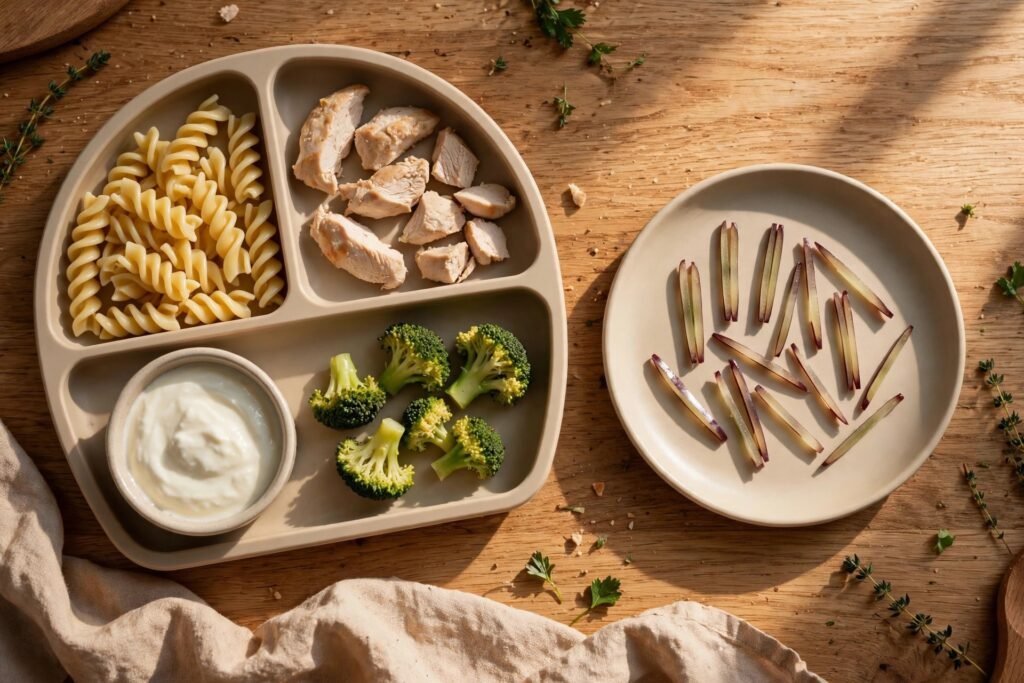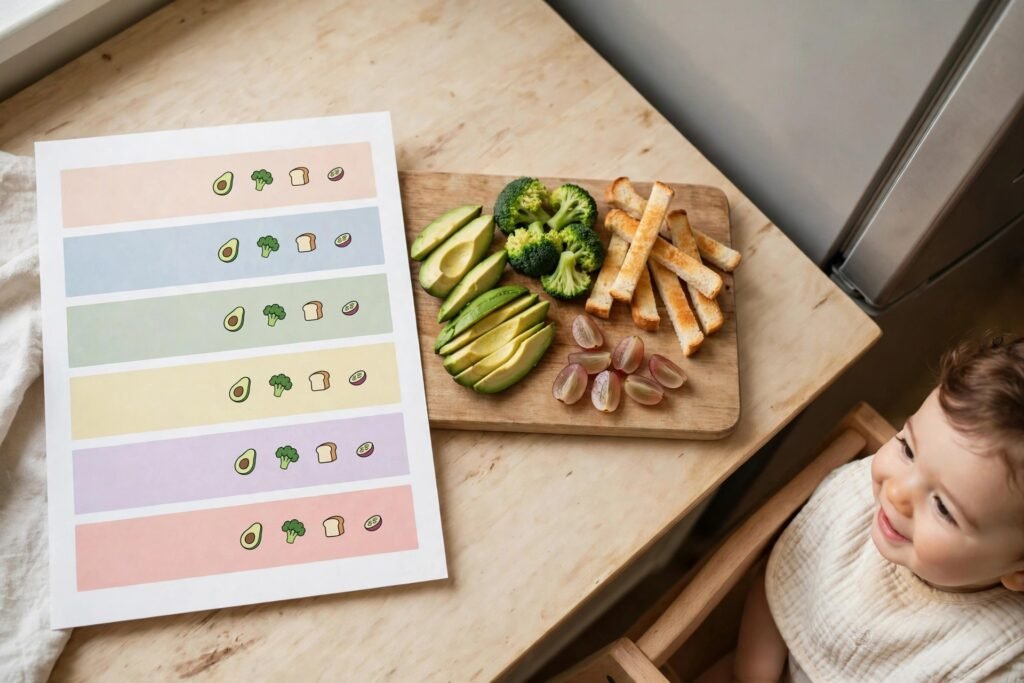
Most parents are already cutting grapes. They’re just cutting them the wrong way.
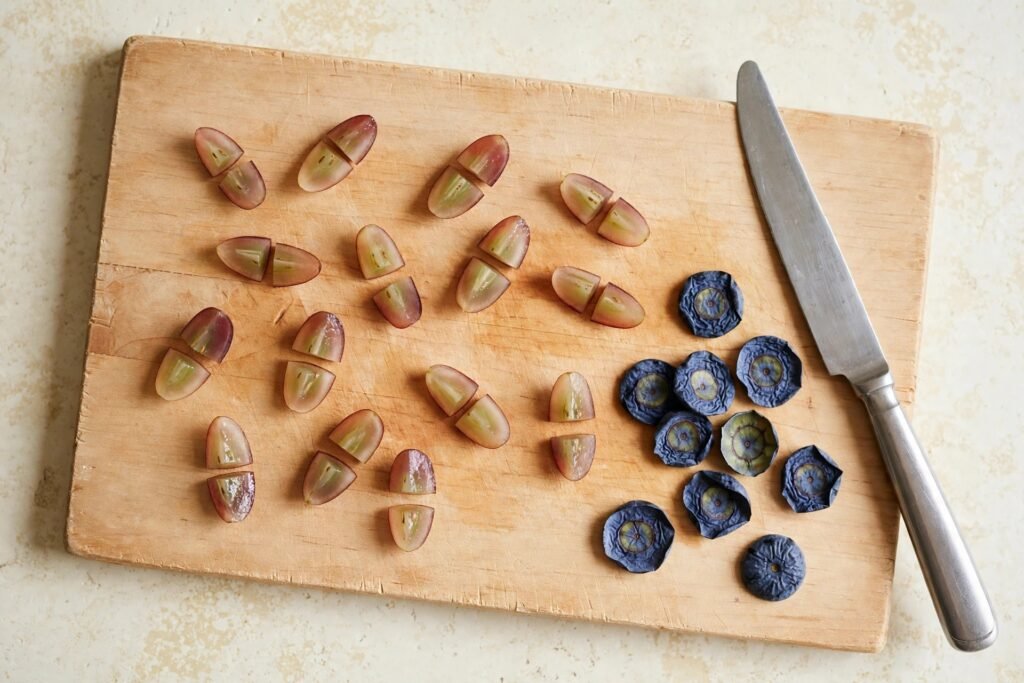
Halved across the middle (the cut almost everyone does), a grape becomes two smaller round pieces. Still round. Still firm. Still roughly the size and shape of a young child’s airway. The cut that changes the risk is the less obvious one: lengthwise, stem to bottom, into quarters, so no piece keeps that plug shape. Orientation matters more than effort.
Medical disclaimer: This article is general information for parents and is not medical advice. Guidance on feeding, health and development can depend on your baby’s individual needs. If you have concerns about your child, please speak to your pediatrician or another qualified health professional.
Table of Contents
The honest line, before the chart
Cutting food this way reduces the risk of choking. It does not make any food “safe,” and no source we rely on promises otherwise. The CDC’s own wording: cutting and mashing “can help prevent choking”, help, not guarantee. Everything below is written with that limit in mind.
The age frame comes from the American Academy of Pediatrics (AAP): modify high-risk foods until 4 years of age or older, depending on each child’s development and maturity level. Two things hide in that sentence. First, the qualifier: development, not just birthdays. Second, turning four is not a switch: a four-year-old who stuffs handfuls, eats on the move and doesn’t chew well may not be ready for whole grapes yet. And if you keep cutting for a five-year-old, that’s a legitimate choice (yours, not a guideline).
Children with developmental delay, reflux or swallowing difficulties, a premature birth history, or a previous choking incident need their pediatrician’s advice, not a general chart.
The shape guide by age
Save this chart, screenshot it, hand it to grandparents and daycare. Every age is labeled with its source, because the authorities do not all say the same number.
| Food | From around 6 months (modified only) | Ages 1–4: keep modifying | From 4 or older |
|---|---|---|---|
| Grapes | Quartered lengthwise (stem to bottom), pieces no larger than ½ inch (AAP). Just starting solids? Cooked until soft or mashed is gentler (feeding-expert guidance) | Keep quartering lengthwise. Halves, either orientation, are not any authority’s standard | Whole only when sitting, supervised, chewing maturely, judge by the child (AAP) |
| Blueberries | Smash or flatten into a disc (feeding-expert method); or cook into food until they burst | Keep flattening into discs; quarter the very large ones lengthwise. Don’t rely on halving, half a berry is still round | Same judgment as grapes; keep flattening the biggest berries if unsure |
| Cherry & grape tomatoes | Quartered: the NHS says cut small round foods “into quarters (4 small pieces)” | Keep quartering lengthwise | Whole when chewing is mature and meals are seated, supervised |
| Cherries | Stone removed first (NHS: remove hard pips and stones), then quartered lengthwise like grapes | Keep quartering lengthwise | Always remove the stone first. Then halved or whole once chewing is mature and meals are seated and supervised |
| Hot dogs & sausages | Never round coins. Cut lengthwise first, then into pieces no larger than ½ inch (AAP) | Keep cutting lengthwise into small pieces, the round cross-section is the hazard | Still slice lengthwise for younger school-age children if pieces would be coin-shaped |
| Whole nuts | Never whole. Ground or crushed nuts, and nut butter spread thinly, are fine from weaning (NHS) | Still never whole, AAP: modify until 4 or older; NHS: under 5 | Follow the stricter line: no whole nuts under 5 (NHS) |
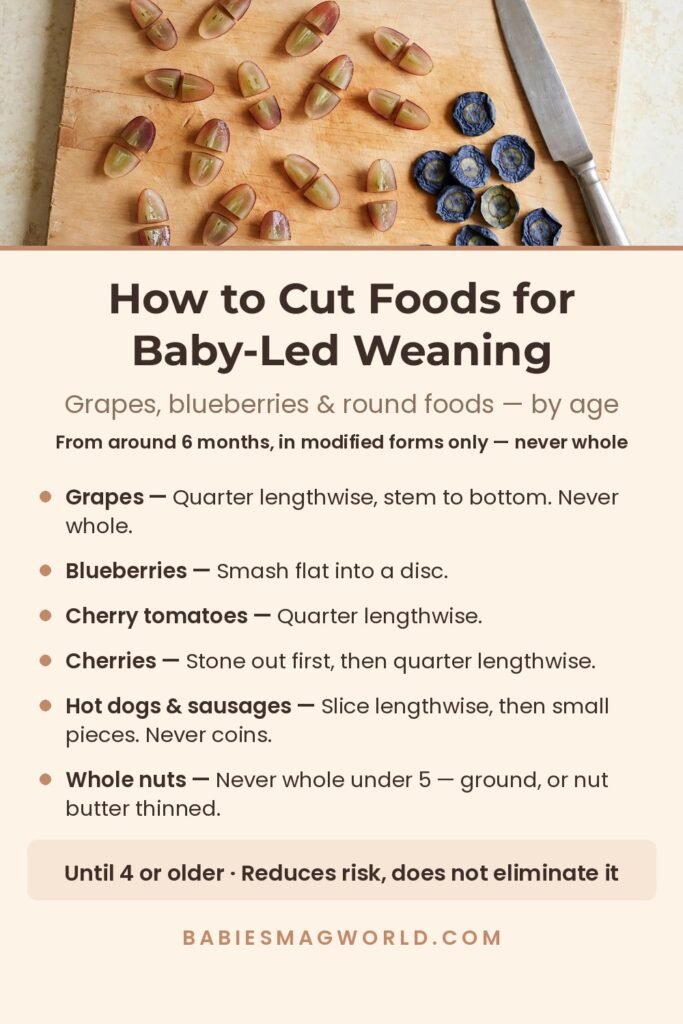
Round foods can be introduced from around 6 months, in the modified forms above, never whole. The CDC lists uncut grapes, berries, cherries, melon balls and cherry or grape tomatoes among the foods to avoid. Still at the timing stage? Our guide to when infants can eat baby food after 6 months covers readiness first.
Why shape matters: the AAP explains that young children who don’t grind or chew food well may try to swallow it whole, and young children are still learning to grind and chew food properly. A round, firm piece can block the airway completely. A lengthwise quarter is narrower and less likely to form the same plug, and the AAP’s half-inch limit keeps pieces small. Less likely is not impossible, which is why the setting and supervision below still matter.
Why ‘just halve them’ isn’t enough
Search this topic and you’ll find confident progressions: halved grapes from 12 months, from 18 months, from age 2. Those schedules come from feeding websites, not the AAP, CDC or NHS, and they disagree with each other by a full year, which tells you something. What AAP parent guidance actually says: round, firm foods such as hot dogs or grapes “can be served if completely chopped into tiny pieces,” cut no larger than one-half inch, modified until 4 or older.
Our line is the conservative one, held on purpose: quarter lengthwise, or smash flat, until 4 or older, then judge by your child. If you remember one line, make it that one.
Two honest complications. First, mouth-stuffing: some toddlers respond to tiny pieces by grabbing three at once. The answer isn’t bigger pieces; it’s fewer pieces on the tray at a time, topped up as they eat, with you right there. Second, the “he’s had whole blueberries loads of times and he’s fine” argument: seeming fine last time tells you about last time, choking doesn’t send a warning first. Safe cutting includes how many pieces are on the tray, not just their shape.
Blueberries: the one everyone forgets
Ask a group of parents and you’ll hear it: grapes get cut religiously, blueberries get served whole without a thought, “I never cut blueberries. Is that a thing?” Grapes get the questions; blueberries are the sibling nobody asks about.
It is. The CDC’s avoid list says berries, uncut, not just grapes. The method differs, though: halving a small round berry still leaves a rounded piece, so feeding experts advise smashing or flattening each blueberry into a disc with your thumb or the back of a spoon, a flat disc is much less likely to plug an airway the way a sphere can. Cooking them into oatmeal or yogurt until they burst works too. One popular feeding site suggests many toddlers are ready for whole blueberries after the first birthday, while acknowledging on the same page that advisory bodies consider them a hazard until age four. We follow the advisory bodies: keep flattening until 4 or older.
The setting matters as much as the knife
The best-cut grape in the world is still a risk in a moving car. The CDC and AAP prevention lists are nearly identical: posture and attention:
- Sit up, in a high chair or at the table, for every meal and snack. Never let a child run, walk, play or lie down with food in their mouth.
- Watch them the whole time they eat, within reach, not from the next room.
- No eating in the car or stroller, a child who chokes in a rear-facing seat can’t be seen or reached.
- Brief the other adults. Grandparents, babysitters and daycare need the actual instruction, “grapes quartered lengthwise until she’s at least four, blueberries squished flat”, not “cut up her fruit.” Warn siblings too: the AAP flags older children giving dangerous foods to a younger child as a real pattern.
Gagging is not choking, and the difference is sound
Early on, expect gagging: noisy, eyes watering, tongue pushing forward, retching as food comes back up, a working protective reflex.
Choking looks and sounds different. The AAP’s warning signs: they can’t breathe, are gasping or wheezing, can’t talk, cry or make noise, turn a bluish color, grab at their throat or wave their arms in panic, or go limp. Silence is the red flag, not noise. Our baby gagging vs choking guide walks through the two side by side, read it before you need it, and if in doubt, treat it as choking and act.
If a child chokes: the first-aid box
Call 911 first, or send someone else to call while you start. Alone with a phone? Put it on speaker.
If they can cough or cry effectively: encourage them to keep coughing, stay, and watch closely. Don’t start back blows while the cough is working, and don’t leave them alone, it can change fast (American Red Cross).
Baby under 1 year: 5 back blows, then 5 chest thrusts, repeated:
- Lay your baby face-down along your forearm, thigh supporting, head lower than the body.
- Give 5 firm back blows with the heel of your hand, between the shoulder blades.
- Turn your baby face-up, head still lower than the body.
- Give 5 quick chest thrusts: in the center of the chest, just below the nipple line, about 1½ inches deep.
- Keep alternating 5 and 5 until the object clears, your baby can cough or cry, or they become unresponsive.
Child over 1 year: 5 back blows, then 5 abdominal thrusts, repeated:
- Support your child leaning forward; give 5 back blows between the shoulder blades with the heel of your hand.
- Stand or kneel behind them. Clenched fist between the navel and the ribs, grasped with your other hand, pull sharply inward and upward, up to 5 times.
- Keep alternating 5 and 5 until the object clears or they become unresponsive.
Never use abdominal thrusts on a baby under 1, infants get chest thrusts instead. Never do a blind finger sweep: remove an object only if you can clearly see it (the American Red Cross: never sweep unless you actually see the object).
If they become unresponsive: lower them to a firm, flat surface and begin CPR, starting with compressions, according to your training.
Even if the object comes out, get medical help, part of it may have been left behind, or your child may have been hurt by the procedure (NHS).
This box is a summary of American Red Cross guidance, not complete first-aid instruction. The American Heart Association and AAP updated infant choking and CPR guidance in October 2025, including hand position for chest thrusts, so learn the current technique in a class. This box is not a substitute for certified training. The AAP’s advice: take a certified CPR and first aid course (Red Cross and American Heart Association classes cover infants and children).
Where the authorities disagree, out in the open
Most articles pick one number and present it as settled. It isn’t. So, labeled: the AAP says modify high-risk foods until 4 years or older, depending on development; the NHS says no whole nuts under 5 (this chart follows the stricter NHS line for nuts, the AAP frame otherwise). The AAP gives a size, no larger than one-half inch, while the NHS gives a count, into quarters; different metrics, cited separately. And a credit correction: blogs often claim “the CDC says quarter grapes lengthwise until 4.” The CDC’s choking hazards page, read in full for this article, gives no age and no lengthwise instruction; that wording comes from AAP policy summaries and NHS-linked guidance. Where they agree is the core of this guide: lengthwise, into quarters, until at least 4.
Guidance checked against the AAP, CDC, NHS and American Red Cross pages cited here on October 30, 2026.