
Finding the best changing pads for babies starts with an unglamorous truth: a changing pad looks like the simplest purchase in the nursery, a rectangle of foam. In practice, the ten products in this guide are four different kinds of thing sold under one name: contoured foam pads that live on a dresser, solid wipe-clean changers that need no cover at all, folding clutches for changes away from home, and thin liners that are not pads at all but a washable layer over one. Comparing them as if they were interchangeable is how a pad ends up two inches too wide for the changing tray, or with a cover in the wash at 3 a.m.
So this guide is grouped by type. Within each group, pads are described by what can be checked: verified dimensions, what they are made of, how the baby is strapped in, how the pad itself is anchored to the furniture, and how it is cleaned. One thing comes before all of that, though, because it matters more than any feature list: changing happens at height, and falls are the real risk in this category. Read the safety section first.
Disclosure: This guide contains affiliate links. If you buy through a link on this page, Babies Mag World may earn a small commission at no extra cost to you. See our Affiliate Disclosure for details.
How products were chosen: Every product below was selected from its manufacturer’s published specifications, dimensions, materials, stated weight limits and documented safety-standard compliance, not from advertising claims. Each model was checked against the CPSC recall database and SaferProducts.gov on October 30, 2026; no recall was found for any product listed here, and the selection box will be updated if that changes. Products are described by what they are, never by promised hygiene or safety outcomes. You can read more about how we research and select products.
Table of Contents
Safety first: falls are the risk that matters
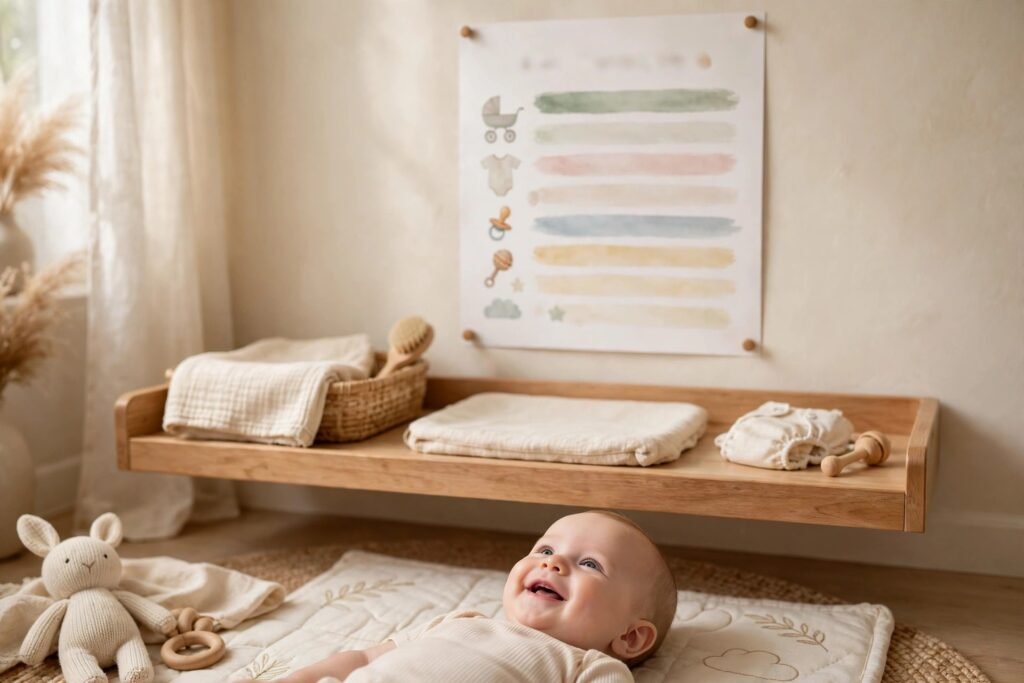
A changing pad sits on a dresser or table, roughly waist-high to you and a long way up for a baby who has just learned to roll. The American Academy of Pediatrics (AAP), in its changing table safety guidance, is blunt about the hierarchy of precautions, and it is worth following in order:
- Never leave your baby unattended on a raised changing surface, not for a moment, and not even if they are strapped in. If you have to step away, take the baby with you or put them somewhere safe, like the crib or floor.
- Keep one hand on your baby throughout the change. KidsHealth’s changing-table guidance gives the same rule: the hand is the primary safety device; everything else is backup.
- Buckle the safety strap every time, but do not depend on it alone. The AAP makes both halves of that point: use the strap, and never treat it as a substitute for staying there.
- Anchor the pad to the furniture. Contoured pads come with a security strap or screws for exactly this. A non-skid base helps, but it is a supplement to anchoring, not a replacement for it, a pad that slides is a pad that can go over the edge with the baby on it.
- Set up before you start. Keep diapers, wipes and cream within your reach but out of your baby’s reach, so you never have to turn away or leave mid-change to fetch something.
- Respect the stated limit. In the US, baby changing products, including contoured pads sold for use on furniture, must comply with ASTM F2388, the standard the CPSC made mandatory under 16 CFR part 1235. The standard covers children up to 30 lb, and KidsHealth notes the typical stopping point is the manufacturer’s limit, usually around age 2 or 30 lb. When your child reaches it, move changes to a floor-level surface.
Two type-specific warnings follow from this. First, check what actually holds the pad itself in place, because the arrangements below are not all equal: some pads belt the baby but anchor nothing themselves, and one states no anchoring method at all, on a pad like that, its position on the furniture rests on its base and your hand, which is fine if you know that is the deal and risky if you assumed otherwise. Second, portable pads are not all dresser-safe: the SnoofyBee below carries the manufacturer’s own instruction not to use it on a raised surface at all. Its place is the floor, a bed or a changing station at floor level, which is also the honest answer for any wiggly toddler who has outgrown raised changes.
The four types, briefly
Contoured foam or vinyl pads, the nursery default: raised sides, a strap for the baby, a strap or screws for the furniture, a cover to wash. Wipe-clean solid-surface changers skip the cover, you wipe the shell down, but their securing arrangements vary the most in this guide. Portable and clutch pads fold into a bag and are for flat, floor-level surfaces only. Pad liners are a washable layer over a pad you already own, not a pad themselves.
The changing pads at a glance
| Product | Type | Size | Baby strap / pad anchoring | Cleaning |
|---|---|---|---|---|
| Summer by Ingenuity Contoured Changing Pad | Contoured foam/vinyl | 32″ x 16″ | Quick-release belt / security strap to furniture + non-skid base | Wipe clean; included liner is machine washable |
| Naturepedic Organic Contoured Changing Pad | Contoured, coated fabric | 31.5″ x 16.5″ | Safety buckle / snap screws secure pad to dresser | Wipe clean with water or mild soap; covers sold separately |
| LA Baby 4-Sided Waterproof Changing Pad | Contoured foam, quilted cover | 30″ x 16″ | Safety harness, quick-release buckle / security strap + non-skid base | Clean in place with mild soap and water |
| Munchkin Secure Grip Changing Pad | Contoured foam | 31″ x 16″ | Buckle strap / Xtra Grip rubber strips + fabric straps with screws included | Wipe clean |
| Keekaroo Peanut Changer | Wipe-clean solid surface | 32″ x 17″ | Safety harness (mandatory per manual) / hook-and-loop tabs adhere pad to the surface, no screws or furniture strap | Wipe clean; no cover needed |
| Bumbo Changing Pad | Wipe-clean solid foam | 29″ x 19″ | Restraint belt / no furniture anchor | Damp cloth and mild detergent only; never immerse |
| Hatch Grow Smart Changing Pad and Scale | Wipe-clean smart changer | 29″ x 16″ | Wide safety strap / no furniture anchor stated | Wipe clean |
| Skip Hop Pronto Changing Station | Portable clutch | 23.5″ x 21.75″ open; 11.75″ x 8.25″ closed | No belt, flat surfaces only | Spot clean; pad zips off |
| SnoofyBee Clean Hands Changing Pad | Portable clutch with toy barrier | 27″ x 13″ changing surface; folds to 13″ x 7″ | No belt, manufacturer states: do not use on a raised surface | Wipe clean; hand wash when needed |
| Munchkin Waterproof Changing Pad Liners (3 count) | Liner | 22.75″ x 11.5″ each | n/a, sits on top of a pad | Machine washable |
Contoured pads for the dresser top
Summer by Ingenuity Contoured Changing Pad
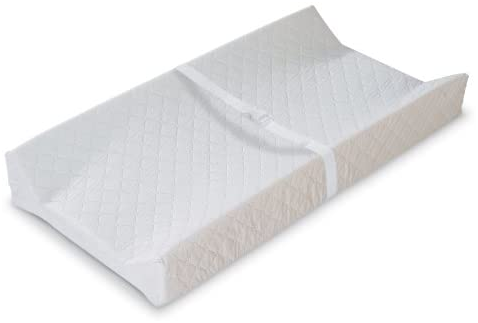
It was formerly sold under the Summer Infant name; the brand now sells it as Summer by Ingenuity (Kids2). It is the standard design done plainly: a foam core under a quilted, double-layer PEVA vinyl surface that the manufacturer describes as waterproof and wipe-clean, raised contoured sides on two sides, and a quick-release safety belt. Underneath there is a non-skid base and a security strap to fix the pad to the changing table or dresser, use the strap; the non-skid base alone is not an anchor. At 32″ x 16″ it fits most standard changing tables and dresser-top trays.
On standards, this is one of the entries where a specific claim can be made and attributed: the manufacturer states the pad is third-party safety tested and meets ASTM F2388, the federal standard for changing products. Care is a damp-cloth wipe for the pad; the current version ships with a waterproof liner that is machine washable, which covers most everyday messes. The honest limitations are built into the design rather than hidden: the contour is two-sided, so the ends are open, and the quilted vinyl surface, while durable, is not removable, so if it is ever punctured or splits, the pad itself is done rather than just a cover.
Naturepedic Organic Contoured Changing Pad
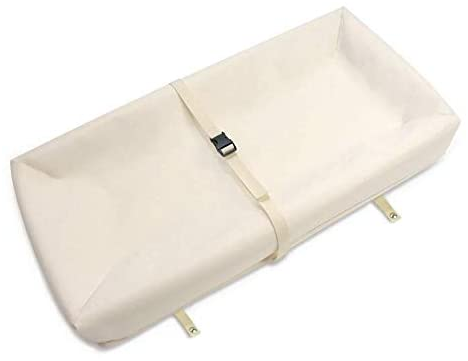
Naturepedic builds this pad for parents who want to know exactly what the foam-and-vinyl default is made of, and to avoid most of it. There is no polyurethane foam and no latex: the support core is the brand’s Air-Core, a network of closed-cell air pockets made from food-grade polyethylene, under an organic cotton fabric with a clear, food-grade polyethylene waterproof coating. The brand states the pad’s organic materials are GOTS-certified and the pad is GREENGUARD Gold certified. It comes in two-sided and four-sided versions at 16.5″ x 31.5″ x 4″.
The securing arrangement is better than average and worth copying as a checklist for any pad: a safety buckle strap for the baby, and snap screws that fix the pad itself to the dresser, so the anchor is hardware rather than friction. Care is a wipe with water or mild soap. Note what the price does and does not include: the pad’s own surface is the waterproof coating, and Naturepedic sells fitted covers separately, most families will want one for warmth and softness, which makes the true cost pad plus cover. This is the premium option in the contoured group, and the premium is for the materials list, stated above, rather than for extra features.
LA Baby 4-Sided Waterproof Changing Pad
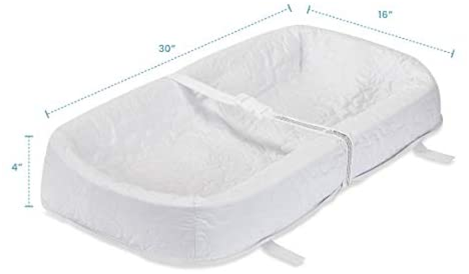
Where most contoured pads raise two sides, this one raises all four, LA Baby calls the shape a cocoon, with walls about 4 inches high around a 30″ x 16″ foam pad. The quilted outer cover is waterproof and cleans in place with mild soap and water. It has the full securing set: a safety harness with a quick-release buckle for the baby, a security strap to hold the pad to the changing table or dresser, and a non-skid bottom. The manufacturer states it is made in the USA.
Two sizing facts decide whether this is the right pad. First, at 30 inches long it is about 2 inches shorter than the common 31 to 32 inch standard: fine for newborns and smaller babies, but a tall toddler in a four-sided cocoon runs out of room sooner than in an open-ended pad. Second, the quilted cover is fixed rather than removable, and a quilted, stitched surface takes a little more wiping after a messy change than a smooth one. Neither fact is a flaw, but both are exactly the kind of thing a feature list will not tell you.
Munchkin Secure Grip Changing Pad
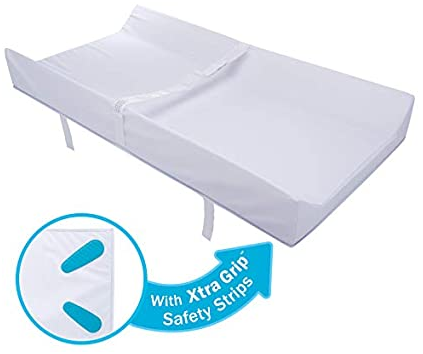
Munchkin’s entry is built around the pad-moving problem. The contoured polyurethane foam cushion has a waterproof, wipe-clean surface; on the underside, Xtra Grip rubber strips resist sliding on the dresser top, and (the part that actually anchors it) a set of fabric straps with screws is included in the box to attach the pad to the dresser or changing table. Use the screws if your furniture allows it; grip strips plus a determined toddler is a contest you do not want to rely on. A buckle safety strap holds the baby, and at 16″ x 31″ the pad fits most standard changing pad covers, dressers and tables.
One note on standards: Munchkin’s product information does not name a specific safety standard for this pad, so this guide does not claim one. What can be said factually is the securing hardware above, which, for this category, is the part that does the work.
Wipe-clean changers: no cover, no laundry
Keekaroo Peanut Changer
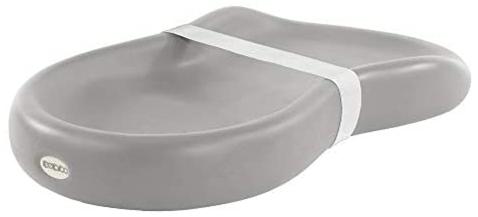
The Peanut is a different construction from everything in the contoured group: a solid Dura-Soft polyurethane shell over a foam core, molded in a peanut shape with raised sides. The manufacturer states the shell is impermeable to fluids, which is the checkable version of this product’s famous claim: nothing soaks into the pad, so there is no cover to remove and nothing to launder, you wipe the surface clean and you are done. The brand states the material is latex-, PVC-, BPA- and phthalate-free, that the changer is made in the USA, and that it is JPMA 2.0 certified (certification by the Baby Safety Alliance, formerly JPMA, meaning sample units were tested by an independent laboratory). It measures 32″ x 17″ x 4″ and the manufacturer rates it for children up to 30 lb.
Now the securing arrangement, stated plainly because it decides how this pad is used: the current Peanut ships with a safety harness, and Keekaroo’s user manual is blunt about it, never use the changer without the harness fastened, and listen for the buckle’s click. The pad itself secures to the tabletop with adhesive hook-and-loop tabs that hold it to the support surface, and the manual says to always engage them; what it does not have is screws or a strap that wraps around the furniture. So the real trade-offs are the adhesive patch, Keekaroo warns it may mar or discolor some surfaces, and the absence of mechanical fixings you can unbolt and move. The pad still weighs about 7 pounds, but that is a fact about lifting it, not the method that holds it in place.
Bumbo Changing Pad
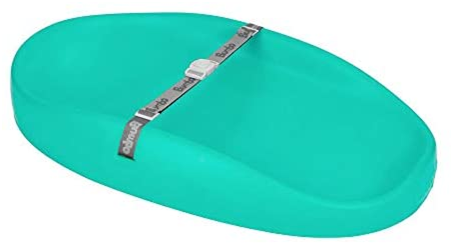
Bumbo’s pad is a single molded piece of soft polyurethane foam, ergonomically contoured with raised sidewalls and an indentation where the baby’s head rests, and it comes with a restraint belt. It is light (about 3.15 lb) and needs no cover. The manufacturer is unusually specific about the setup, and the specifics are the entry: the pad must sit on a level, stable, structurally sound surface at least 19″ x 29″, and the maximum weight is 30 lb (the brand’s guidance is birth to about 18 months).
Two limitations follow from the material and the dimensions. The foam is open-celled, and the manufacturer warns that it absorbs water like a sponge if over-wetted: clean it with a damp cloth and mild detergent only, and never immerse it. So “wipe-clean” here means a light wipe, not a rinse under the faucet. And at 19 inches wide, this pad is about 3 inches wider than the standard 16-inch nursery pad, it will not sit inside many changing trays and toppers, so measure your furniture before you buy. It also has no anchoring strap for the furniture itself; the belt is for the baby only.
A note worth adding because the name confuses people: the widely reported CPSC recall involving Bumbo covers the Bumbo Floor Seat, a different product. This changing pad was checked against the CPSC database for this guide (October 30, 2026) and no recall was found for it.
Hatch Grow Smart Changing Pad and Scale
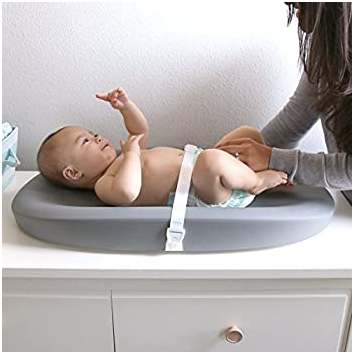
The Grow is a changing pad with a built-in wireless scale: a wipeable foam top over a rigid base (29.1″ x 16.2″ x 3.9″, about 7 lb) that weighs your baby during the change and syncs to the free Hatch Baby app. Hatch states the scale calculates weight changes to the nearest 0.25 ounce, which is the feature aimed at feeding: weigh before and after a feed and the app logs the difference, alongside weights, diaper changes and growth charts that Hatch says can be compared with WHO percentile data. It runs on 3 AAA batteries and has a wide safety strap for the baby.
The framing matters more than the features. A home scale tells you what your baby weighs between appointments; it does not assess whether they are growing well, and weight tracking at home does not replace pediatrician growth checks, where weight is read alongside length, head circumference and the baby in front of the doctor. If feeding or weight is worrying you, that is a conversation for your pediatrician, with or without a chart from an app. Buy this because the automatic logging genuinely suits you, not because more data is automatically more reassurance.
Practical notes: weighing requires the app, so a dead phone or a lapsed account stands between you and the scale readout; and at 29 inches long it is the shortest dresser pad in this guide. Hatch’s own store no longer sells the Grow (the company’s range is now sleep products); it remains available through Amazon and other retailers, which is worth knowing for long-term app and support expectations.
Portable pads and clutches
Skip Hop Pronto Changing Station
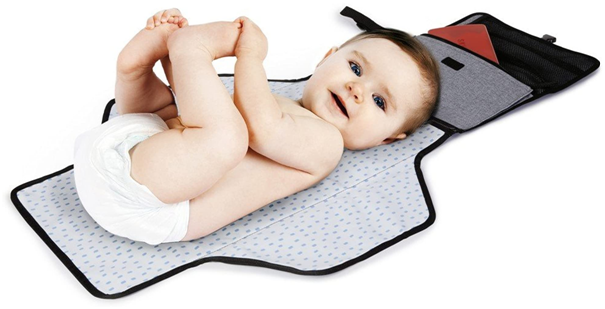
The Pronto is the portable benchmark this category is measured by: a clutch that unfolds one-handed into a changing station. The wipe-clean changing pad (23.5″ x 21.75″ open) zips off for separate use and has a built-in pillow at the head end; closed, the clutch is 11.75″ x 8.25″ and weighs about 12 ounces. Storage is the point of the design: a translucent wipes case you can check at a glance, a large mesh pocket that Skip Hop states holds up to four diapers plus creams, and a front zippered pocket for keys or a phone. Carry it by the wrist strap, drop it in a larger bag, or clip it to the stroller. The body is polyester with light foam cushioning; care is spot cleaning with a damp cloth and mild detergent.
Set expectations by design rather than by disappointment: the pad is thin (about a quarter inch), because a clutch that folds into a bag cannot also be a cushion, it is a clean, familiar surface for a public changing station or a carpet, not a replacement for the nursery pad. And it is stocked for a short outing, so it needs restocking after each trip; in BabyGearLab’s testing, the included wipes case also did not seal tightly enough to keep wipes from drying out over time, which is worth knowing if you leave it packed for weeks.
SnoofyBee Clean Hands Changing Pad
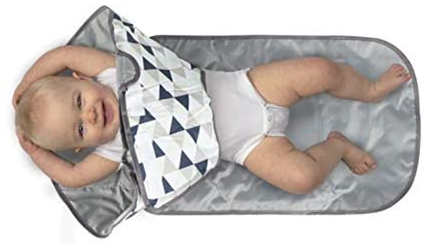
SnoofyBee’s idea is the one genuinely different idea in this guide. The pad folds to a 13″ x 7″ x 3″ clutch with a wrist or stroller strap, and opens to a changing surface 27″ long by 13″ wide (26″ wide with the sides laid flat). The sides fold up into an adjustable barrier around the baby’s upper body, with loops for attaching toys and teethers, the “redirection barrier”, so grabby hands have something sanctioned to hold above the mess. A few diapers and supplies fold inside, and there is a quarter-inch foam pillow at the head end. The surface is polyester with a water-resistant polyurethane backing, per the manufacturer: wipe it clean after use and hand wash when needed. The brand states the pad is tested through a CPSIA-approved third-party facility, and rates it from newborn to age 2.
Two honest qualifications. First, the barrier is a distraction device, not a restraint: there is no belt, it does not hold the baby in place, and SnoofyBee’s own cautions say not to over-tighten it and never to place it around the child’s neck. Second, the manufacturer states plainly: do not use this pad on a raised surface. It is a floor-level and flat-surface pad, for home floors, beds and travel, and used that way it is a clever solution to a real problem. Used on a dresser it would be the wrong tool in the wrong place, which is precisely why it is grouped with the portables and not the dresser pads.
Liners: the layer that does the laundry instead
Munchkin Waterproof Changing Pad Liners (3 count)
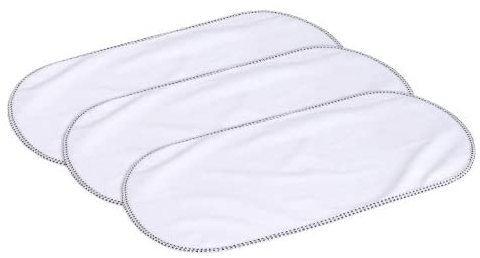
A liner is not a changing pad, so it gets its own section here. What you get is three rectangles of 100% polyester with a waterproof polyurethane coating (Munchkin states the backing is PVC-free), each 22.75″ x 11.5″, that lie on top of a standard changing pad or in a bassinet. The liner takes the mess; you swap it for a clean one and put it in the wash, the liners are machine washable, instead of stripping a fitted cover off the pad several times a day. The listing shows OEKO-TEX Standard 100 certification for the fabric.
The limits are dimensional: at under 23 inches long, a liner covers the business end of the pad, not all of it, and it offers no padding, contour or strap of its own. Think of liners as the cheapest quality-of-life upgrade in this guide for anyone who already owns a contoured pad, and as no substitute at all for one if you don’t.
Buyer’s guide: how to choose the best changing pads for babies
Measure the furniture first, then shop. Most contoured pads are about 16 inches wide and 31–32 inches long, and most changing trays are built for exactly that. The exceptions in this guide are real: the Bumbo is 19 inches wide, the LA Baby is 30 inches long, the Hatch is 29 inches long. A pad that overhangs or rocks in the tray is worse than a plainer pad that fits, so the tape measure comes before the shortlist.
Contoured sides help; they do not supervise. Raised sides slow a roll and center the baby, and a four-sided pad contains more of the wiggling. The AAP’s position is still that the strap, the anchor and your hand do the safety work. When comparing pads, compare the securing hardware, belt, furniture strap, screws, or (say it plainly) none, before you compare colors.
Waterproofing is about what happens after the mess. A smooth, non-porous surface (the Keekaroo’s shell, a vinyl-covered foam pad) wipes clean in seconds and dries immediately. A coated fabric surface (Naturepedic) wipes clean too, but most people put a cover over it for warmth, at which point the cover is doing the work and needs washing. Neither is “germ free”, and no pad in this guide is: cleanability is about surfaces and laundry, and any product that promises more than that is promising something unverifiable.
Liners are the laundry shortcut. If you go the foam-pad-and-cover route, a three-pack of washable liners over the top will cut your cover changes dramatically, because most changes are small. They cost little and fit whatever pad you already own.
When a portable pad is enough. If you mostly change at home on the floor, or you are equipping a grandparents’ house, travel bag or second floor rather than a nursery, a clutch pad may be all you need, used on flat, floor-level surfaces, as their makers intend. What a portable cannot do is turn a dresser top into a changing station: no contour, no strap, no anchor.
Check the standard, and check for recalls. Look for a named standard (ASTM F2388 is the US standard for changing products, mandatory under CPSC rule 16 CFR part 1235) or a certification you can verify, such as JPMA/Baby Safety Alliance certification, rather than a vague promise that a product “meets all safety regulations”. And whatever you buy, especially second-hand, run the exact model through the CPSC recall database first; it takes a minute and it is the check that actually corresponds to a hazard.
FAQ
Do I need a changing pad at all, or is a towel on the floor enough?
A towel on the floor is a safe changing surface, arguably the safest, since there is nowhere to fall from, and for many families floor changes become the default once a baby can roll. What a pad buys you is a raised, defined station with raised sides, a strap and everything in one place, which is easier on your back for the ten-plus changes a day of the newborn months. It is a comfort and organization purchase, not a safety requirement.
When should I stop using a dresser-top changing pad?
At the manufacturer’s stated limit. The US standard for changing products covers children up to 30 lb, and KidsHealth notes the typical limit is around age 2 or 30 lb, whichever your child’s pad states. In practice, many parents move to floor changes earlier, the first time a strong, determined roll makes the raised surface feel like a negotiation. That instinct is correct, follow it.
Can a portable changing pad be my only pad?
Yes, if your changes are on flat surfaces, floors, beds, the trunk of the car, which is what portables are designed for. No, if you want a raised changing station: a portable has no contour deep enough, no safety strap and no way to anchor to furniture, and at least one maker in this guide states outright that its pad must not be used on a raised surface. Match the pad to the surface, not the other way around.
The bottom line
For a standard dresser-top setup, the contoured group is where to start: the Summer by Ingenuity for the straightforward, standards-documented default; the Munchkin Secure Grip if pad movement is your worry, because it ships with the screws to actually anchor itself; the Naturepedic if the materials list is your priority and the budget stretches; the LA Baby if you want four raised sides and accept the shorter length. Choose a wipe-clean changer, the Keekaroo or the Bumbo, when laundry is the thing you are eliminating, and go in clear-eyed about how each one secures: the Keekaroo harnesses the baby and holds the pad to the surface with adhesive hook-and-loop tabs, while the Bumbo belts the baby but anchors nothing. The Hatch Grow is a scale that happens to be a changing pad; buy it for the logging, never as a substitute for the pediatrician’s scales. A pack of Munchkin liners over whatever pad you own is the cheapest daily improvement in this guide, and the Pronto and the SnoofyBee cover everything that happens away from the nursery.
Keep reading: for the rest of the changing-and-care routine, see our guide to gentle face washes for kids, and browse more baby care and product guides for the rest of the series.