
Most roundups of the best rubber bands for toddler hair are really roundups of whatever came in the biggest, cheapest pack. This one is shorter, and starts from a different place: a hair tie for a two-year-old is a small object that will, at some point, be pulled out and mouthed. Everything below is chosen and labeled with that in mind.
Here, the safety rules come first and decide what makes the list.
Disclosure: This guide contains affiliate links. If you buy through a link on this page, Babies Mag World may earn a small commission at no extra cost to you. See our Affiliate Disclosure for details.
How products were chosen: Every product below was selected from its manufacturer’s published specifications and stated age guidance, fabric-covered, seamless or one-piece formats first, because those are the formats a parent can supervise. Two products are included without any affiliate link, because they fill a slot honestly and no link existed. Read more about how we research and select products.
Table of Contents
Safety first: hair ties are small parts, not toys
Toddlers explore with their mouths, normal development, and exactly the behavior the US small-parts rules were written around. Under the CPSC’s Small Parts Regulation (16 CFR Part 1501), an object counts as a small part if it fits entirely inside a test cylinder 1.25 inches (about 32mm) wide and 2.25 inches long, based on the fully expanded throat of a child under three. Articles intended for under-3s that fit, or that shed a component which fits, are banned as choking hazards.
Hold that cylinder in mind when you look at hair ties: a standard bulk-pack baby elastic is 20 to 25mm across, and fits inside it with room to spare. That does not ban every toddler from wearing one, it means the adult rules below are not decoration:
- Hair accessories are not toys. ASTM F963 is the safety standard for toys; a hair tie is not tested as a toy unless its maker says so, and none in this guide claims to be. Do not hand ties to a toddler to play with or chew on.
- An adult puts them in and takes them out. Every time, at every age in this guide.
- Out before naps and sleep. Ties work loose, and a loose tie in a crib or a sleepy child’s hand ends up in a mouth.
- Store them like the small parts they are. Closed container, out of reach. A 100-piece pack spilled on the floor is 100 small parts at crawling height.
- Tug-test anything attached. Bows and decorations should be sewn, not just glued, and checked before each use. If it moves, retire it.
- Check recalls before you buy. Children’s hair accessories do get recalled: a snap hair clip set sold on Amazon was recalled over lead content. Search your product at cpsc.gov/Recalls or SaferProducts.gov, and treat unbranded clip sets with caution, this guide lists no clips at all.
How to choose the best rubber bands for toddler hair
Bigger and one-piece beats tiny and loose. The old advice to buy “the smallest available hair tie” for a small child is backwards. Small is not gentler; it is just harder to keep track of. Bows on elastics, fabric-covered ties and spiral coils are formats you can see, count and retrieve.
Fabric covering, or a seamless braid, over bare rubber. A covered tie glides over hair instead of gripping and snapping it, and has no separate parts. Whatever the format, avoid metal crimps: the crimp is what snags hair, and it is a hard little component in its own right.
Match the tie to the hair, not the outfit. Fine, wispy hair needs a soft, light tie and fewer twists, terry or fabric-covered loops are made for it. Thicker hair in a child of three or more can hold a braided elastic or a coil. If a style has to be forced tight to stay in, the tie is wrong, or the hair is not ready yet.
Be skeptical of material claims, including ours. Most listings do not publish full material-safety documentation, so this guide makes no toxin-free claims for anything in it. What you can do: buy from brands that state their materials plainly (Goody lists the rubber in its elastics), and check the recall databases above.
The hair ties at a glance
| Product | Age label | Type | Standout fact | Keep in mind |
|---|---|---|---|---|
| InSowni 40 Pack Grosgrain Ribbon Bow Elastics | About 2 years + | Ribbon bows on elastic ties | 20 colors in pairs, made for pigtails | Bow is an attached part, tug-test before use |
| Goody Kids Ouchless Tiny Terry Ponytailers | Toddlers (adult applies) | Terry fabric-covered loops | No metal parts; made for fine hair | Small loops, store closed and out of reach |
| Goody Kids Ouchless Hair Elastics | 3 years + | Braided elastics, 2mm | Goody’s own label says “not for children under 3 yrs” | 2mm elastics are small parts; closed-container storage |
| OOO Hair Ties Spiral Coils | 3 years + | One-piece spiral coils | No seam, no crimp, nothing to detach | Can drag on fine or fragile hair when removed |
| Lintopos Elastic Hair Bands | 3 years +, adult use only | Seamless rubber elastics, ~25mm | The small-elastic option, kept under strict rules | Adult keeps the box, applies, removes, and cuts them out |
InSowni 40 Pack Grosgrain Ribbon Bow Elastics
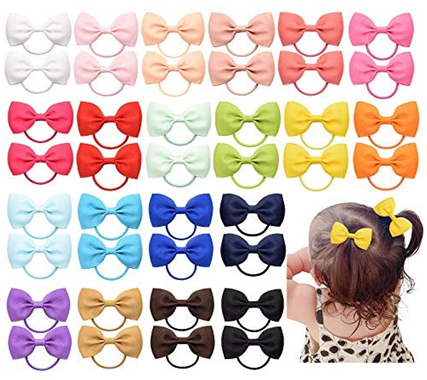
Age label: about 2 years and up.
The dress-up option: 40 elastic ties carrying grosgrain ribbon bows of about 2.75 inches, in 20 colors supplied as pairs, the real point of the set, because pigtails need two of the same. The bows are handmade and attached to the band, per the listing. A bow this size is easy to supervise, and easy to find again when it is pulled out.
The honest limitation is the attachment itself: a bow joined to a band, sewn, glued or both, is a part that can work loose. Tug-test each bow before it goes in, and retire any tie whose bow is separating. Under-twos, and any child still mouthing everything, should wait for this one.
Goody Kids Ouchless Tiny Terry Ponytailers
Age label: toddlers, with an adult applying and removing.
For fine, flyaway first hair, this is the gentlest format in the guide: small loops covered in terry fabric, with no metal parts, made by Goody (Beauty By Imagination) for fine hair. The covering slides over delicate hair instead of gripping it, and there is nothing attached that can come off. Goody markets them for girls and babies; the pack holds 42 in assorted colors.
Two ground rules still apply. The loops are small, so the pack lives in a closed container out of reach, and an adult does the tying and removing. And terry loops stretch with use, a tie that has gone slack should be replaced, not forced tighter.
Goody Kids Ouchless Hair Elastics
Age label: 3 years and up.
The everyday workhorse, and the entry that states this guide’s whole position for us. These are 2mm braided elastics with no metal closures, the “Ouchless” design point, per Goody, is that there is no crimp to snag or pull hair, made for fine to medium hair, 60 to a pack. And Goody prints on its own listing: “Small parts. Not for children under 3 yrs.” A manufacturer saying plainly that its elastics are not for under-3s is the honesty this category usually skips, so this guide’s label simply follows Goody’s: age three and up. Braided construction also stretches and recovers better than a bare band. Storage rule unchanged, the pack stays closed and out of reach, and an adult removes them, by cutting, as described below.
OOO Hair Ties: Spiral Coil Ponytail Holders
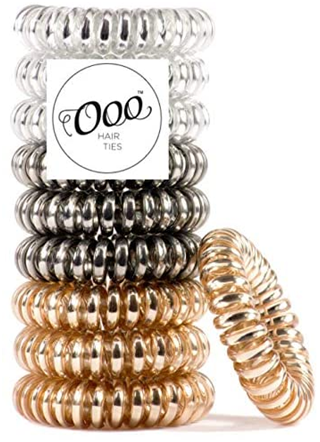
Age label: 3 years and up.
A different mechanism entirely: a one-piece spiral coil that wraps around the ponytail and spreads the hold along the coil rather than pinching at one point. No seam, no crimp, nothing glued on, so nothing to detach, the strongest small-parts profile in this list. The plastic coil also shrugs off water, which suits swimming. Ten to a pack.
Now the limitation: a coil grips by wrapping, and on fine or fragile hair it can drag as it comes out. Unwind it in reverse rather than pulling it down the ponytail; if your child’s hair is fine or easily broken, choose the terry ties above instead.
Lintopos Elastic Hair Bands
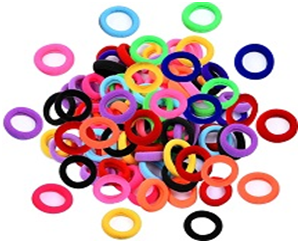
Age label: 3 years and up, adult use only.
These are the small elastics most parents picture: seamless rubber bands about 25mm (0.97 inches) across, 100 pieces in assorted colors. They stay in this guide under strict conditions, because they are genuinely useful for small, neat styles, braid ends, tiny top-knots, on children of three and up, and pretending parents do not use them would help nobody. But nothing about them “ensures safety”, as the old entry claimed; they are a tool an adult keeps, not a product a child handles.
The conditions: the box stays closed and out of reach; an adult applies and removes them; never on a child under three; removal is by cutting (next section), never by dragging a day-old band down the hair. Rubber also ages, a band that has gone tacky, stretched or nicked gets binned, not reused, because that is the band that snaps.
How to remove elastics without the tears or the damage
Most “hair ties hurt” stories are removal stories: the tie went in fine at 8am, but by 6pm it has hair wound around it, and dragging it out takes hair with it. Work like this instead:
- Cut out small elastics. For single-day bands like the Lintopos elastics, slide blunt-tipped scissors under the band, away from the skin, and snip. The band falls away and takes nothing with it, a 100-piece pack makes the bands disposable, so treat them that way.
- Unwind fabric ties one loop at a time, holding the base of the ponytail with your other hand so the hair itself is never pulled.
- Unwind spiral coils in reverse, following the coil back around, rather than pulling them straight down.
- Detangle after, not during. Then work through tangles with fingers or a wide-tooth comb, ends first, the method set out in our guide to how to wash toddler hair without tears.
FAQ
Can my baby wear hair ties?
For babies under one, there is rarely enough hair to need one, and anything small and removable is a mouthing risk. Skip elastics at this age. A soft headband for photos comes off when the photos finish, never for sleep, never unsupervised.
How tight is too tight?
If a style leaves a mark, makes your child flinch, or needs force to undo, it is too tight or the tie is too small. A tie should hold with the fewest twists that work, and recurring fussing at the same spot is information: loosen up, or change format.
The bottom line
For toddlers, the best rubber bands are the ones an adult can supervise: terry loops for fine first hair, ribbon-bow elastics for a child of two or more whose bows get tug-tested, and, from age three, following the manufacturer’s own label, braided no-crimp elastics, one-piece coils, and small seamless bands kept in a closed box and cut out at removal. What did not survive tells the same story from the other side: no 200-piece packs of 20mm bands, no adult scrunchies or thick-hair bands relabelled for toddlers, no set claiming to suit everyone from 6 months to 12 years. For bath-time battles beyond hair, see gentle facial cleansers for kids.
Keep reading: most hair battles at this age happen at washing, not styling, see our calm routine for how to wash toddler hair without tears, and browse more toddler care and product guides.