
Medical disclaimer: This article is general information for parents and is not medical advice. Guidance on feeding, health and development can depend on your baby’s individual needs. If you have concerns about your child, please speak to your pediatrician or another qualified health professional.
Some mornings run themselves. Others fall apart before the coffee is ready: breakfast refused, one shoe missing, a small person crying because the banana broke in half. If your days feel like the second kind more often than not, a toddler daily routine chart is worth trying, not as a timetable anyone has to obey, but as a shape for the day that your toddler can learn to predict.
Below is a sample day for a 1-year-old, a 2-year-old and a 3-year-old, plus a picture routine you can make at home for the parts of the day toddlers negotiate hardest. One honest warning first: the only numbers here that come from medical guidance are the sleep totals. Every clock time is one family’s example rhythm, picked so the day’s sleep adds up, and each schedule shows its work, so you can slide the whole day earlier or later to fit your child.
Table of Contents
The one set of numbers that is actually guidance
Start with sleep, because it’s the only part of a routine with real numbers behind it. The American Academy of Sleep Medicine’s recommendations, endorsed by the American Academy of Pediatrics, say children aged 1 to 2 should regularly sleep 11 to 14 hours in 24 hours, including naps, and children aged 3 to 5 should regularly sleep 10 to 13 hours, including naps. The CDC and KidsHealth print the same ranges.
“Including naps” is the part that trips people up. You don’t judge the night on its own. You add night sleep and daytime sleep together, then compare the total with the band. It’s also a band, not a target: sleep needs vary from child to child, and a night outside the range now and then is not a failed exam. Regularly sleeping far fewer hours than recommended is associated with attention, behavior and learning problems and a higher risk of accidents, per the AASM statement, which is why the totals, and only the totals, are treated as guidance here.
Notice what guidance doesn’t give you: no authority sets a bedtime by the clock, a required nap length, or a maximum number of hours your toddler may be awake. Charts elsewhere state those things with great confidence, but it isn’t coming from the AAP or the CDC, so this chart doesn’t borrow it.
How to use this chart
A routine is a repeated, predictable sequence, and the sequence is the part that matters. ZERO TO THREE puts it plainly: the order of steps stays the same, while the timing can vary for the individual child. Knowing what comes next comforts young children; it’s a large part of why a predictable day feels calmer than an improvised one.
So treat the clock times below as pegs, not orders. Five rules make any of the sample days work:
- Keep the anchors fixed. The AAP’s sleep guidance suggests the same waking time on weekdays and weekends, plus regular mealtimes, nap time and play times. A child who knows lunch follows the park stops asking what happens next.
- Slide the day, don’t rebuild it. Pick the wake-up time that suits your household and shift every block by the same amount; the sample days below use different wake times on purpose, to show the shape survives the shift.
- If bedtime is a battle, move the routine, not just the bedtime. Starting the bedtime routine 15 to 20 minutes earlier can make a big difference, per the AAP, and if you’re waiting for yawning and eye-rubbing before you start, that’s probably already too late.
- Feed on a rhythm too. The CDC’s feeding guidance describes something to eat or drink every 2 to 3 hours, roughly 3 meals and 2 to 3 planned snacks. That pattern is written for under-2s; the 3-year-old’s day below keeps the same rhythm as an example only. Meals are anchors too: hands washed first, everyone seated, distractions limited, 10 to 15 minutes or as long as your child can pay attention, with your child deciding how much gets eaten.
- Screens off before bed. The AAP says to turn screens off at least an hour before bedtime and keep them out of children’s bedrooms.
Sample day: a 1-year-old (two naps, for now)
At this age, many toddlers nap once or twice a day. Both patterns are common. Most move from two naps to one at around 18 months, sometimes sooner, and fighting the morning nap is often the first sign the change is coming. This 1-year-old’s day shows the two-nap version; the one-nap swap is underneath.
| Time | What happens |
|---|---|
| 7:00 | Wake, diaper change, get dressed |
| 7:15 | Breakfast |
| 7:45 | Play: floor play, books, getting out of the house |
| 9:00 | Morning snack |
| 9:30–10:15 | Nap 1 |
| 10:15 | Play, errands, fresh air |
| 12:00 | Lunch |
| 1:00–2:15 | Nap 2 |
| 2:30 | Afternoon snack |
| 2:45 | Play |
| 5:30 | Dinner |
| 6:30 | Bath |
| 6:50 | Pajamas, brush teeth, a book or two (Brush, Book, Bed) |
| 7:30 | Bed |
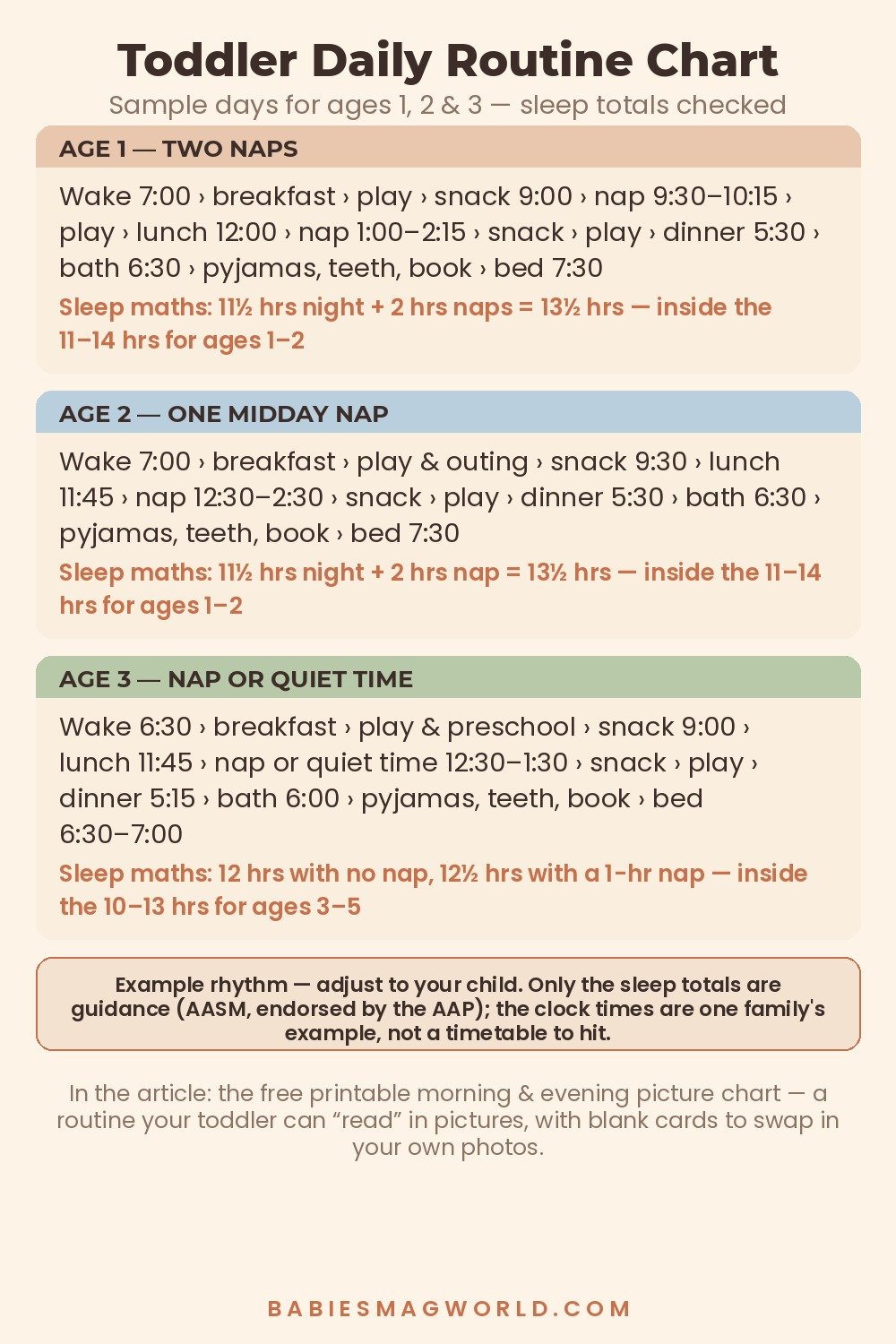
Example rhythm: adjust to your child. Only the sleep totals are guidance (AASM/AAP); the times are one family’s example. Sleep math: night 11½ hours (7:30 p.m.–7:00 a.m.) + naps 2 hours (45 min + 1¼ hours) = 13½ hours total, inside the 11–14 hours for ages 1–2. One-nap version: swap both naps for one nap, 12:30–2:30 after lunch; the total is unchanged.
Sample day: a 2-year-old (one midday nap)
By 2, the day usually settles into one midday nap, shown here as an example, not as a rule attached to the birthday. Keep the nap at a regular time and not too close to bedtime, with the same short settle-down each day: dim lights, a quiet story, soft music if your child likes it.
| Time | What happens |
|---|---|
| 7:00 | Wake, potty or diaper change, get dressed |
| 7:15 | Breakfast |
| 7:45 | Play, outing, playgroup |
| 9:30 | Morning snack |
| 11:45 | Lunch |
| 12:30–2:30 | Nap |
| 2:45 | Afternoon snack |
| 3:00 | Play |
| 5:30 | Dinner |
| 6:30 | Bath |
| 6:50 | Pajamas, brush teeth, a book or two (Brush, Book, Bed) |
| 7:30 | Bed |
Example rhythm: adjust to your child. Only the sleep totals are guidance (AASM/AAP); the times are one family’s example. Sleep math: night 11½ hours (7:30 p.m.–7:00 a.m.) + nap 2 hours = 13½ hours total, inside the 11–14 hours for ages 1–2.
Sample day: a 3-year-old (nap or quiet time)
Age 3 is where families trip over the bands: a 3-year-old’s sleep total now sits in the 3-to-5-years range of 10 to 13 hours, not the 11 to 14 of the toddler years. It’s also the age where the nap becomes optional. Many preschoolers give up the afternoon nap at some point during these years, because they’re getting enough sleep at night. This 3-year-old’s day shows the midday slot as “nap or quiet time,” with two bedtimes, because the honest answer is that the day works both ways, as long as the total lands in the band.
| Time | What happens |
|---|---|
| 6:30 | Wake, potty, get dressed |
| 6:45 | Breakfast |
| 7:15 | Play, outing, preschool |
| 9:00 | Morning snack |
| 11:45 | Lunch |
| 12:30–1:30 | Nap or quiet time |
| 2:00 | Afternoon snack |
| 2:15 | Play |
| 5:15 | Dinner |
| 6:00 | Bath |
| 6:20 | Pajamas, brush teeth, a book or two (Brush, Book, Bed) |
| 6:30 or 7:00 | Bed: the earlier time on no-nap days |
Example rhythm: adjust to your child. Only the sleep totals are guidance (AASM/AAP); the times are one family’s example. Sleep math, both ways. No nap: night 12 hours (6:30 p.m.–6:30 a.m.) = 12 hours total, inside the 10–13 hours for ages 3–5. With a 1-hour nap: night 11½ hours (7:00 p.m.–6:30 a.m.) + 1 hour = 12½ hours total, also inside the band.
If your 3-year-old won’t nap, don’t turn the slot into a daily battle: offer quiet time instead: books and quiet play in their room. Rest counts even without sleep. And if the nap disappears altogether, consider an earlier bedtime, which is what the earlier bedtime in the table is doing.
A picture routine chart (the part your toddler can “read”)
A toddler can’t read a timetable, but they can read pictures: ZERO TO THREE suggests a picture reminder of a routine’s steps: photos of your own child doing each step, in order, showing what comes next. You can make one in ten minutes: two short picture sequences, morning and evening, using a photo of your own child for each step.
Morning: Wake up → Potty or diaper change → Get dressed → Brush teeth → Breakfast → Shoes on, ready to go.
Evening: Dinner → Bath → Pajamas → Potty → Brush teeth → Book (one or two) → Bed.
The evening order follows the AAP’s Brush, Book, Bed on purpose: teeth brushed, then a book, then bed, nothing to eat or drink after brushing except water. If you make your own, add two lines to it so it still makes sense without this article: “Every child differs, follow your child’s cues and your pediatrician’s advice” and “Steps in order, times are flexible, a routine is a rhythm, not a clock”, plus one safety line on the evening side: a grown-up stays close at bath time.
Stick the chart at toddler eye height, and point to the next picture instead of announcing the next battle. The potty steps in both sequences are where readiness practice quietly lives, if you’re wondering whether your child is there yet, work through the signs your toddler is ready for potty training alongside it. And if the bath step is the one that stalls the whole evening, our guide to how to wash toddler hair without tears is the fix most families here end up needing.
When the routine keeps falling apart
Some days will ignore the chart completely; that’s toddlers, not failure. But if the pattern is daily, treat it as information. KidsHealth suggests asking: Does my child act sleepy during the day? Are they cranky, whiny or moody, especially later in the day? Is it a battle to get them out of bed in the morning? Are they inattentive, impatient or having trouble focusing? A yes or two means it’s worth changing something, usually the bedtime or the nap schedule, instead.
Work the levers in order. First, start the bedtime routine 15 to 20 minutes earlier. Second, protect the anchors (wake time, meals, the order of the evening) and let everything between them flex; the sequence is the routine, not the minute hand. Third, look at the flashpoints. Transitions (getting dressed, leaving the house, turning the bath faucet off) are where toddlers dig in, and having what to say instead ready for those moments helps more than a stricter timetable. If night waking is the thing unraveling your evenings, it also helps to know whether you’re looking at a sleep regression or teething before you rebuild the schedule around it.
And some things aren’t a scheduling problem at all. Talk to your pediatrician about sleep that seems severely disturbed, recurring nightmares, snoring, loud or heavy breathing or possible sleep apnea, or bedtime resistance that nothing shifts. A toddler daily routine chart can organize a day; it can’t diagnose a sleep problem, and it isn’t meant to.
Sources
- American Academy of Sleep Medicine sleep-duration consensus (Journal of Clinical Sleep Medicine, 2016), endorsed by the AAP
- HealthyChildren.org (AAP), “Healthy Sleep Habits: How Many Hours Does Your Child Need?”; “Brush, Book, Bed”
- CDC, “About Sleep”; Infant and Toddler Nutrition (feeding amounts; mealtime routines)
- KidsHealth (Nemours), “Naps”; “Toddler Sleep: 1- to 2-Year-Olds”
- ZERO TO THREE, “The Practical Magic of Daily Routines”; ZERO TO THREE / NAEYC, “Rituals and Routines”