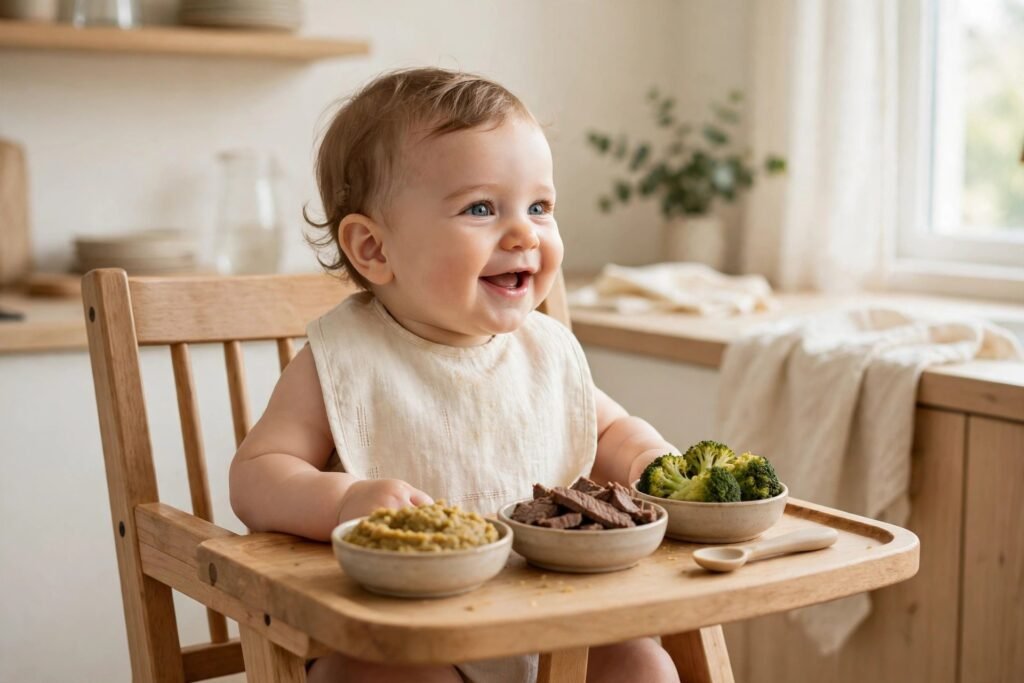
Eleven milligrams. That’s how much iron a baby needs per day in the second half of their first year (National Academies figures, via the NIH). Now look at what your baby actually eats: two spoonfuls of purée, half of it on the bib.
Most lists of iron-rich first foods only tell you the first one. They rank foods by half-cup and three-ounce portions a 7-month-old won’t finish this month, let alone today. This guide does it differently: the verified number, honest portions, and one plate formula you can repeat without doing math at the high chair.
Medical disclaimer: This article is general information for parents and is not medical advice. Guidance on feeding, health and development can depend on your baby’s individual needs. If you have concerns about your child, please speak to your pediatrician or another qualified health professional.
Table of Contents
Why iron suddenly matters at around 6 months
Babies are born with a stockpile: the iron stored in a full-term baby’s body covers roughly the first half of the first year, then runs low. The NIH puts it plainly, by 6 to 9 months, full-term babies could become iron deficient unless they eat iron-enriched solid foods or drink iron-fortified formula.
That timing is why iron-rich first foods belong in the first weeks of weaning, not as an afterthought at 9 months. Iron helps red blood cells carry oxygen, and the CDC’s iron page for parents is direct about what it supports: brain development, immune function, and a child’s ability to grow, pay attention and learn. Babies who keep getting too little can develop iron deficiency anemia, linked to learning difficulties.
The daily figures, so you have them straight:
- Birth to 6 months: 0.27 mg/day, covered by birth stores plus milk.
- 7 to 12 months: 11 mg/day, the big jump.
- 1 to 3 years: 7 mg/day.
These are National Academies values from the NIH iron fact sheet. Note the middle band starts at 7 months, not 6: at 6 months the point isn’t hitting a number, it’s that the stockpile is fading. If you’re still working out the start itself, our guide to when babies can start baby food after 6 months covers the timing and readiness signs.
Feeding type matters here. Standard iron-fortified formula (12 mg of iron per liter, per the CDC) meets a baby’s iron needs for the first 12 months, and iron foods still belong on the tray from about 6 months, because eating is also practice. Breast milk alone doesn’t cover iron after the stockpile fades, which is why breastfed babies are the group pediatricians watch most closely on iron.
The two kinds of iron (and why one needs a partner)
Not all food iron behaves the same way:
- Heme iron comes from animal products, red meat, poultry, seafood, eggs. The body absorbs it more easily.
- Non-heme iron comes from plants and iron-fortified products, beans, lentils, tofu, spinach, fortified cereals. It’s absorbed less easily, and the CDC is blunt that getting enough iron from non-heme sources alone “will require careful planning.”
Here’s the lever you actually control: vitamin C helps your baby absorb non-heme iron. The CDC’s wording is that pairing non-heme iron sources with foods high in vitamin C “can help your baby absorb needed iron.” No percentages, no magic multiplier, anyone quoting you a “times more absorption” figure is inventing it. But the pairing is real, it’s free, and it’s the simplest habit in this article. Every food below is one kind or the other, and the non-heme ones need their partner.
Save this: the iron + vitamin C plate formula
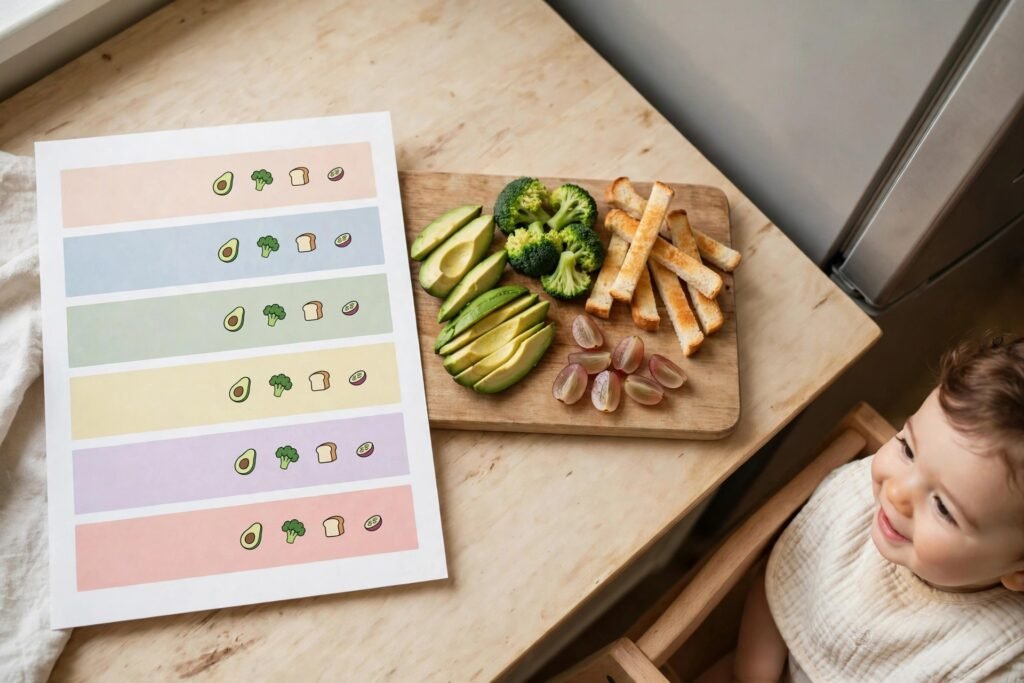
One iron food, one vitamin C food, same plate. That’s the formula. Vitamin C partners from the CDC and NIH lists: citrus fruits, strawberries and other berries, tomatoes, broccoli, cabbage, papaya, sweet potatoes, sweet peppers.
| Iron food | Vitamin C partner | What lands on the tray |
|---|---|---|
| Lentils | Tomato | Soft lentil and tomato mash |
| Black beans | Sweet potato | Mashed beans stirred through sweet potato |
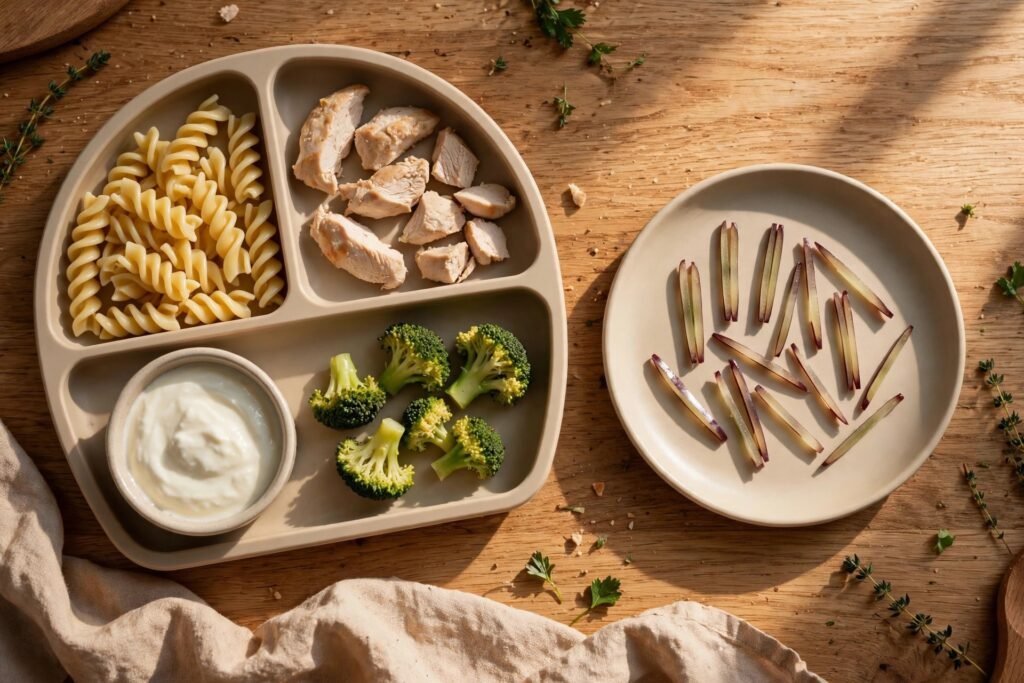
| Tofu | Broccoli | Soft tofu pieces with steamed broccoli florets |
| Spinach | Strawberries | Spinach and strawberry blended into a smoothie or mash |
| Iron-fortified oat cereal | Berries | Cereal thinned with milk, mashed berries on top |
| Beef | Broccoli | Soft beef strips or ground beef with broccoli; heme iron absorbs well on its own |
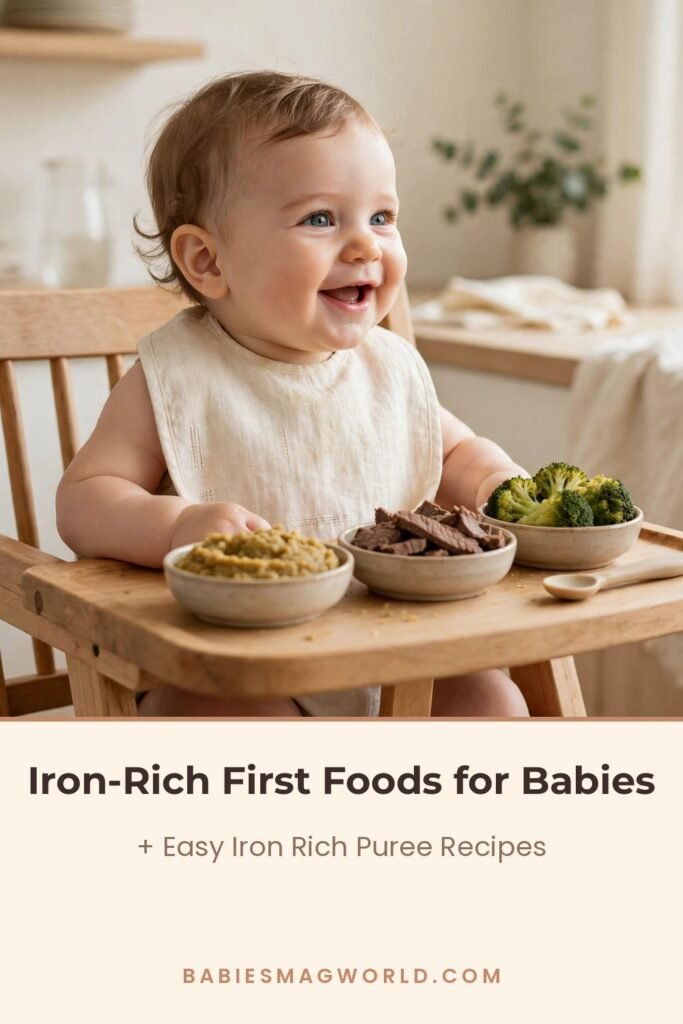
Two foods get miscast in other lists. Sweet potato and broccoli are the partners in this system, not iron sources. Their iron content is modest. And eggs contain some iron, but they’re a supporting player, not a headline source. Build the plate around the left-hand column.
Once your baby is eating happily, that spinach-and-strawberry row works as one of these easy smoothie recipes for babies at 6 months, iron food and vitamin C partner in the same cup.
Blended versions count as well: the spinach-and-strawberry and lentil-and-tomato pairings both work as smooth purées for spoon-fed babies, with the vitamin C partner already built in.
What the numbers look like in real servings
Here is the honest version. These are reference servings from USDA-based tables, mostly bigger than a new eater manages. Read them for ranking, not as targets for a single meal:
| Food (reference serving, as sourced) | Iron |
|---|---|
| Iron-fortified infant oat cereal, ¼ cup | 6.8 mg |
| Cooked spinach, ½ cup | 3.2 mg |
| Canned black beans, ½ cup | 2.3 mg |
| Baby-food oatmeal cereal, dry, 1 tablespoon | 1.6 mg |
| Ground beef, 1 ounce | 0.83 mg |
| Canned salmon, 1 ounce | 0.33 mg |
Two things jump out. First, iron-fortified infant cereal is the heavy lifter of early weaning. Nothing else a baby eats comes close per spoonful. Second, your baby will eat tablespoons, not quarter-cups. A couple of tablespoons of fortified cereal, a few spoonfuls of lentil mash, some soft beef at dinner: that’s how 11 mg gets approached across a day, alongside milk feeds, not in one heroic meal. Treat 11 mg as the day’s direction, not a score to hit by 6 p.m.
One cereal caution, from the CDC’s guide to introducing solid foods: rotate your grains. Feeding only infant rice cereal can increase your baby’s exposure to arsenic, so mix it up with iron-fortified oat, barley and multigrain cereals instead of serving rice every time.
A realistic day (no math required)
Here’s what one day can look like:
- Breakfast: iron-fortified oat cereal thinned with breast milk or formula, mashed strawberries stirred in.
- Lunch: lentil and tomato mash, soft enough to spoon or scoop.
- Dinner: soft beef strips or finely ground beef (excess fat trimmed or drained first) with steamed broccoli florets.
Rotate the main iron food across the week, cereal most mornings, meat or fish a few times, lentils, beans or tofu on the other days. And expect the long game: the NHS notes it can take 10 tries or more before a baby accepts a new food. A rejected lentil on Tuesday is data, not a verdict.
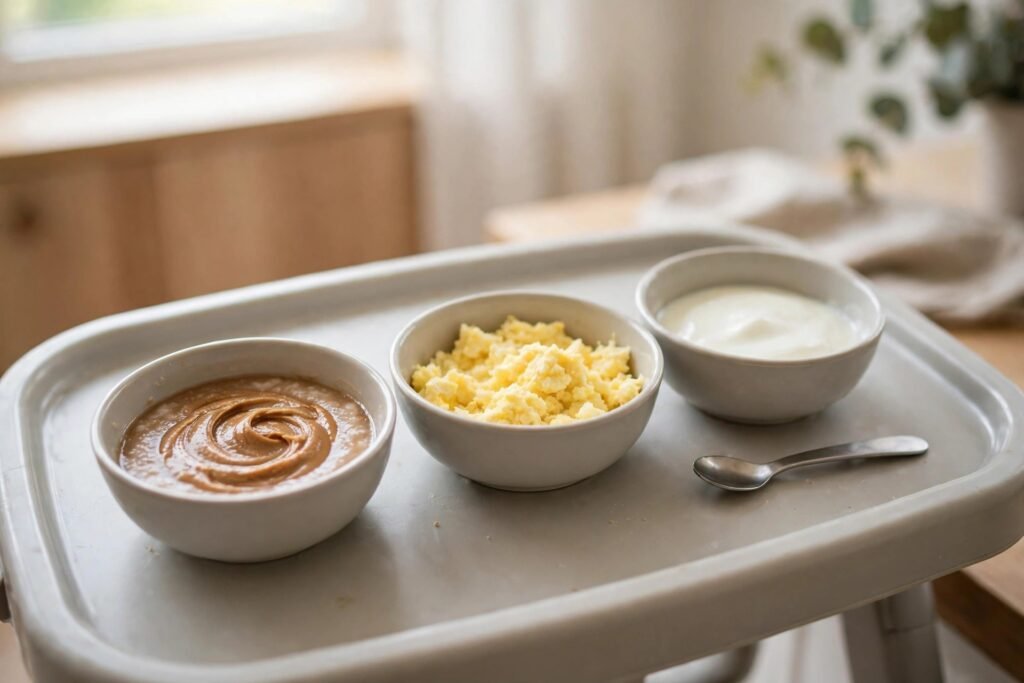
Basics that apply to every food here: introduce one new single-ingredient food at a time, waiting 3 to 5 days between new foods (CDC), and keep allergens like egg and thinned peanut butter in the mix from around 6 months rather than delaying them, unless your pediatrician advises otherwise.
If your baby eats mostly plants
Plant-based weaning can work, but it asks more of you, that’s the CDC’s “careful planning” point, not a scare tactic. The working version: an iron food plus a vitamin C food at most meals, fortified cereal as a daily anchor, and variety across beans, lentils, tofu and dark green vegetables. If your family is vegan, raise iron (and vitamin B12) with your pediatrician, before stores run low. The foods are the same; the planning around them is not.
Born early, or small?
Premature and low-birth-weight babies start with smaller iron stores, and the CDC notes they may need extra iron beyond what breast milk or formula provides. Their weaning timing can differ too. So treat this article’s timelines as written for full-term babies, and let your baby’s own medical team set the iron plan.
Screening, signs and supplements: the honest timeline
You may see “tested at 12 months” in one place and “tested at 9 months” in another and wonder who’s right. Both are real guidance, from different bodies:
- CDC: at around 12 months, your child’s doctor or nurse will likely test for anemia.
- AAP (2026 clinical report): screening starts at about 9 to 12 months for babies who mostly consume breast milk, and 15 to 18 months for babies who mostly consume infant formula, because formula is iron-fortified.
The AAP’s current anemia guidance for parents lists the signs that can accompany iron deficiency: paler, yellowish or ashy skin; faded cheeks, lips and nail beds; tiredness; irritability; and craving or chewing non-food items such as ice, dirt or paper. Treat those as reasons to ask about the blood test, not as a home diagnosis, the signs overlap with ordinary babyhood, deficiency can be present with no obvious signs, and only a blood test confirms it.
Supplements, clearly: you will find specific doses online. Don’t use them. AAP guidance on iron supplements for breastfed babies exists, and it has shifted. The AAP’s 2026 clinical report points to iron supplementation for exclusively breastfed infants by 4 months, with waiting until 6 months as an alternative, while the AAP’s parent guidance describes starting around 6 months. That gap is why the decision belongs to your pediatrician. Ask at the 4-month and 6-month visits. One safety fact from the NIH: accidental overdose of iron-containing products is a leading cause of fatal poisoning in children under 6, and the upper limit for babies under 12 months is 40 mg a day from all sources. Iron supplements are medicine, they live out of reach, like medicine.
Finally, a milk rule that protects iron: cow’s milk shouldn’t be your baby’s main drink until after 12 months. The AAP notes it can cause blood loss in the stool and decrease iron absorption; after the first birthday, keep it to no more than 24 ounces a day. Yogurt and cheese before 12 months are fine, it’s the drink that waits. For the wider menu, see the first foods chart by age.
Quick answers
My baby hates meat. Can they still get enough iron?
Yes, with the formula doing the work: fortified cereal daily, plus lentils, beans, tofu and spinach, each paired with a vitamin C food. Meat is the easy route, not the only one, and keep offering it in new forms; rejection at 7 months rarely predicts rejection at 10.
Should I buy iron drops just in case?
No. Whether a breastfed baby needs supplemental iron, and from when, is a pediatrician decision, guidance differs by feeding type and has recently changed. Ask at the 4- and 6-month check-ups.