If hair wash night in your house involves screaming you can hear through a closed bathroom door, you’re not dealing with a badly behaved toddler. You’re dealing with a completely normal one, at the exact age where this peaks. This guide is the routine that lets you wash toddler hair without tears, most nights, anyway.
Parents ask about this constantly: is this normal, and please tell me they grow out of it. They do, it’s a phase, and for many families it eases off around age four or five. That doesn’t help you tonight, though. Tonight you need mechanics: what to actually do with the cup, the water and the small furious person. The mechanics below work on an ordinary Tuesday.
Medical disclaimer: This article is general information for parents and is not medical advice. Bathing, skin and hair care can depend on your toddler’s individual needs. If you have concerns about your toddler’s skin, scalp or behavior around bath time, please speak to your pediatrician or another qualified health professional.
Table of Contents
It’s the water, not the shampoo
Here’s the reframe that changes everything. Most toddlers aren’t afraid of shampoo. They’re afraid of water running over their face (into eyes, ears and nose) and of tipping their head back and feeling like they’re falling. Add a loss of control (you hold the cup; they can’t stop it) and, for some children, genuine sensory sensitivity, and the screaming makes complete sense.
Test it in one bath: many toddlers who melt down at rinsing happily sit through the shampooing part. The lather isn’t the problem: the flood is.
This is also why “tear-free” shampoo, on its own, fixes nothing, though the label is worth understanding. Tear-free formulas use milder cleansing ingredients (surfactants), in smaller amounts, and leave out harsher ones like sodium lauryl sulfate, which makes them less likely to sting eyes. Despite the stubborn myth, they contain no numbing agents. Thoroughly debunked. And two honest limits: they clean oil away less aggressively by design, and plain water alone can make eyes water, because water’s pH differs slightly from the eye’s. Even with the gentlest shampoo in the world, a face full of rinse water can still produce tears. The fix is keeping water off the face. Understanding the label helps, but it is the rinse that decides it.
Set the scene before anyone gets wet
Two safety numbers are worth thirty seconds, because everything else sits on top of them.
- Bath water around 100°F (38°C): the target in Mayo Clinic’s baby bath basics. Test with your wrist or elbow; swish out any hot patches.
- Water heater set so the hottest tap water is no more than 120°F (48.9°C): the AAP’s bathroom safety guidance. That’s a scald-prevention setting, not a bath temperature.
And the rule that outranks every technique below: never leave a young child alone in the bath, even for a moment. The AAP is blunt: children can drown in only a few inches of water, and a thrashing, mid-meltdown toddler is a slipping risk besides.
A tear-free hair wash routine, step by step
Screenshot this sequence: nobody remembers a blog post mid-bath.
Order matters as much as technique:
- Wash the hair last. Let the bath start as play; don’t leave your toddler sitting in sudsy water for the whole soak. Hair at the end, then out.
- Rehearse outside the crisis. Earlier in the day, let your toddler “wash” a doll’s hair (or yours) with a dry cup, narrating the steps. A child who knows what’s next has less to fear.
- Use a drop, not a dollop. Mayo’s guidance for babies is a drop of mild baby shampoo massaged into the scalp, and toddlers don’t need much more. Less lather, shorter rinse.
- Shield the eyes before the water moves. Cup one hand firmly across the forehead (Mayo’s technique, and it works like a dam) or hold a folded washcloth across the hairline.
- Give them somewhere to look. A sticker stuck high on the wall or ceiling turns “look up” from an instruction into a game; a target works better than the instruction alone.
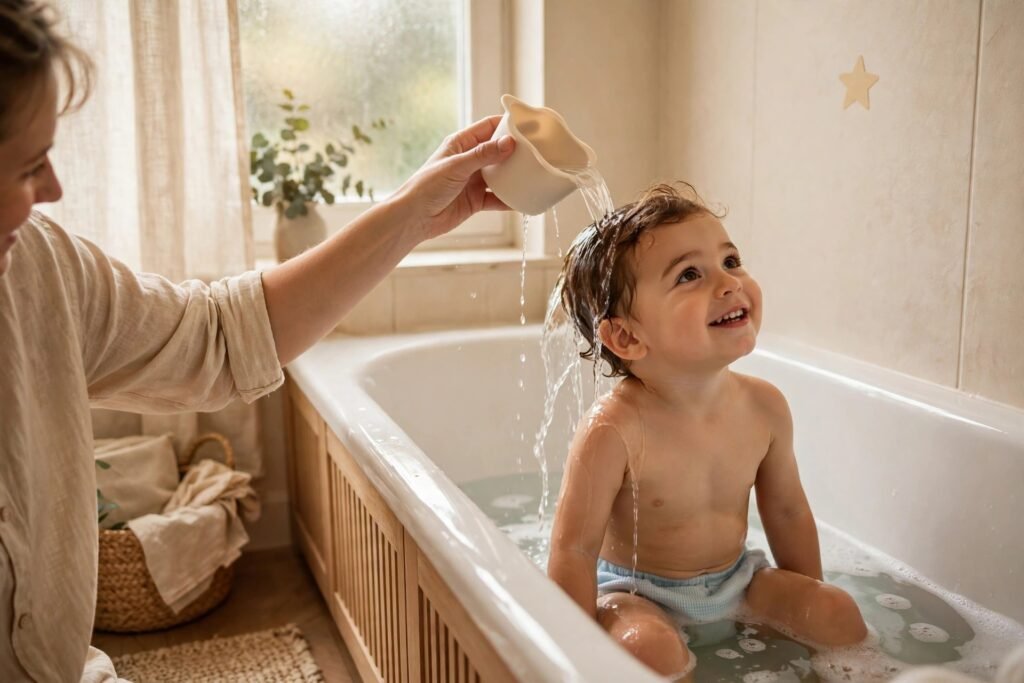
- Rinse with a soft-edge cup, counted out loud. Rest a flexible-edge rinse cup against the forehead so water runs back, not down. Then count: “Three cups to rinse. One… two… three.” A counted rinse has an ending your toddler can hear coming: a sequence, not an ambush.
- Work back to front. With a handheld shower, use the lowest pressure, start at the back of the head and move forward. Back-first means the first water never lands on the face.
- For the truly pour-averse, skip pouring entirely. A washcloth wrung out and wiped over the hair, again and again, rinses shampoo out slowly but completely, the method that finally works in many households after everything else has been thrown out of the bath.
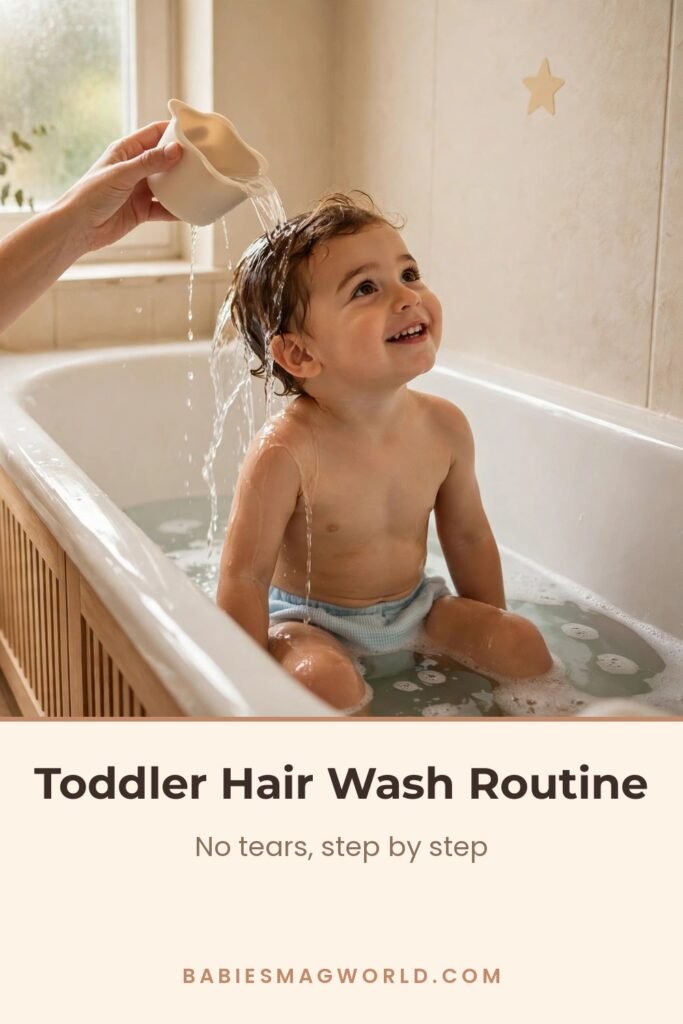
Two alternatives if the standard position is the whole problem. A rinse visor or swim goggles help some toddlers, comfort tools, nothing more; they don’t medically protect eyes or ears, and plenty of children tear them off. And there’s the salon wash: a small chair in front of the tub (or at the kitchen sink), toddler leaning back with a rolled towel under their neck, head over the edge, so water never travels toward the face. Support their head and neck and stay right there throughout. It only works fully supervised. Each of these is a different route to the same goal: keeping water off the face.
If they panic anyway: the off-ramp nobody mentions
Some weeks, none of it works. Here’s the part most guides won’t tell you: you are allowed to wash less, and you are allowed to stop.
Never force a hair wash on a very upset toddler. A skipped wash harms nothing. Between baths, a warm washcloth over the head and neck (the old top-and-tail approach the NHS describes for babies) keeps things reasonably clean, and most toddlers do fine with a proper hair wash just once or twice a week anyway.
Then rebuild slowly with graded practice: water on the tummy during play, then legs, then chest, and only much later the head, tiny steps, lots of praise, stop while it’s still going well. It’s exactly the kind of everyday moment our guide to positive parenting tips for building strong bonds is about: the goal is a child who trusts bath time again, not one who was wrestled through it. Graded practice is the long game: calm hair washes every time, not just on good nights.
One more thing: if your child’s distress around water, touch or noise is a pattern across the whole day, not just the bath, mention it to your pediatrician. For autistic children and children with sensory processing differences, bath time piles many sensations into a few minutes; a pediatrician can help you manage it.
How to detangle toddler hair without the second battle
Detangling matters too: the rinse can go perfectly and the comb still ruins it.
For many families the wash is only round one: the screaming restarts at the comb. The method that works:
- Detangle wet, conditioned hair: never dry, never unconditioned. Work conditioner through the lengths and ends first.
- Fingers before tools. Pick out big knots with your fingers, then a wide-tooth comb or detangling brush.
- Start at the ends and work up in short strokes, holding the hair above the tangle so the pull doesn’t reach the scalp.
- Section thick hair rather than fighting it all at once.
Tangles set overnight, so mornings are the worst of it. Hair left loose overnight tangles less than a tight style left in, and any ties come out before sleep, a loose tie in a crib ends up in a mouth, so the morning starts with loose hair, not a wrestling match over an overnight style (we’ve rounded up the best rubber bands for toddler hair separately). And squeeze hair dry with the towel instead of rubbing it into a nest.
A quick hair-type table
Treat these as starting points, not rules, no medical authority sets an exact toddler wash schedule, and any guide that gives you one as fact is making it up. Frequency is the other half of the job, and it depends on hair type.
| Hair type | How often (starting point) | What helps |
|---|---|---|
| Fine | About twice a week, it looks oily sooner | Lightweight products; gentle brushing to avoid breakage |
| Straight / wavy | Once or twice a week | The standard routine above usually just works |
| Curly / coily | About once a week; condition every wash | Tends to be drier, so less washing and more moisture suits many families; never brush dry; detangle wet and conditioned, in sections |
| Thick | Once or twice a week | Extra water worked to the scalp, sectioning, a longer, slower rinse |
For comparison, official guidance for babies is lighter still: the AAP suggests shampooing a baby’s hair about once a week is enough for most, and Mayo Clinic notes bathing a newborn around three times a week is plenty. More can dry young skin out. Toddlers get grubbier, but the principle survives: less often than you think.
Still seeing flakes? It might be cradle cap
Plenty of younger toddlers still carry cradle cap into their second year: greasy, scaly white-or-yellow patches that crust on the scalp. Know two things first: it is not itchy or painful, and it’s not caused by dirty hair. The cause isn’t fully settled; it’s thought to be linked to overactive oil glands. It doesn’t change the routine much: keep it gentle, and get a doctor’s input before any medicated product.
The home routine, per the NHS cradle cap guidance, is gentle:
- Massage an emollient (moisturizer), or petroleum jelly or mineral oil, onto the scalp to loosen scales, then loosen gently with a soft brush.
- Wash with a mild, unperfumed baby shampoo.
- Don’t pick or scratch the crusts off: that risks infection.
- Don’t use olive oil or peanut oil. Older advice recommends olive oil; current NHS and AAP guidance says not to: the NHS notes it may not be suitable for skin, and the AAP warns it may increase yeast growth. Peanut oil is out for allergy reasons.
You may read elsewhere about anti-dandruff shampoos, hydrocortisone creams or antifungal shampoos for cradle cap. Those are things a doctor might suggest: Mayo’s position is to talk to your child’s doctor before using over-the-counter cortisone or antifungal products on young skin, and that’s the line we follow here.
See your pediatrician if the flakes are itchy or painful (simple cradle cap isn’t, itching, spreading, weeping or soreness points to something else, like eczema or an infection), if crusts bleed, leak or look swollen, if it spreads beyond the scalp, if it isn’t improving after a few weeks of home care, or if it’s still there after 12 months. The AAP expects cradle cap to resolve on its own between 6 and 12 months in most cases.
Quick answers
Can I use my own shampoo on my toddler?
Stick with a mild, fragrance-free-if-you-can baby shampoo. Adult shampoos are stronger than young scalps need. NHS guidance on young children’s scalps is explicit about avoiding adult shampoo and fragranced products there, and a mild baby shampoo is the safer default for a toddler too.
What if my toddler screams no matter what I do?
Stop, don’t force it, and wash with a wrung-out washcloth for a while. Then rebuild with graded steps and counted rinses. If the fear is intense, lasting, or part of a wider sensory pattern, raise it with your pediatrician. A washcloth week still counts: the goal is to wash toddler hair without tears, not to win the bath.