
Most backyard playsets are built for children aged 3 to 10 or 11, whatever a listing headline says. None of them is suitable for an infant, and that matters: age grading on play equipment reflects what a child can climb, grip and fall from, not just how much they weigh. This guide only includes sets whose manufacturers publish their age and weight limits.
This guide to small backyard playsets starts with age grading, because a set is only suitable for the ages stated on its box. One swing is genuinely made for toddlers under 3, and it sits in its own section. Everything else is graded by its manufacturer for ages 3 and up, chosen because its footprint is at the smaller end of the market, and this guide does the space math properly, because a “small” playset plus its safety zone is often not small at all.
Disclosure: This guide contains affiliate links. If you buy through a link on this page, Babies Mag World may earn a small commission at no extra cost to you. See our Affiliate Disclosure for details.
How products were chosen: Every product below was selected from its manufacturer’s published specifications, stated age and weight limits, and compliance with the home playground standard (ASTM F1148), not from advertising claims. Age ranges in this guide are the manufacturer’s grading: a set is only suitable for the ages stated on its box, whatever a listing headline implies. Each model was checked against the CPSC recall database on October 30, 2026; check yours again before buying at cpsc.gov/Recalls or SaferProducts.gov, especially if buying second-hand. You can read more about how we research and select products.
Table of Contents
Safety and space planning come first
Before the products: the part of playset shopping that actually prevents injuries, drawn from the U.S. Consumer Product Safety Commission’s Outdoor Home Playground Safety Handbook (Publication 324), the CPSC’s standard reference for home playground equipment.
Measure the zone, not just the set. Protective surfacing should extend at least 6 feet from the equipment in all directions. For ordinary to-and-fro swings, the surfaced area in front of and behind the swing should extend a distance equal to twice the height of the top bar the swing hangs from, so a set with a 6 ft 5 in swing beam needs roughly 13 feet of clear, surfaced ground in front of the swings and 13 feet behind. When you measure your yard, measure that total area, and keep it clear of fences, trees, clotheslines and other structures.
Surfacing is not optional. Falls are the main injury mechanism on home play equipment, and the ground underneath decides how bad they are. Never install a playset over concrete or asphalt. Use loose-fill surfacing (wood chips, mulch, sand or pea gravel) at the depth the CPSC handbook specifies for your set’s fall height, or rubber mats/tiles tested to ASTM F1292 (the impact-attenuation standard) with a critical fall height rating at least equal to the height a child could fall from.
Check openings before children climb. Spaces a child’s body can slip through but their head cannot are an entrapment hazard. The CPSC rule of thumb: openings should be smaller than 3.5 inches or larger than 9 inches, nothing in between. Run that check over guardrails, ladder rungs and fort openings on any set, new or second-hand.
Anchor it, and keep anchoring it. Use the ground anchors or stakes the manufacturer supplies, on level ground. Then build the boring habit that keeps sets safe: manufacturers such as Backyard Discovery instruct owners to check all nuts and bolts twice a month during the playing season and tighten as needed, because wood expands, contracts and loosens hardware.
Supervise, and plan for sun. On-site adult supervision is in every manual in this guide. Position sets where the supervising adult can actually see the whole structure, think about afternoon shade before you fix the location, and keep toddler swinging physically separate from the swing arcs of older children.
Small backyard playsets at a glance
| Product | Manufacturer ages | Assembled size (in) | Weight limits | Assembly |
|---|---|---|---|---|
| Sportspower My 1st Toddler Swing | Listing 9–36 months; manual 12–36 months, follow the manual | 52 x 55 x 47 in | Up to 55 lb, one child | Two adults; short build, frame folds for storage |
| Step2 Naturally Playful Adventure Lodge | 3–8 years | 201 x 102.5 x 88.5 in | 75 lb per child; 300 lb max in clubhouse; up to 4 children | Two adults; budget most of a day |
| Backyard Discovery Dayton | 3–10 years | 196 x 89 x 94 in | See the model’s Basic Setup Dimensions in its manual | Two adults; a full weekend job (see entry) |
| Backyard Discovery Tucson | 3–10 years | 211 x 87 x 113 in | 150 lb per child (individual areas); 120 lb per child (shared areas); up to 9 children | Two adults; a long day (see entry) |
| Gorilla Playsets Outing | 3–11 years | 180 x 150 x 114 in | 800 lb total on the fort platforms; 225 lb per belt swing; 150 lb on the slide | Two adults; ~8 hours average |
| Little Tikes Jump ‘n Slide Bouncer | 3–8 years | 144 x 108 x 72 in (inflated) | 250 lb combined; max 3 children | Inflates in minutes with the included blower |
For toddlers under 3: one swing, chosen carefully
Here is the headline: exactly one product in this guide is graded by its manufacturer for children under 3. Toddlers need full-bucket seats they cannot slip through, low fall heights and equipment scaled to unsteady legs, the CPSC handbook gives toddler (tot) swings their own section for exactly these reasons. If your child is under 3, this section is your list. The sets further down are for their older siblings, later.
Sportspower My 1st Toddler Swing (FNS-001)
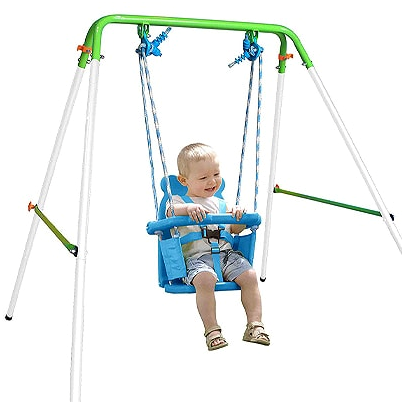
This is a single freestanding toddler swing: a powder-coated steel A-frame (52 x 55 x 47 in assembled) with a molded nursery bucket seat, a T-bar that locks in front of the child and a safety harness. The manufacturer states it meets or exceeds ASTM safety standards, and the frame folds down for storage or transport, which is why it also works indoors in a large room, for the rainy-day version of this category, see our guide to indoor swing sets for toddlers. The weight limit is 55 lb, one child at a time, and the owner’s manual specifies assembly by two adults.
One discrepancy worth printing, because it teaches the right habit: Sportspower’s listing grades this swing at 9–36 months, while the printed owner’s manual states the product is intended for children aged 12–36 months. Where a listing and a manual disagree, follow the manual in your box.
The limitation is built into the category: this is a first swing, and most children will outgrow it around their third birthday. Buy it as a toddler product with a short, specific job, not as a starter version of the big sets below.
Compact playsets for ages 3 and up
Every set in this section is graded by its manufacturer for children aged 3 and older. None is suitable for infants or young toddlers, whatever marketplace headlines suggest. They are ordered by footprint, smallest first, remembering that the safety zone from the section above goes around every one of them.
Step2 Naturally Playful Adventure Lodge Play Center (801300)
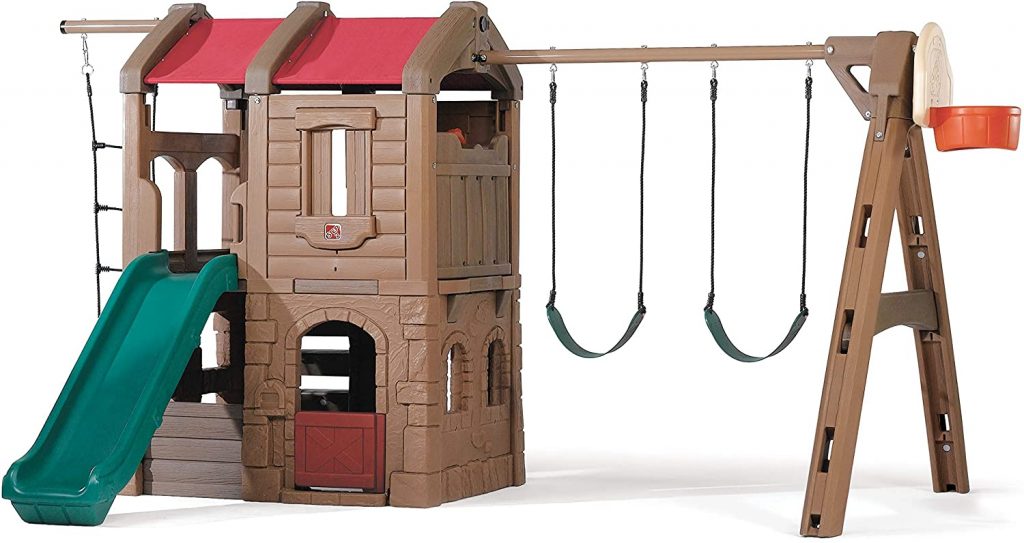
The only plastic set in this guide: a two-level clubhouse with a working door and fabric panel roof, stairs and a rope ladder up, a slide down, two strap swings, a two-seat glider, a steering wheel and a basketball backboard, on an A-frame support with ground anchors. Step2’s manual is unusually specific, and this guide follows it: for children ages 3 to 8 only, maximum user weight 75 lb per child, a limit of 4 children, and a maximum weight of 300 lb in the clubhouse. The manual also states the set must only be used with its anchor stakes in place, installed at an angle to stop the unit lifting in wind.
Assembled, it measures about 201 x 102.5 x 88.5 in, a touch over 16.5 ft long, which makes it one of the larger footprints here despite being the plastic option. Assembly is a two-adult job; budget the better part of a day.
The limitation: plastic construction keeps it lighter to move and free of splinters and staining, but the 75 lb per-child ceiling is the lowest of the full sets in this guide, so older or heavier children age out of it sooner than the wooden sets below.
Backyard Discovery Dayton
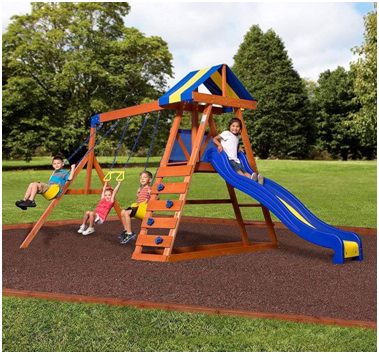
The narrowest of the wooden sets here: a cedar fort on a 4 ft deck (the deck itself is 55 x 20 in, under a fabric canopy), reached by a ladder or a rock wall, with an 8 ft wave slide, two belt swings and a trapeze bar on a swing beam 6 ft 5 in off the ground, and a sandbox underneath the deck that holds up to 5 cubic feet of sand. Assembled dimensions are 16 ft 4 in long x 7 ft 5 in wide, with the canopy top at 7 ft 10 in. Like all Backyard Discovery sets, it is recommended by the manufacturer for children ages 3 to 10, carries a 1-year warranty on parts and 5 years on lumber, and the manufacturer recommends staining the cedar once a year. Exact occupant and weight capacities for this model are printed in the Basic Setup Dimensions section of its manual, check them there rather than trusting any retailer’s summary, ours included.
Assembly is the Dayton’s real cost: allow a full weekend. Two adults and a commonly reported 10–12 hours is the realistic plan for this model, and Backyard Discovery’s manuals advise laying out and inventorying every part before starting.
The limitation to weigh: that narrow footprint is bought with a small deck. A 55 x 20 in platform is fine for two preschoolers and tight for anyone bigger, so families buying for the top of the 3–10 age range should look at the wider sets below.
Backyard Discovery Tucson (65411)
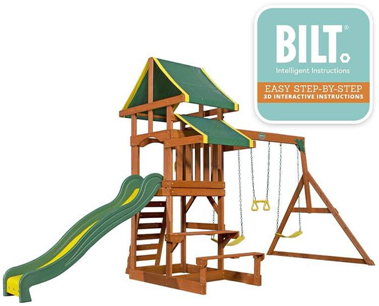
A step up in size from the Dayton: covered upper deck, wave slide, combo ladder/rock-wall climb, two belt swings and an acrobat (trapeze) bar, and a covered snack bench underneath. The manufacturer’s manual grades it for ages 3 to 10 and gives its weight guidance directly: up to 150 lb per child in individual-activity areas, 120 lb per child in areas where children play together, and a maximum of nine children at one time. Assembled, it measures 211 x 87 x 113 in, about 17 ft 7 in long and 9 ft 5 in at its highest point, and Backyard Discovery requires at least a 6 ft perimeter around and above the set, which the manual’s own safe-play-zone diagram builds into its stated play area. Do that math before ordering: with clearances, this set wants a clear patch of yard roughly 30 x 19 ft. Cedar construction, annual staining recommended, and the manufacturer offers the BILT app with 3D guided assembly.
Assembly for two adults is a long day.
The limitation is simple: the manual’s weight limits are the specification, not a cushion. Follow them strictly rather than treating them as conservative.
Gorilla Playsets Outing (01-1063)
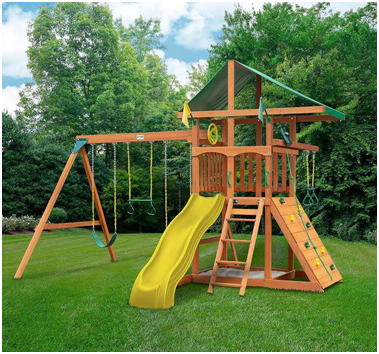
The set with the highest per-swing limit stated in this guide (225 lb per belt swing) and the widest manufacturer age range: Gorilla Playsets grades its playsets for ages 3 to 11. This version of the Outing combines an alpine wave slide, a rock wall with climbing rope, a safe-entry ladder, two belt swings and a trapeze swing, a built-in sandbox area, steering wheel and telescope, and (on the 01-1063 configuration) monkey bars. Gorilla publishes its component weight limits openly, which is the kind of transparency this guide rewards: 800 lb total on the fort platforms, 225 lb per belt swing, 150 lb on the slide, and stated compliance with ASTM safety standards. Assembled it measures about 15 ft wide x 12.5 ft deep x 9.5 ft high, and retailer specifications for this model state a safety zone of 26.5 x 27 ft, read that again before calling it a small-yard set. Lumber is covered by a 10-year limited warranty, and average assembly time is listed at about 8 hours; the package weight is around 405 lb, so plan for help on delivery day too.
The limitation: between the footprint, the safety zone and the price, the Outing is the biggest commitment in this guide on every axis. It earns that with frame strength and the 3–11 age span, a set a child can genuinely use for most of a decade, but it is not the answer for a genuinely small yard.
Little Tikes Jump ‘n Slide Bouncer
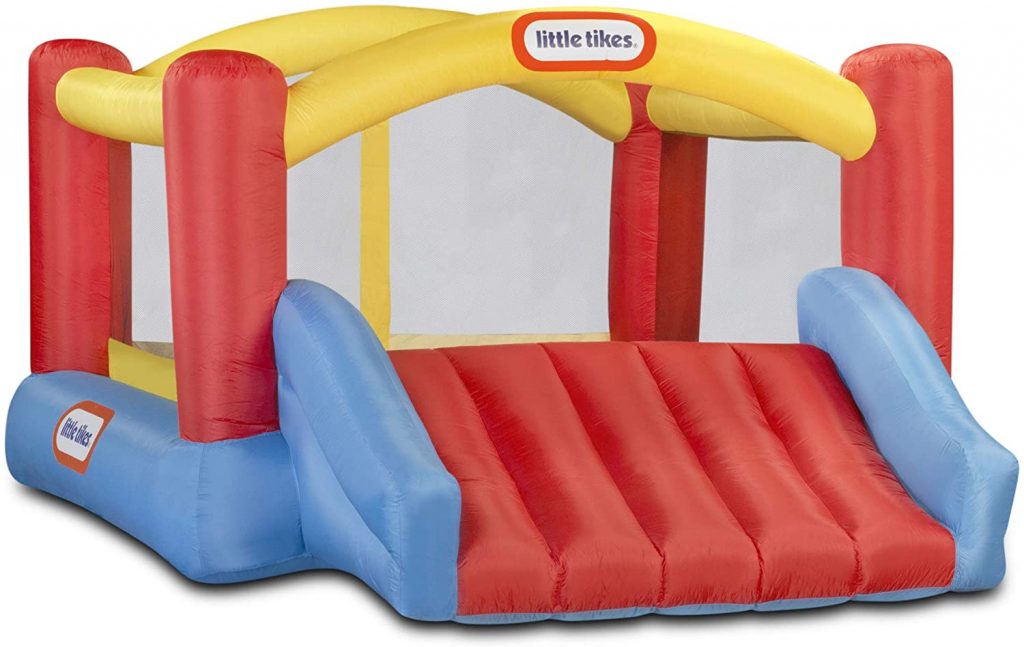
Included with a label, because it is not a playset: this is an inflatable bouncer that goes up when you want it and packs away when you don’t, which makes it the only zero-permanent-footprint option here. Inflated, it measures 144 x 108 x 72 in (12 x 9 x 6 ft) with a wide jumping area and a slide. The manufacturer’s limits are a maximum of 3 children, a maximum combined weight of 250 lb, and an age range of 3 to 8 years. It comes with a heavy-duty blower (with a GFCI plug), stakes, repair patches and a storage bag.
Inflatables have their own rules, and they are not optional: the blower runs continuously while children are inside, the bouncer must be staked down, it comes down in wind and rain, and a supervising adult stays at the entrance. Setup takes minutes; the discipline is in the packing away.
The limitation is the category itself: no climbing, no swinging, no fort, and nothing at all on the days you don’t inflate it. As a flexible extra for parties and small yards it makes sense; as a family’s only play equipment, it is a different purchase from the sets above.
Pre-purchase checklist
Run through this before any set in this guide goes in the basket:
- Measure the yard including the use zone, footprint plus at least 6 ft on every side, and twice the top-bar height in front of and behind the swings. Write down the total, not the box dimensions.
- Match the youngest child to the manufacturer’s age grading. A set graded 3+ is not made safer for a 2-year-old by being sturdy, and a toddler on 3+ equipment is the single most common mismatch in this category.
- Check the exact model against the recalls at cpsc.gov/Recalls and SaferProducts.gov. Do this again for second-hand sets, where it matters most, never buy a set you cannot identify by model.
- Plan the surfacing before the set arrives: material, depth for the fall height, edging to keep loose fill in place, and drainage so it does not turn to soup.
- Budget the assembly realistically: two adults, the tools the manual lists, and a day to a weekend for the wooden sets. Professional assembly is a legitimate line item, not a luxury.
- Plan shade and sightlines: where will the set sit at 3 pm in July, and can a supervising adult see all of it from where they will actually be?
FAQ
No, and supervision is not the missing ingredient. Age grading reflects the size of openings, fall heights, grip strength and climbing judgment the equipment assumes. A child below the graded age can be hurt on correctly used equipment with an adult standing right there. Under-3s need equipment graded for under-3s, like the toddler swing in this guide, and their own play space away from older children’s swings.
More than the box suggests. Take the set’s footprint, add at least 6 ft of surfaced safety zone on every side, then extend the swing side further: in front of and behind a swing, the zone runs to twice the height of the top bar. A set that measures 17 x 7 ft on its spec sheet can need a clear, surfaced area around 30 x 19 ft once the swing arc is counted. That arithmetic, not the footprint, is what decides whether a set fits your yard.
What is the safest surface under a playset?
One that is actually a surface, installed at the right depth. The CPSC handbook’s options are loose-fill materials (wood chips, mulch, sand, pea gravel) maintained at the specified depth for the set’s fall height, or rubber surfacing tested to ASTM F1292 with a critical fall height at or above the equipment’s. Grass over packed earth, bare dirt, concrete and asphalt are not protective surfacing, whatever the set is sitting on in the showroom photo.
The bottom line
For a child under 3, the list is short because it should be: the Sportspower toddler swing, graded and harnessed for that age, in its own space. For ages 3 and up in a small yard, the Step2 Adventure Lodge and the Backyard Discovery Dayton are the genuinely compact fixed sets, plastic with a strict 75 lb per-child limit, or cedar with a small deck and a weekend of assembly. The Tucson and the Gorilla Outing are better equipment for bigger children, but do their safety-zone math and they stop being small-yard products. And if your yard cannot spare any permanent footprint at all, the Little Tikes bouncer is the truthful alternative, rules and all.
Whichever you choose, the order of operations in this guide is the point: age grading first, safety zone second, surfacing third, and only then the slide your child has already fallen in love with. Browse more kids’ outdoor and product guides for the rest of the series. Play itself is also building strong bonds through everyday play.